Department of Pulmonary and Critical Care Medicine, National Clinical Research Center for Respiratory Diseases, Institute of Respiratory Medicine, Chinese Academy of Medical Sciences, China-Japan Friendship Hospital, Beijing, China.
School of Biological Science and Medical Engineering, Beihang University, Beijing, China.
Crit Care Med. 2020 Nov;48(11):e1079-e1086. doi: 10.1097/CCM.0000000000004558.
An ongoing outbreak of coronavirus disease 2019 is spreading globally. Acute hypoxemic respiratory failure is the most common complication of coronavirus disease 2019. However, the clinical effectiveness of early high-flow nasal oxygen treatment in patients with coronavirus disease 2019 with acute hypoxemic respiratory failure has not been explored. This study aimed to analyze the effectiveness of high-flow nasal oxygen treatment and to identify the variables predicting high-flow nasal oxygen treatment failure in coronavirus disease 2019 patients with acute hypoxemic respiratory failure.
A multicenter, retrospective cohort study.
Three tertiary hospitals in Wuhan, China.
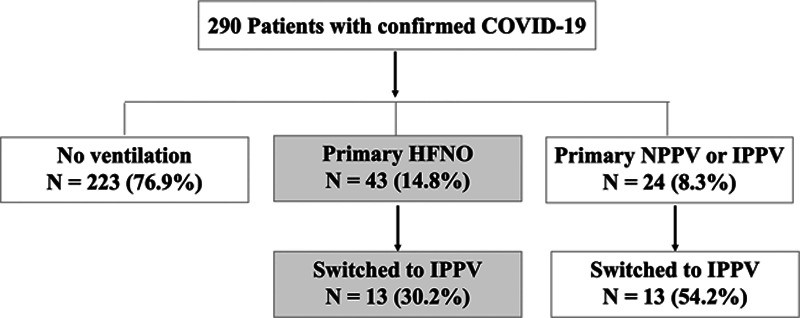
Forty-three confirmed coronavirus disease 2019 adult patients with acute hypoxemic respiratory failure treated with high-flow nasal oxygen.
None.
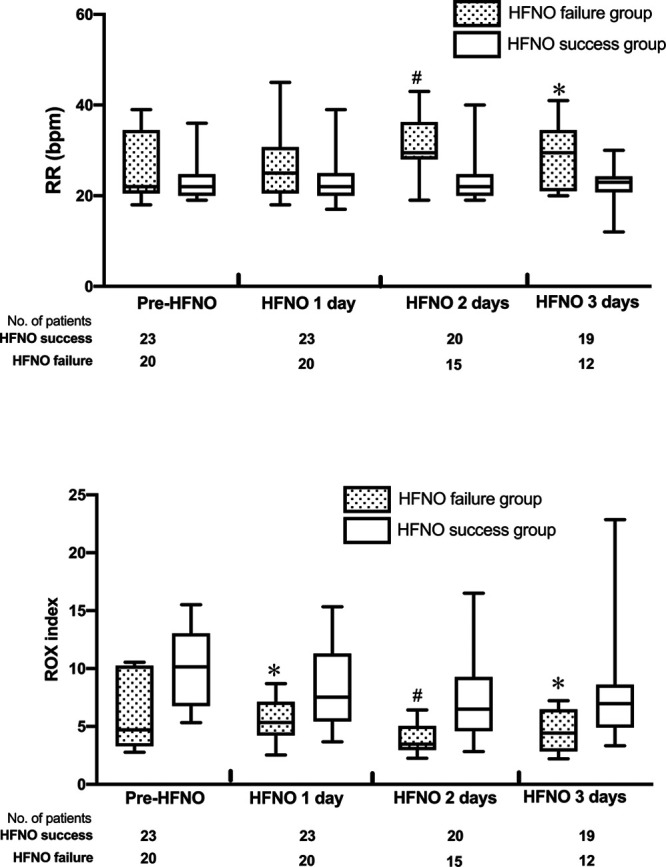
Mean age of the enrolled patients was 63.0 ± 9.7 years; female patients accounted for 41.9%. High-flow nasal oxygen failure (defined as upgrading respiratory support to positive pressure ventilation or death) was observed in 20 patients (46.5%), of which 13 (30.2%) required endotracheal intubation. Patients with high-flow nasal oxygen success had a higher median oxygen saturation (96.0% vs 93.0%; p < 0.001) at admission than those with high-flow nasal oxygen failure. High-flow nasal oxygen failure was more likely in patients who were older (p = 0.030) and male (p = 0.037), had a significant increase in respiratory rate and a significant decrease in the ratio of oxygen saturation/FIO2 to respiratory rate index within 3 days of high-flow nasal oxygen treatment. In a multivariate logistic regression analysis model, male and lower oxygen saturation at admission remained independent predictors of high-flow nasal oxygen failure. The hospital mortality rate of the cohort was 32.5%; however, the hospital mortality rate in patients with high-flow nasal oxygen failure was 65%.
High-flow nasal oxygen may be effective for treating coronavirus disease 2019 patients with mild to moderate acute hypoxemic respiratory failure. However, high-flow nasal oxygen failure was associated with a poor prognosis. Male and lower oxygenation at admission were the two strong predictors of high-flow nasal oxygen failure.
目前,2019 年冠状病毒病(COVID-19)正在全球范围内持续蔓延。急性低氧性呼吸衰竭是 COVID-19 的最常见并发症。然而,早期高流量鼻氧疗在 COVID-19 合并急性低氧性呼吸衰竭患者中的临床疗效尚未得到探索。本研究旨在分析高流量鼻氧疗的疗效,并确定 COVID-19 合并急性低氧性呼吸衰竭患者高流量鼻氧疗失败的预测因素。
多中心、回顾性队列研究。
中国武汉的 3 家三级医院。
43 例确诊的 COVID-19 成年患者,均合并急性低氧性呼吸衰竭,给予高流量鼻氧疗。
无。
纳入患者的平均年龄为 63.0±9.7 岁,女性占 41.9%。20 例(46.5%)患者发生高流量鼻氧疗失败(定义为升级呼吸支持为有创机械通气或死亡),其中 13 例(30.2%)需要气管插管。高流量鼻氧疗成功患者的入院时中位氧饱和度高于高流量鼻氧疗失败患者(96.0%比 93.0%;p<0.001)。高龄(p=0.030)和男性(p=0.037)、高流量鼻氧疗治疗后 3 天内呼吸频率显著增加和氧合指数/呼吸频率比值显著降低的患者更有可能发生高流量鼻氧疗失败。多变量逻辑回归分析模型显示,男性和入院时较低的氧饱和度是高流量鼻氧疗失败的独立预测因素。本队列的住院病死率为 32.5%;然而,高流量鼻氧疗失败患者的住院病死率为 65%。
高流量鼻氧疗可能对治疗 COVID-19 合并轻度至中度急性低氧性呼吸衰竭患者有效。然而,高流量鼻氧疗失败与不良预后相关。男性和入院时较低的氧合是高流量鼻氧疗失败的两个重要预测因素。