Division of Rheumatology, Department of Internal Medicine, Seoul St. Mary's Hospital, College of Medicine, The Catholic University of Korea, Seoul, Korea.
Division of Rheumatology, Department of Internal Medicine, Bucheon St. Mary's Hospital, College of Medicine, the Catholic University of Korea, Bucheon, Korea.
Korean J Intern Med. 2021 Nov;36(6):1492-1503. doi: 10.3904/kjim.2020.146. Epub 2020 Aug 24.
BACKGROUND/AIMS: This study was performed to clarify influences of anticentromere antibody (ACA) on clinical phenotypes of primary Sjögren's syndrome (pSS) patients in Korea.
We assessed 318 patients who met the 2016 American College of Rheumatology/European League Against Rheumatism classification criteria for pSS. All patients were selected from the Korean Initiative of primary Sjögren's Syndrome (KISS), a prospective cohort. Among them, 53 patients were positive for ACA, while another 265 patients were not. We compared various clinical data including demographic features, extra-glandular manifestations (EGMs), clinical indices, and laboratory values available from the KISS database between the two groups.
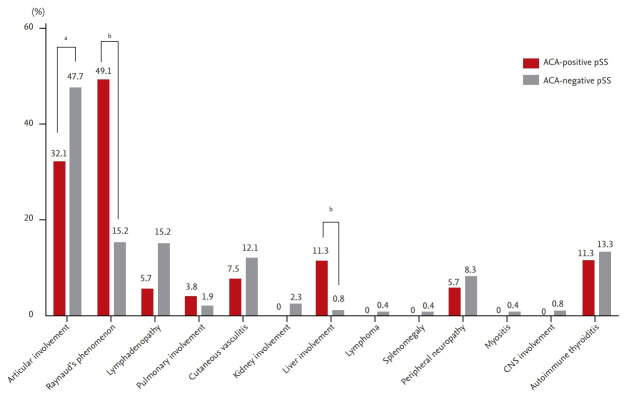
Patients in the ACA-positive pSS group were older (p = 0.042), and had higher xerostomia inventory scores (p = 0.040), whereas glandular dysfunction represented with Schirmer I test was more severe in the ACA-negative group. More frequent Raynaud's phenomenon and liver involvement (both p < 0.001) and less articular involvement (p = 0.037) were observed among the EGMs in the ACA-positive group. Less frequency of leukopenia (p = 0.021), rheumatoid factor (p < 0.001), anti-Ro/SSA antibody positivity (p < 0.001), and hypergammaglobulinemia (p = 0.006), as well as higher positivity rates of anti-nuclear antibody and anti-topoisomerase antibody (p < 0.001 and p = 0.006, respectively) were found in the laboratory data in the ACA-positive pSS group.
Considering distinct phenotypes in hematological and serological features and EGMs, we should monitor the occurrence of these clinical features among pSS patients with ACA in caution.
背景/目的:本研究旨在阐明抗着丝点抗体(ACA)对韩国原发性干燥综合征(pSS)患者临床表型的影响。
我们评估了符合 2016 年美国风湿病学会/欧洲抗风湿病联盟 pSS 分类标准的 318 例患者。所有患者均来自韩国原发性干燥综合征倡议(KISS)的前瞻性队列。其中,53 例患者 ACA 阳性,另外 265 例患者 ACA 阴性。我们比较了两组之间来自 KISS 数据库的各种临床数据,包括人口统计学特征、外分泌腺表现(EGMs)、临床指标和实验室值。
ACA 阳性 pSS 组患者年龄较大(p=0.042),口干量表评分较高(p=0.040),而 Schirmer I 试验代表的腺体功能障碍在 ACA 阴性组更为严重。ACA 阳性组的 EGMs 中,更频繁出现雷诺现象和肝脏受累(均 p<0.001),关节受累较少(p=0.037)。ACA 阳性组的实验室数据中,白细胞减少症(p=0.021)、类风湿因子(p<0.001)、抗 Ro/SSA 抗体阳性(p<0.001)、高丙种球蛋白血症(p=0.006)的频率较低,抗核抗体和抗拓扑异构酶抗体的阳性率较高(均 p<0.001 和 p=0.006)。
鉴于血液学和血清学特征以及 EGMs 中存在不同的表型,我们应警惕 ACA 阳性 pSS 患者发生这些临床特征。