• 文献检索
  • 文档翻译
  • 深度研究
  • 学术资讯
  • Suppr Zotero 插件Zotero 插件
  • 邀请有礼
  • 套餐&价格
  • 历史记录
应用&插件
Suppr Zotero 插件Zotero 插件浏览器插件Mac 客户端Windows 客户端微信小程序
定价
高级版会员购买积分包购买API积分包
服务
文献检索文档翻译深度研究API 文档MCP 服务
关于我们
关于 Suppr公司介绍联系我们用户协议隐私条款
关注我们

Suppr 超能文献

核心技术专利:CN118964589B侵权必究
粤ICP备2023148730 号-1Suppr @ 2026

文献检索

告别复杂PubMed语法,用中文像聊天一样搜索,搜遍4000万医学文献。AI智能推荐,让科研检索更轻松。

立即免费搜索

文件翻译

保留排版,准确专业,支持PDF/Word/PPT等文件格式,支持 12+语言互译。

免费翻译文档

深度研究

AI帮你快速写综述,25分钟生成高质量综述,智能提取关键信息,辅助科研写作。

立即免费体验

移动应用程序在城市社区居住的老年韩国成年人失眠自我管理中的使用:回顾性干预研究。

Mobile App Use for Insomnia Self-Management in Urban Community-Dwelling Older Korean Adults: Retrospective Intervention Study.

机构信息

Department of Psychiatry, Yonsei University College of Medicine, Yongin Severance Hospital, Yonsei University Health System, Yongin, Republic of Korea.

Center for Digital Health, Yongin Severance Hospital, Yonsei University Health System, Yongin, Republic of Korea.

出版信息

JMIR Mhealth Uhealth. 2020 Aug 24;8(8):e17755. doi: 10.2196/17755.

DOI:10.2196/17755
PMID:32831177
原文链接:https://pmc.ncbi.nlm.nih.gov/articles/PMC7477668/
Abstract

BACKGROUND

As an evidence-based psychotherapy for treating insomnia, cognitive behavioral therapy for insomnia (CBT-I), which helps people with sleep problems to change their unhelpful sleep-related beliefs and habits, has been well-established in older adults. Recently, the utilization of mobile CBT-I apps has been getting attention from mental health professionals and researchers; however, whether mobile CBT-I apps are usable among older users has yet to be determined.

OBJECTIVE

The aims of this study were to explore the relationships between subjective sleep quality and subjective memory complaints and depressive symptoms; to explore the relationship between perceived difficulty in mobile app use and usability of the mobile phone-based self-help CBT-I app, named MIND MORE, in urban community-dwelling Korean older adults; to compare changes in subjective sleep quality from pre-intervention to post-intervention, during which they used the mobile app over a 1-week intervention period; and evaluate adherence to the app.

METHODS

During the 2-hour training program delivered on 1 day titled "Overcoming insomnia without medication: How to use the 'MIND MORE' mobile app for systematic self-management of insomnia" (pre-intervention), 41 attendants were asked to gain hands-on experience with the app facilitated by therapists and volunteer workers. They were then asked to complete questionnaires on sociodemographic characteristics, subjective evaluation of mental health status (ie, depression, memory loss and impairment, and sleep problems), and app usability. For the 1-week home-based self-help CBT-I using the app (post-intervention), 9 of the 41 program attendants, who had already signed up for the pre-intervention, were guided to complete the given questionnaires on subjective evaluation of sleep quality after the 1-week intervention, specifically 8 days after the training program ended.

RESULTS

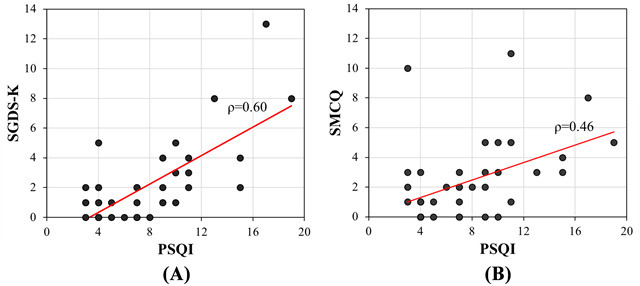
Due to missing data, 40 of 41 attendants were included in the data analysis. The main findings of this study were as follows. First, poor subjective sleep quality was associated with higher ratings of depressive symptoms (40/40; ρ=.60, P<.001) and memory complaints (40/40; ρ=.46, P=.003) at baseline. Second, significant improvements in subjective sleep quality from pre-intervention to post-intervention were observed in the older adults who used the MIND MORE app only for the 1-week intervention period (9/9; t=3.74, P=.006). Third, apart from the program attendants who did not have a smartphone (2/40) or withdrew from their MIND MORE membership (3/40), those who attended the 1-day sleep education program adhered to the app from at least 2 weeks (13/35, 37%) to 8 weeks (2/35, 6%) without any further contact.

CONCLUSIONS

This study provides empirical evidence that the newly developed MIND MORE app not only is usable among older users but also could improve subjective sleep quality after a 1-week self-help intervention period.
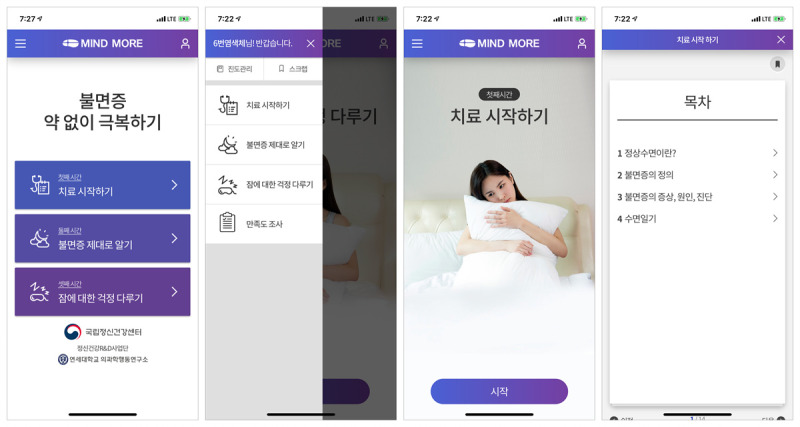
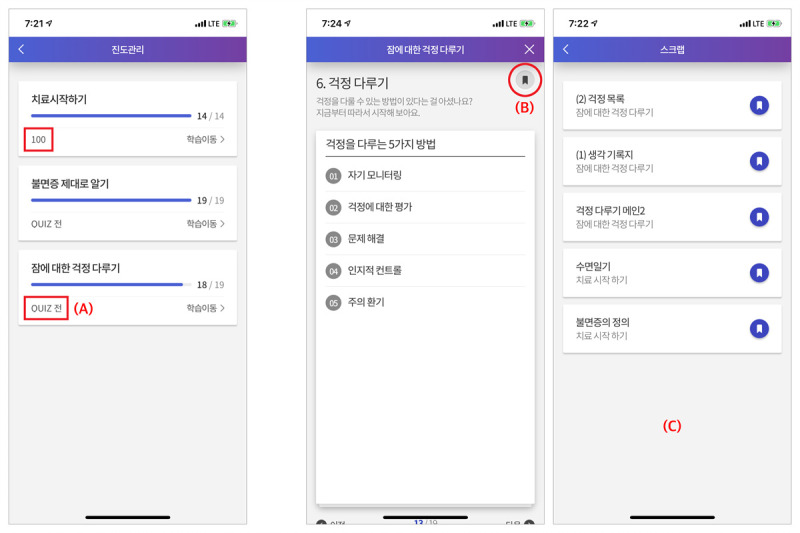
https://cdn.ncbi.nlm.nih.gov/pmc/blobs/ca88/7477668/9a0d4e89acee/mhealth_v8i8e17755_fig6.jpg
https://cdn.ncbi.nlm.nih.gov/pmc/blobs/ca88/7477668/a0e058a8c8fc/mhealth_v8i8e17755_fig1.jpg
https://cdn.ncbi.nlm.nih.gov/pmc/blobs/ca88/7477668/404938d6cf4f/mhealth_v8i8e17755_fig2.jpg
https://cdn.ncbi.nlm.nih.gov/pmc/blobs/ca88/7477668/e9a06458bb5e/mhealth_v8i8e17755_fig3.jpg
https://cdn.ncbi.nlm.nih.gov/pmc/blobs/ca88/7477668/5f9c595120cc/mhealth_v8i8e17755_fig4.jpg
https://cdn.ncbi.nlm.nih.gov/pmc/blobs/ca88/7477668/bf85f1eecf10/mhealth_v8i8e17755_fig5.jpg
https://cdn.ncbi.nlm.nih.gov/pmc/blobs/ca88/7477668/9a0d4e89acee/mhealth_v8i8e17755_fig6.jpg
https://cdn.ncbi.nlm.nih.gov/pmc/blobs/ca88/7477668/a0e058a8c8fc/mhealth_v8i8e17755_fig1.jpg
https://cdn.ncbi.nlm.nih.gov/pmc/blobs/ca88/7477668/404938d6cf4f/mhealth_v8i8e17755_fig2.jpg
https://cdn.ncbi.nlm.nih.gov/pmc/blobs/ca88/7477668/e9a06458bb5e/mhealth_v8i8e17755_fig3.jpg
https://cdn.ncbi.nlm.nih.gov/pmc/blobs/ca88/7477668/5f9c595120cc/mhealth_v8i8e17755_fig4.jpg
https://cdn.ncbi.nlm.nih.gov/pmc/blobs/ca88/7477668/bf85f1eecf10/mhealth_v8i8e17755_fig5.jpg
https://cdn.ncbi.nlm.nih.gov/pmc/blobs/ca88/7477668/9a0d4e89acee/mhealth_v8i8e17755_fig6.jpg
摘要

背景

认知行为疗法(CBT-I)是一种基于循证的失眠治疗方法,可帮助有睡眠问题的人改变无益的与睡眠相关的信念和习惯,在老年人中已得到广泛应用。最近,移动 CBT-I 应用程序的使用引起了心理健康专业人员和研究人员的关注;然而,移动 CBT-I 应用程序是否适用于老年用户尚未确定。

目的

本研究旨在探讨主观睡眠质量与主观记忆主诉和抑郁症状之间的关系;探讨在城市社区居住的韩国老年人中,感知移动应用程序使用难度与基于手机的自助 CBT-I 应用程序(名为 MIND MORE)的可用性之间的关系;比较在使用移动应用程序进行 1 周干预期间,主观睡眠质量从干预前到干预后的变化;并评估对应用程序的依从性。

方法

在为期 2 小时的培训课程中,名为“无需药物即可克服失眠:如何使用‘MIND MORE’移动应用程序对失眠进行系统的自我管理”(干预前),41 名参与者被要求在治疗师和志愿者的帮助下获得应用程序的实际操作经验。然后,他们被要求完成关于社会人口统计学特征、心理健康状况主观评估(即抑郁、记忆丧失和损伤以及睡眠问题)和应用程序可用性的问卷。在使用该应用程序进行为期 1 周的家庭自助 CBT-I 干预(干预后)期间,已报名参加干预前的 41 名参与者中的 9 名被引导在 1 周干预后完成给定的睡眠质量主观评估问卷,具体时间是在培训课程结束 8 天后。

结果

由于数据缺失,仅 41 名参与者中的 40 名被纳入数据分析。本研究的主要发现如下。首先,较差的主观睡眠质量与更高的抑郁症状评分(40/40;ρ=.60,P<.001)和记忆主诉(40/40;ρ=.46,P=.003)相关。其次,仅在干预期间使用 MIND MORE 应用程序的老年人中,主观睡眠质量从干预前到干预后显著改善(9/9;t=3.74,P=.006)。第三,除了没有智能手机的参与者(2/40)或退出 MIND MORE 会员资格的参与者(3/40)外,那些参加为期 1 天的睡眠教育计划的参与者至少坚持使用该应用程序 2 周(13/35,37%)至 8 周(2/35,6%),而无需进一步联系。

结论

本研究提供了实证证据,表明新开发的 MIND MORE 应用程序不仅在老年用户中可用,而且在 1 周自助干预后还可以改善主观睡眠质量。

相似文献

1
Mobile App Use for Insomnia Self-Management in Urban Community-Dwelling Older Korean Adults: Retrospective Intervention Study.移动应用程序在城市社区居住的老年韩国成年人失眠自我管理中的使用:回顾性干预研究。
JMIR Mhealth Uhealth. 2020 Aug 24;8(8):e17755. doi: 10.2196/17755.
2
Effect of an Internet-Delivered Cognitive Behavioral Therapy-Based Sleep Improvement App for Shift Workers at High Risk of Sleep Disorder: Single-Arm, Nonrandomized Trial.互联网提供的认知行为疗法为睡眠障碍高危轮班工人改善睡眠的应用效果:单臂、非随机试验。
J Med Internet Res. 2023 Aug 22;25:e45834. doi: 10.2196/45834.
3
Mobile Phone-Delivered Cognitive Behavioral Therapy for Insomnia: A Randomized Waitlist Controlled Trial.手机交付的失眠认知行为疗法:一项随机等待列表对照试验。
J Med Internet Res. 2017 Apr 11;19(4):e70. doi: 10.2196/jmir.6524.
4
Smartphone-Based Virtual Agents to Help Individuals With Sleep Concerns During COVID-19 Confinement: Feasibility Study.基于智能手机的虚拟代理在新冠疫情居家隔离期间帮助有睡眠问题的个体:可行性研究。
J Med Internet Res. 2020 Dec 18;22(12):e24268. doi: 10.2196/24268.
5
Cognitive Behavioral Therapy for Insomnia Self-Management Mobile Apps: A Review of Efficacy and Quality.失眠自我管理手机应用的认知行为疗法:疗效和质量评估综述
J Clin Psychol Med Settings. 2024 Sep;31(3):537-549. doi: 10.1007/s10880-023-09992-y. Epub 2024 Jan 28.
6
Mobile Application-Assisted Cognitive Behavioral Therapy for Insomnia in an Older Adult.针对老年人失眠的移动应用辅助认知行为疗法
Telemed J E Health. 2016 Apr;22(4):332-4. doi: 10.1089/tmj.2015.0064. Epub 2015 Sep 22.
7
Smartphone apps for insomnia: examining existing apps' usability and adherence to evidence-based principles for insomnia management.智能手机应用程序治疗失眠症:评估现有应用程序的可用性和对基于证据的失眠症管理原则的遵循情况。
Transl Behav Med. 2019 Jan 1;9(1):110-119. doi: 10.1093/tbm/iby014.
8
A Pilot Randomized Controlled Trial of the Insomnia Coach Mobile App to Assess Its Feasibility, Acceptability, and Potential Efficacy.一项关于失眠教练手机应用程序的可行性、可接受性和潜在疗效的初步随机对照试验。
Behav Ther. 2022 May;53(3):440-457. doi: 10.1016/j.beth.2021.11.003. Epub 2021 Nov 19.
9
Cognitive behaviour therapy for older adults experiencing insomnia and depression in a community mental health setting: Study protocol for a randomised controlled trial.社区心理健康环境中针对患有失眠和抑郁症的老年人的认知行为疗法:一项随机对照试验的研究方案。
Trials. 2015 Nov 27;16:538. doi: 10.1186/s13063-015-1066-6.
10
Treating depression with a smartphone-delivered self-help cognitive behavioral therapy for insomnia: study protocol for a parallel group randomized controlled trial.采用通过智能手机提供的失眠自助认知行为疗法治疗抑郁症:一项平行组随机对照试验的研究方案
Trials. 2020 Oct 9;21(1):843. doi: 10.1186/s13063-020-04778-1.

引用本文的文献

1
Effectiveness of Information and Communication Technology-Based Cognitive Behavioral Therapy Using the Smart Sleep App on Insomnia in Older Adults: Randomized Controlled Trial.使用智能睡眠应用程序的基于信息通信技术的认知行为疗法对老年人失眠的有效性:随机对照试验
J Med Internet Res. 2025 Jun 25;27:e67751. doi: 10.2196/67751.
2
Therapeutic Guidelines for the Self-Management of Major Depressive Disorder: Scoping Review.重度抑郁症自我管理的治疗指南:范围综述
Interact J Med Res. 2025 Mar 6;14:e63959. doi: 10.2196/63959.
3
Exploring the Role of Mobile Apps for Insomnia in Depression: Systematic Review.

本文引用的文献

1
Mobile App Use for Insomnia Self-Management: Pilot Findings on Sleep Outcomes in Veterans.用于失眠自我管理的移动应用程序:退伍军人睡眠结果的初步研究结果
Interact J Med Res. 2019 Jul 24;8(3):e12408. doi: 10.2196/12408.
2
Mobile health for older adult patients: Using an aging barriers framework to classify usability problems.移动医疗在老年患者中的应用:利用老龄化障碍框架对可用性问题进行分类。
Int J Med Inform. 2019 Apr;124:68-77. doi: 10.1016/j.ijmedinf.2019.01.006. Epub 2019 Jan 15.
3
Older Adults' Perspectives on Using Digital Technology to Maintain Good Mental Health: Interactive Group Study.
探索移动应用程序在抑郁症失眠中的作用:系统评价。
J Med Internet Res. 2024 Oct 18;26:e51110. doi: 10.2196/51110.
4
Use of mHealth Technologies to Increase Sleep Quality among Older Adults: A Scoping Review.使用移动健康技术提高老年人睡眠质量:一项范围综述
Clocks Sleep. 2024 Sep 4;6(3):517-532. doi: 10.3390/clockssleep6030034.
5
Redefining the Successful Aging of Veterans: A Scoping Review.重新定义退伍军人的成功老龄化:一项范围综述。
Gerontologist. 2024 Dec 13;65(1). doi: 10.1093/geront/gnae105.
6
Understanding the multilevel factors influencing the implementation of digital health interventions for supportive care in Adolescents and Young Adult (AYA) cancer survivorship: determinants of adopting mindfulness-based mobile applications.了解影响青少年和青年成人(AYA)癌症幸存者支持性护理数字健康干预措施实施的多层次因素:采用基于正念的移动应用程序的决定因素。
Implement Sci Commun. 2024 Jul 17;5(1):76. doi: 10.1186/s43058-024-00612-w.
7
Design considerations for the migration from paper to screen-based media in current health education for older adults: a scoping review.从纸质媒体向基于屏幕的媒体迁移在当前老年人健康教育中的设计考虑因素:范围综述。
BMJ Open. 2024 Apr 10;14(4):e078647. doi: 10.1136/bmjopen-2023-078647.
8
User-Friendly Chatbot to Mitigate the Psychological Stress of Older Adults During the COVID-19 Pandemic: Development and Usability Study.在新冠疫情期间减轻老年人心理压力的用户友好型聊天机器人:开发与可用性研究
JMIR Form Res. 2024 Mar 13;8:e49462. doi: 10.2196/49462.
9
Scoping Review of Technological Solutions for Community Dwelling Older Adults and Implications for Instrumental Activities of Daily Living.针对社区居住老年人的技术解决方案的范围综述及其对日常生活活动能力的影响
Aging Dis. 2024 Feb 23;16(1):345-72. doi: 10.14336/AD.2024.0215.
10
Information and Communication Technology-Based Application for Cognitive Behavioral Therapy among Community-Dwelling Older Adults with Insomnia: Development and Validation Study.基于信息通信技术的社区失眠老年人认知行为疗法应用:开发与验证研究。
Healthcare (Basel). 2024 Jan 2;12(1):106. doi: 10.3390/healthcare12010106.
老年人对使用数字技术维持良好心理健康的看法:互动小组研究
J Med Internet Res. 2019 Feb 13;21(2):e11694. doi: 10.2196/11694.
4
Factors Associated with Insomnia among the Elderly in a Korean Rural Community.韩国农村社区老年人失眠的相关因素
Psychiatry Investig. 2017 Jul;14(4):400-406. doi: 10.4306/pi.2017.14.4.400. Epub 2017 Jul 11.
5
Mobile Phone-Delivered Cognitive Behavioral Therapy for Insomnia: A Randomized Waitlist Controlled Trial.手机交付的失眠认知行为疗法:一项随机等待列表对照试验。
J Med Internet Res. 2017 Apr 11;19(4):e70. doi: 10.2196/jmir.6524.
6
Long-Term Maintenance of Therapeutic Gains Associated With Cognitive-Behavioral Therapy for Insomnia Delivered Alone or Combined With Zolpidem.单独使用或联合唑吡坦的失眠认知行为疗法相关治疗效果的长期维持
Sleep. 2017 Mar 1;40(3). doi: 10.1093/sleep/zsx002.
7
Cognitive Behavioral Therapy Using a Mobile Application Synchronizable With Wearable Devices for Insomnia Treatment: A Pilot Study.使用可与可穿戴设备同步的移动应用程序进行认知行为疗法治疗失眠的初步研究。
J Clin Sleep Med. 2017 Apr 15;13(4):633-640. doi: 10.5664/jcsm.6564.
8
The role of depression in the insomnia of people with subjective memory impairment, mild cognitive impairment, and dementia in a community sample of elderly individuals in South Korea.在韩国老年人群体的社区样本中,抑郁症在主观记忆障碍、轻度认知障碍和痴呆症患者失眠问题中所起的作用。
Int Psychogeriatr. 2017 Apr;29(4):653-661. doi: 10.1017/S1041610216002076. Epub 2016 Dec 6.
9
Internet-Based Psychotherapy for Adult Depression: What About the Mechanisms of Change?基于互联网的成人抑郁症心理治疗:改变机制如何?
J Clin Psychol. 2017 Jan;73(1):5-64. doi: 10.1002/jclp.22326. Epub 2016 Sep 29.
10
Prevalence and clinical characteristics of insomnia and its subtypes in the Korean elderly.韩国老年人失眠及其亚型的患病率和临床特征。
Arch Gerontol Geriatr. 2017 Jan-Feb;68:68-75. doi: 10.1016/j.archger.2016.09.005. Epub 2016 Sep 17.