Horsch Corine Hg, Lancee Jaap, Griffioen-Both Fiemke, Spruit Sandor, Fitrianie Siska, Neerincx Mark A, Beun Robbert Jan, Brinkman Willem-Paul
Department of Intelligent Systems, Delft University of Technology, Delft, Netherlands.
Department of Clinical Psychology, University of Amsterdam, Amsterdam, Netherlands.
J Med Internet Res. 2017 Apr 11;19(4):e70. doi: 10.2196/jmir.6524.
This study is one of the first randomized controlled trials investigating cognitive behavioral therapy for insomnia (CBT-I) delivered by a fully automated mobile phone app. Such an app can potentially increase the accessibility of insomnia treatment for the 10% of people who have insomnia.
The objective of our study was to investigate the efficacy of CBT-I delivered via the Sleepcare mobile phone app, compared with a waitlist control group, in a randomized controlled trial.
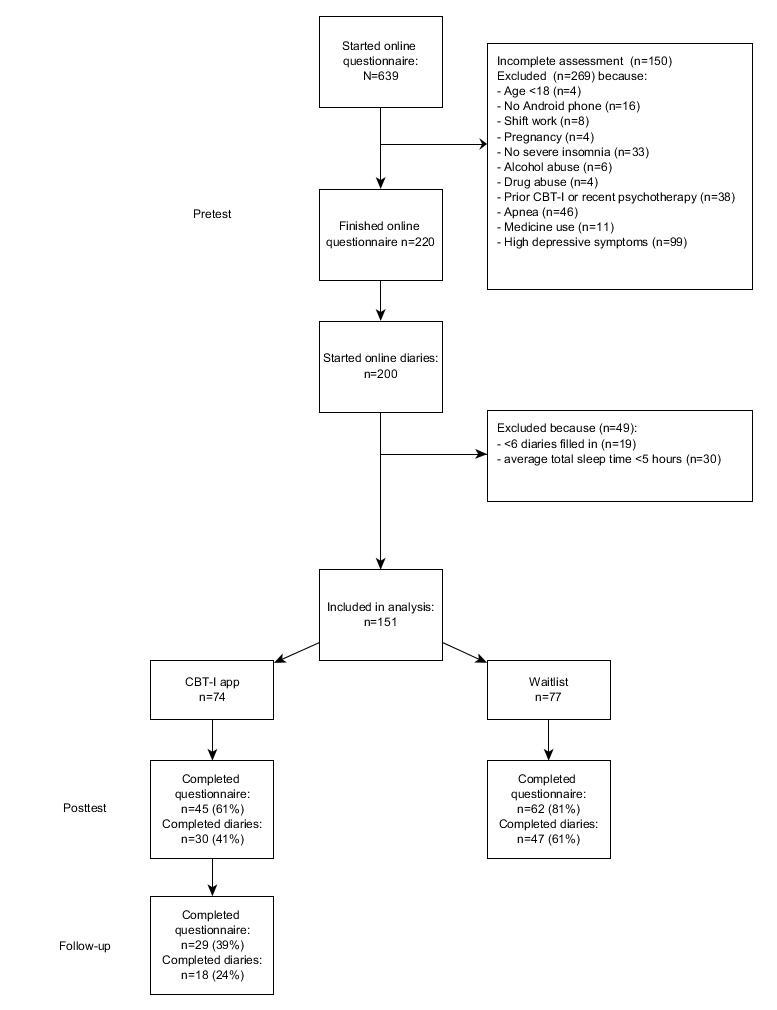
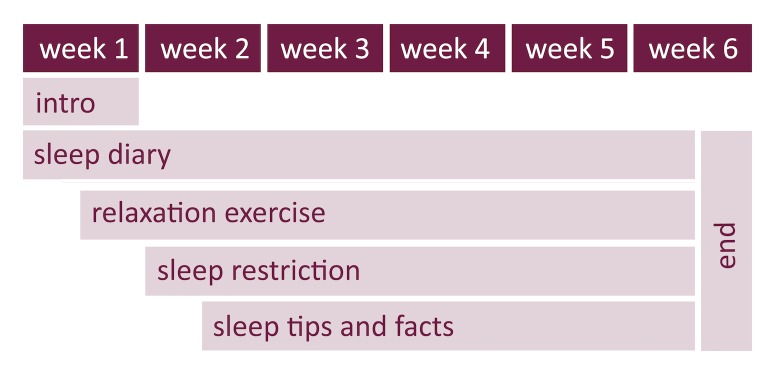
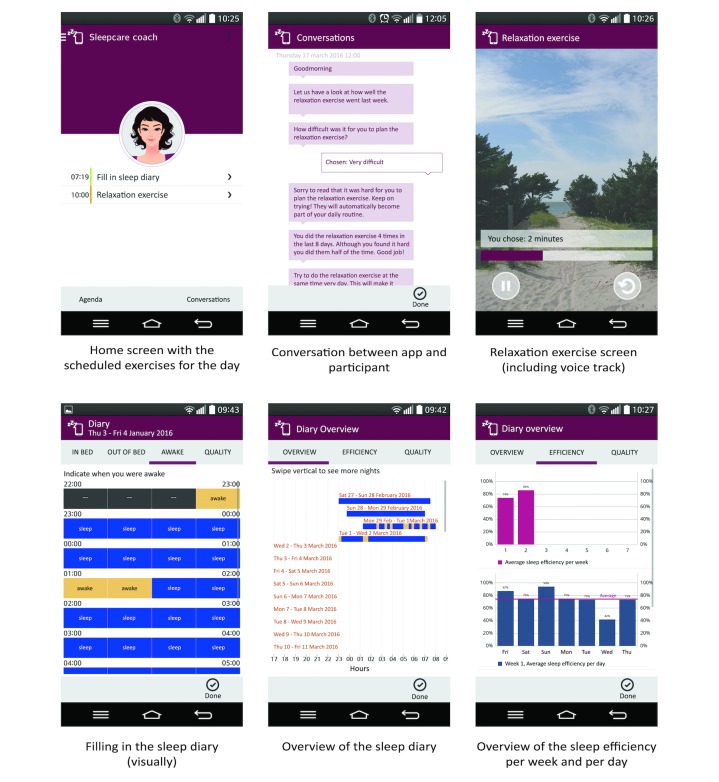
We recruited participants in the Netherlands with relatively mild insomnia disorder. After answering an online pretest questionnaire, they were randomly assigned to the app (n=74) or the waitlist condition (n=77). The app packaged a sleep diary, a relaxation exercise, sleep restriction exercise, and sleep hygiene and education. The app was fully automated and adjusted itself to a participant's progress. Program duration was 6 to 7 weeks, after which participants received posttest measurements and a 3-month follow-up. The participants in the waitlist condition received the app after they completed the posttest questionnaire. The measurements consisted of questionnaires and 7-day online diaries. The questionnaires measured insomnia severity, dysfunctional beliefs about sleep, and anxiety and depression symptoms. The diary measured sleep variables such as sleep efficiency. We performed multilevel analyses to study the interaction effects between time and condition.
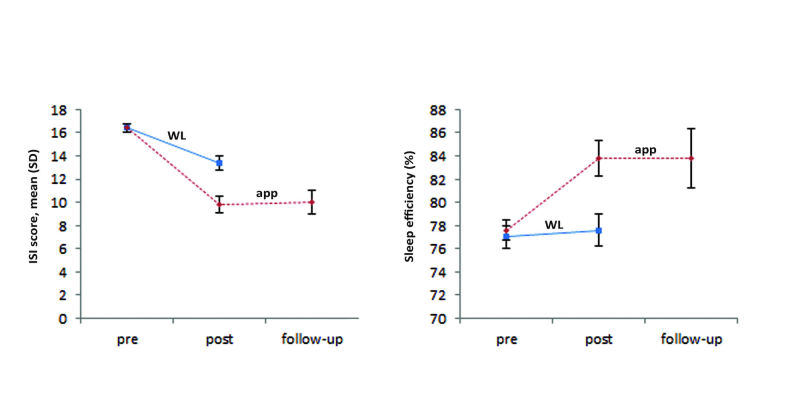
The results showed significant interaction effects (P<.01) favoring the app condition on the primary outcome measures of insomnia severity (d=-0.66) and sleep efficiency (d=0.71). Overall, these improvements were also retained in a 3-month follow-up.
This study demonstrated the efficacy of a fully automated mobile phone app in the treatment of relatively mild insomnia. The effects were in the range of what is found for Web-based treatment in general. This supports the applicability of such technical tools in the treatment of insomnia. Future work should examine the generalizability to a more diverse population. Furthermore, the separate components of such an app should be investigated. It remains to be seen how this app can best be integrated into the current health regimens.
Netherlands Trial Register: NTR5560; http://www.trialregister.nl/trialreg/admin/rctview.asp?TC=5560 (Archived by WebCite at http://www.webcitation.org/6noLaUdJ4).
本研究是首批调查通过全自动手机应用程序提供的失眠认知行为疗法(CBT-I)的随机对照试验之一。这样的应用程序有可能提高10%患有失眠症的人获得失眠治疗的机会。
我们研究的目的是在一项随机对照试验中,比较通过Sleepcare手机应用程序提供的CBT-I与候补对照组的疗效。
我们在荷兰招募了患有相对轻度失眠症的参与者。在回答一份在线预测试问卷后,他们被随机分配到应用程序组(n = 74)或候补组(n = 77)。该应用程序包含睡眠日记、放松练习、睡眠限制练习以及睡眠卫生和教育内容。该应用程序是全自动的,并会根据参与者的进展进行自我调整。项目持续时间为6至7周,之后参与者接受测试后测量和3个月的随访。候补组的参与者在完成测试后问卷后会收到该应用程序。测量包括问卷和7天的在线日记。问卷测量失眠严重程度、对睡眠的功能失调信念以及焦虑和抑郁症状。日记测量睡眠变量,如睡眠效率。我们进行了多层次分析以研究时间和条件之间的交互作用。
结果显示在失眠严重程度(d = -0.66)和睡眠效率(d = 0.71)的主要结局指标上,存在显著的交互作用(P <.01),支持应用程序组。总体而言,这些改善在3个月的随访中也得以保持。
本研究证明了全自动手机应用程序在治疗相对轻度失眠方面的疗效。其效果与一般基于网络的治疗效果相当。这支持了此类技术工具在失眠治疗中的适用性。未来的工作应研究其在更广泛人群中的普遍性。此外,应研究此类应用程序的各个单独组成部分。这种应用程序如何最好地融入当前的健康养生方案还有待观察。
荷兰试验注册库:NTR5560;http://www.trialregister.nl/trialreg/admin/rctview.asp?TC=5560(由WebCite存档于http://www.webcitation.org/6noLaUdJ4)。