Department of Earth and Planetary Sciences, Yale University, New Haven, CT 06511, USA.
Department of Chemistry, Yale University, New Haven, CT 06520, USA.
Sci Adv. 2020 Jul 10;6(28):eaba6883. doi: 10.1126/sciadv.aba6883. eCollection 2020 Jul.
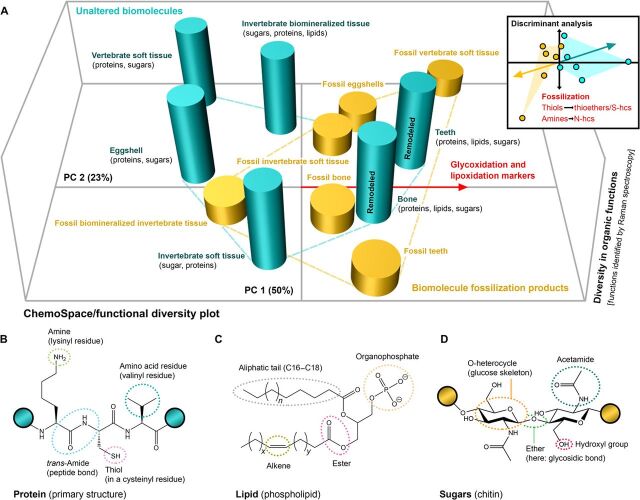
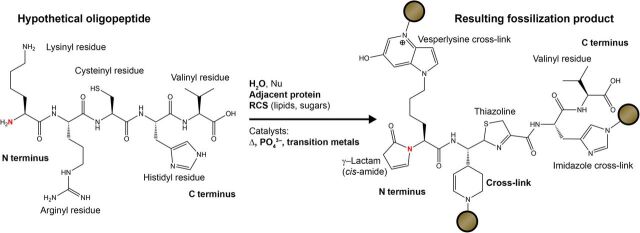
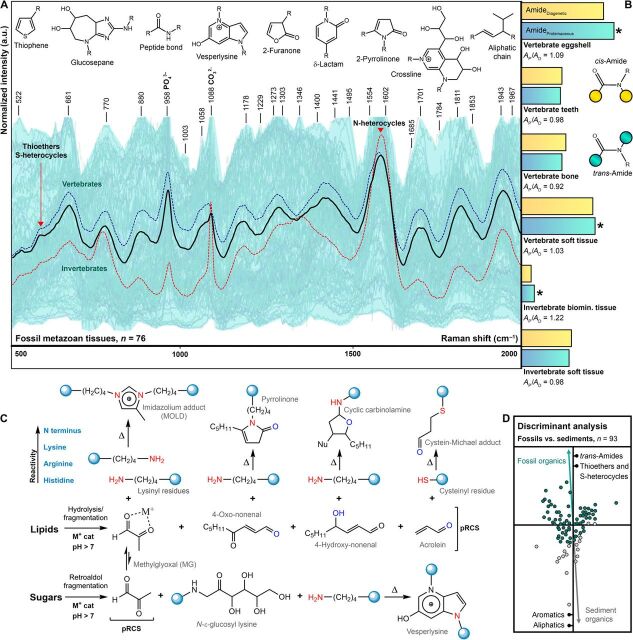
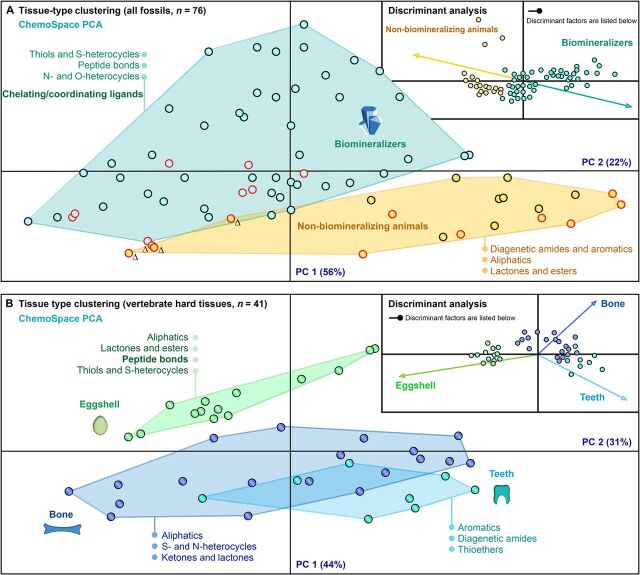
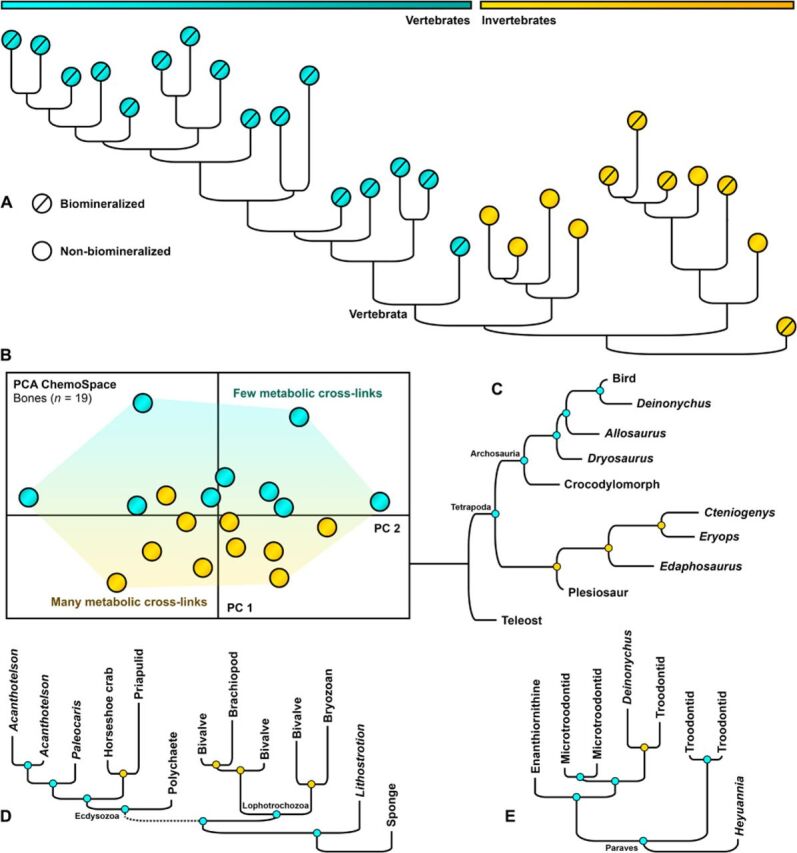
Proteins, lipids, and sugars establish animal form and function. However, the preservation of biological signals in fossil organic matter is poorly understood. Here, we used high-resolution in situ Raman microspectroscopy to analyze the molecular compositions of 113 Phanerozoic metazoan fossils and sediments. Proteins, lipids, and sugars converge in composition during fossilization through lipoxidation and glycoxidation to form endogenous N-, O-, and S-heterocyclic polymers. Nonetheless, multivariate spectral analysis reveals molecular heterogeneities: The relative abundance of glycoxidation and lipoxidation products distinguishes different tissue types. Preserved chelating ligands are diagnostic of different modes of biomineralization. Amino acid-specific fossilization products retain phylogenetic information and capture higher-rank metazoan relationships. Molecular signals survive in deep time and provide a powerful tool for reconstructing the evolutionary history of animals.
蛋白质、脂质和糖建立了动物的形态和功能。然而,化石有机物质中生物信号的保存机制还不太清楚。在这里,我们使用高分辨率的原位拉曼微光谱分析技术,对 113 个显生宙后生动物化石和沉积物的分子组成进行了分析。在化石形成过程中,通过脂氧化和糖氧化作用,蛋白质、脂质和糖会汇聚形成内源性 N、O 和 S 杂环聚合物。尽管如此,多元光谱分析揭示了分子的异质性:糖氧化和脂氧化产物的相对丰度可以区分不同的组织类型。保留的螯合配体是不同生物矿化模式的诊断特征。特定于氨基酸的化石产物保留了系统发育信息,并捕获了更高阶的后生动物关系。分子信号在长时间尺度上得以保存,为重建动物的进化历史提供了有力工具。