Kheir Michael M, Tan Timothy L, Rondon Alexander J, Chen Antonia F
Department of Orthopaedic Surgery, Indiana University School of Medicine, Indianapolis, Indiana.
The Rothman Institute at Thomas Jefferson University, Philadelphia, Pennsylvania.
JB JS Open Access. 2020 Jun 24;5(2). doi: 10.2106/JBJS.OA.20.00043. eCollection 2020 Apr-Jun.
Orthopaedic surgery residency has become increasingly competitive for medical school applicants with at least one in five applicants not matching annually. For unmatched applicants, the new application cycle is a perplexing and disconcerting period, where unique decisions must be addressed by the applicant. We aimed to investigate the risk factors and outcomes of unmatched orthopaedic applicants.
This was a retrospective study using a survey-based questionnaire administered electronically to medical students annually from 2016 to 2019 immediately after match day. Applicant responses totaled 934 completed surveys, of which 81 identified themselves as unmatched from the previous year and reapplied for a subsequent cycle. Variables collected through the survey included demographics, United States Medical Licensing Examination scores, Electronic Residency Application Service application characteristics, and interim year pursuits. A univariate analysis was performed with an alpha level of 0.05 denoting statistical significance.
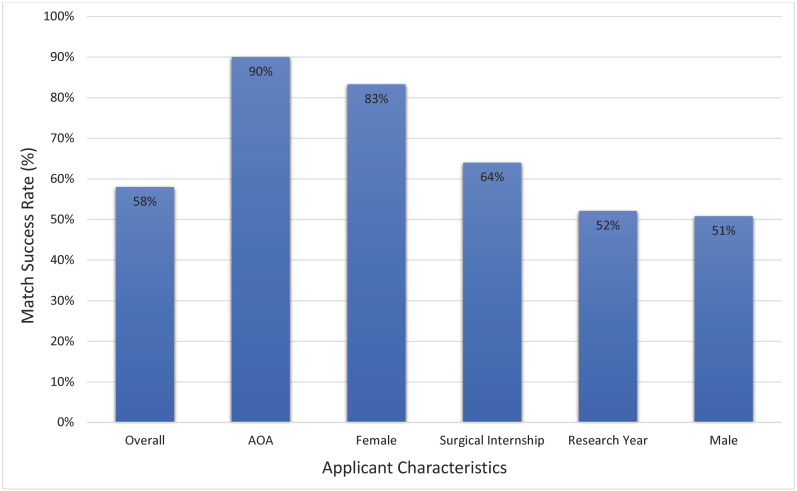
Overall, 58.0% of unmatched applicants subsequently matched into an orthopaedic residency. Applicants who pursued a research year or surgical internship after initially not matching had a subsequent match rate of 52.1% and 64.0%, respectively (p = 0.46). Of those who matched, 19.1% were Alpha Omega Alpha (AOA) compared with 2.9% in the unmatched group (p = 0.04). When stratified by gender, 83.3% of women matched subsequently compared with 50.8% of men (p = 0.02). There were no differences in Step 1 scores (242.5 vs. 240.7, p = 0.60), Step 2 clinical knowledge (CK) scores (248.3 vs. 244.5, p = 0.60), or the number of publications (15.6 vs. 10.9, p = 0.25) between applicants who matched or did not match, respectively.
Our findings demonstrate that most orthopaedic applicants matched during their subsequent attempt. Women and those with AOA status had a significantly higher match rate than their counterparts. There was no difference in outcomes between those who pursued a research year or surgical internship, Step 1 or 2CK scores, or the number of publications. Further study is warranted to properly analyze risk factors for not matching on a subsequent attempt.
Prognostic Level IV.
骨科住院医师培训项目对医学院申请者的竞争愈发激烈,每年至少五分之一的申请者未能成功匹配。对于未匹配成功的申请者而言,新的申请周期是一段令人困惑且不安的时期,申请者必须做出独特的决定。我们旨在调查未匹配成功的骨科申请者的风险因素及结果。
这是一项回顾性研究,于2016年至2019年每年在匹配日之后立即通过电子方式向医学生发放基于调查问卷的问卷。申请者的回复总计934份完整调查问卷,其中81人表明自己上一年未匹配成功并重新申请了后续周期。通过调查收集的变量包括人口统计学信息、美国医学执照考试成绩、电子住院医师申请服务的申请特征以及过渡年的追求。进行单因素分析,α水平设定为0.05表示具有统计学意义。
总体而言,58.0%未匹配成功的申请者随后成功匹配到骨科住院医师培训项目。最初未匹配成功后选择进行研究年或外科实习的申请者,其后续匹配率分别为52.1%和64.0%(p = 0.46)。在成功匹配的申请者中,19.1%是美国医学荣誉协会(AOA)成员,而未匹配成功的申请者中这一比例为2.9%(p = 0.04)。按性别分层时,83.3%的女性随后成功匹配,而男性的这一比例为50.8%(p = 0.02)。成功匹配和未成功匹配的申请者在第一步考试成绩(242.5对240.7,p = 0.60)、第二步临床知识(CK)考试成绩(248.3对244.5,p = 0.60)或发表文章数量(15.6对10.9,p = 0.25)方面均无差异。
我们的研究结果表明,大多数骨科申请者在后续尝试中成功匹配。女性和具有AOA身份的申请者的匹配率显著高于其对应人群。在选择进行研究年或外科实习的申请者、第一步或第二步CK考试成绩以及发表文章数量方面,结果没有差异。有必要进行进一步研究以恰当分析后续尝试中未匹配成功的风险因素。
预后IV级。