Liu Haomin, Zhang Zaixu, Zhang Tao, Wang Liyang
School of Economics and Management, China University of Petroleum, Qingdao 266580, China.
Energy (Oxf). 2020 Oct 1;208:118361. doi: 10.1016/j.energy.2020.118361. Epub 2020 Jul 26.
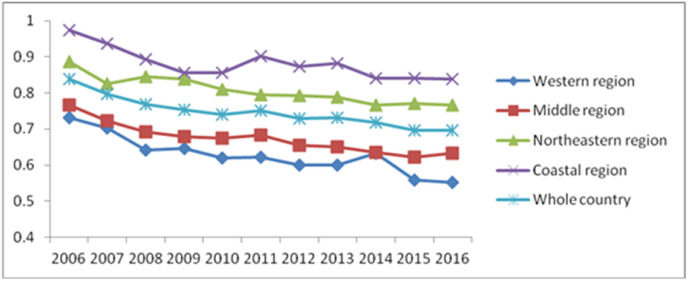
Improving the energy efficiency is a fundamental way to ensure energy security and sustainable development, and is also the requirement of supply-side structural reform of China's energy. This paper uses the DEA-BCC model to estimate China's energy efficiency at the provincial level, analyzes its regional differences from 2006 to 2016, and applies a panel data model to analyze the influencing factors of energy efficiency. It selects labor, capital stock and total energy consumption as inputs and takes real GDP and comprehensive index of environmental pollution as desirable and undesirable outputs, respectively. The results show that (1) energy efficiency when undesirable output is included is generally lower than when undesirable output is excluded; (2) There is a considerable difference in energy efficiency among provinces, and China's energy efficiency, by and large, shows a trend of declining. The energy efficiency of four major regions demonstrates obvious regional differences: coastal region>northeastern region> middle region >western region; (3) The economic development level, technological progress, energy price and urbanization level are positively associated with energy efficiency, while the proportion of secondary industry and the energy consumption structure dominated by coal and oil are negatively correlated with energy efficiency.
提高能源效率是保障能源安全和可持续发展的根本途径,也是中国能源供给侧结构性改革的要求。本文运用DEA - BCC模型对中国省级层面的能源效率进行测度,分析2006 - 2016年期间的区域差异,并运用面板数据模型对能源效率的影响因素进行分析。选取劳动力、资本存量和能源消费总量作为投入,分别将实际GDP和环境污染综合指数作为期望产出和非期望产出。研究结果表明:(1)考虑非期望产出时的能源效率普遍低于不考虑非期望产出时的能源效率;(2)各省份能源效率存在较大差异,总体上中国能源效率呈下降趋势。四大区域的能源效率呈现出明显的区域差异:沿海地区>东北地区>中部地区>西部地区;(3)经济发展水平、技术进步、能源价格和城镇化水平与能源效率呈正相关,而第二产业比重以及以煤炭和石油为主的能源消费结构与能源效率呈负相关。