Stepaniuk Peter, Kan Manstein, Kanani Amin
Division of Allergy and Immunology, Department of Medicine, University of British Columbia, Vancouver, BC Canada.
Allergy Asthma Clin Immunol. 2020 Jul 15;16:63. doi: 10.1186/s13223-020-00459-5. eCollection 2020.
Although the diagnosis and management of chronic spontaneous urticaria (CSU) is well documented in the literature, some aspects of the disease remain unclear. We aimed to further describe the natural history, prognostic factors, humanistic burden and uptake of traditional and alternative therapies in patients with CSU.
This was a prospective, cross-sectional analysis at a single centre. We reviewed patient medical records and conducted a survey in patients with CSU.
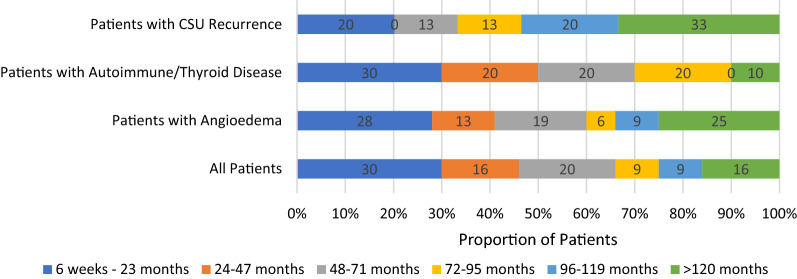
72 patients participated in the study with a median duration of CSU of 48 months. 30% of patients had symptoms that resolved in under 2 years with these patients trending towards an older age of onset of CSU (48 ± 17 years). 16% of patients had symptoms lasting 10 years or longer with these patients trending towards a younger age of onset (22 ± 16 years). Patients with a relapsing/remitting disease course (31%) and those with co-existing angioedema (57%) trended towards a longer median duration of CSU (96 and 50 months respectively) and were observed to have a higher proportion of patients reporting CSU duration of 10 years or longer (33% and 25%, p = 0.033 and p = 0.036 respectively). Patients with co-existing autoimmune/thyroid disease (19%) trended towards a shorter median duration of CSU (37 months). 54 patients (75%) reported sleep disturbance and 29 patients (43%) required emergency room visit(s) for symptomatic control. 84% of patients who trialed second generation antihistamines reported a response to treatment, while 73% of patients who trialed omalizumab reported a response to treatment. Patients using alternative medicine such as acupuncture, traditional Chinese medicine and naturopathic medicine had lower reported response rates (20-29%) to treatment.
The natural history of CSU may be longer than previously reported with our study finding a median duration of symptoms of nearly 4 years with one-third of patients reporting a relapsing/remitting disease course. Younger age of onset, a relapsing/remitting disease course and angioedema may predict a longer duration of CSU, whereas older age of onset and co-existing autoimmune/thyroid disease may predict a shorter duration of CSU. Reported symptomatic benefit was higher from guidelines based pharmacologic therapy versus various alternative medicines.
尽管慢性自发性荨麻疹(CSU)的诊断和管理在文献中有充分记载,但该疾病的某些方面仍不清楚。我们旨在进一步描述CSU患者的自然病史、预后因素、人文负担以及传统和替代疗法的使用情况。
这是一项在单一中心进行的前瞻性横断面分析。我们查阅了患者的病历,并对CSU患者进行了调查。
72名患者参与了该研究,CSU的中位病程为48个月。30%的患者症状在2年内缓解,这些患者的CSU发病年龄趋于较大(48±17岁)。16%的患者症状持续10年或更长时间,这些患者的发病年龄趋于较小(22±16岁)。疾病呈复发/缓解病程的患者(31%)和合并血管性水肿的患者(57%)的CSU中位病程趋于更长(分别为96个月和50个月),且观察到报告CSU病程为10年或更长时间的患者比例更高(分别为33%和25%,p = 0.033和p = 0.036)。合并自身免疫性/甲状腺疾病的患者(19%)的CSU中位病程趋于更短(37个月)。54名患者(75%)报告有睡眠障碍,29名患者(43%)因症状控制需要前往急诊室就诊。试用第二代抗组胺药的患者中有84%报告对治疗有反应,而试用奥马珠单抗的患者中有73%报告对治疗有反应。使用针灸、中药和自然疗法等替代医学的患者报告的治疗反应率较低(20 - 29%)。
CSU的自然病史可能比先前报道的更长,我们的研究发现症状的中位持续时间近4年,三分之一的患者报告疾病呈复发/缓解病程。发病年龄较小、疾病呈复发/缓解病程和血管性水肿可能预示CSU病程更长,而发病年龄较大和合并自身免疫性/甲状腺疾病可能预示CSU病程更短。与各种替代医学相比,基于指南的药物治疗报告的症状改善更明显。