The FinnBrain Birth Cohort Study, Turku Brain and Mind Center, Institute of Clinical Medicine, University of Turku, Finland; Department of Psychiatry, Turku University Hospital, University of Turku, Turku, Finland; Turku Collegium for Science and Medicine, University of Turku, Turku, Finland; Department of Psychiatry, University of Oxford, UK (Sigrid Juselius Fellowship), United Kingdom.
The FinnBrain Birth Cohort Study, Turku Brain and Mind Center, Institute of Clinical Medicine, University of Turku, Finland; Department of Psychology, University of Turku, Finland; Infant Cognition Laboratory, Center for Child Health Research, School of Medicine, University of Tampere, Finland.
Dev Cogn Neurosci. 2020 Oct;45:100839. doi: 10.1016/j.dcn.2020.100839. Epub 2020 Aug 15.
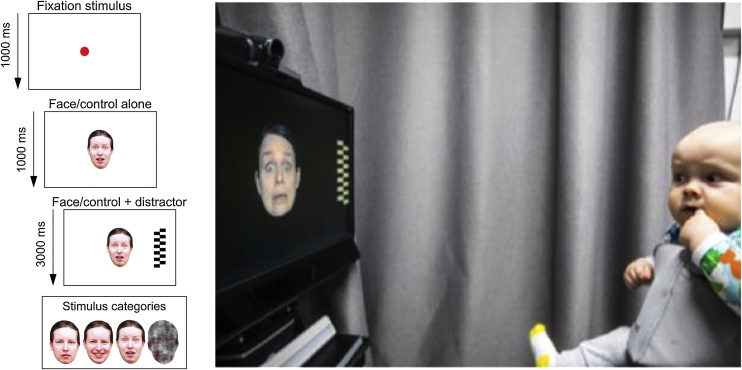
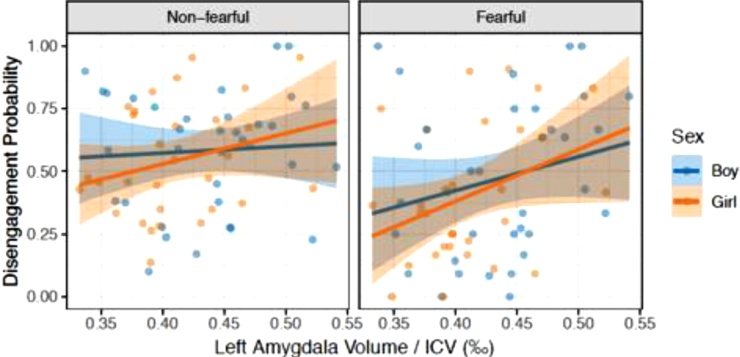
After 5 months of age, infants begin to prioritize attention to fearful over other facial expressions. One key proposition is that amygdala and related early-maturing subcortical network, is important for emergence of this attentional bias - however, empirical data to support these assertions are lacking. In this prospective longitudinal study, we measured amygdala volumes from MR images in 65 healthy neonates at 2-5 weeks of gestation corrected age and attention disengagement from fearful vs. non-fearful facial expressions at 8 months with eye tracking. Overall, infants were less likely to disengage from fearful than happy/neutral faces, demonstrating an age-typical bias for fear. Left, but not right, amygdala volume (corrected for intracranial volume) was positively associated with the likelihood of disengaging attention from fearful faces to a salient lateral distractor (r = .302, p = .014). No association was observed with the disengagement from neutral or happy faces in equivalent conditions (r = .166 and .125, p = .186 and .320, respectively). These results are the first to link the amygdala volume with the emerging perceptual vigilance for fearful faces during infancy. They suggest a link from the prenatally defined variability in the amygdala size to early postnatal emotional and social traits.
5 个月大后,婴儿开始优先注意到恐惧表情,而不是其他表情。一个关键的假设是,杏仁核及相关的早期成熟的皮质下网络,对于这种注意力偏向的出现很重要——然而,缺乏支持这些主张的经验数据。在这项前瞻性纵向研究中,我们使用磁共振成像测量了 65 名健康新生儿在 2-5 周胎龄校正年龄的杏仁核体积,并在 8 个月大时使用眼动追踪测量了他们对恐惧和非恐惧面部表情的注意力脱离情况。总的来说,婴儿不太可能从恐惧面孔上转移注意力,而更倾向于从快乐/中性面孔上转移,这表明他们对恐惧存在典型的偏向。左侧杏仁核体积(校正为颅内体积)与从恐惧面孔转移注意力到显著的外侧分心物的可能性呈正相关(r =.302,p =.014)。在相同条件下,与中性或快乐面孔的注意力脱离均无关联(r =.166 和.125,p =.186 和.320)。这些结果首次将杏仁核体积与婴儿期对恐惧面孔的知觉警觉性联系起来。它们表明,从杏仁核大小的产前可变性到早期的情绪和社交特质存在关联。