Center for Child Health Research, Faculty of Medicine and Health Technology, Tampere University, Tampere, Finland.
Department of Paediatrics, Tampere University Hospital, Tampere, Finland.
Sci Rep. 2019 Oct 8;9(1):14414. doi: 10.1038/s41598-019-51034-x.
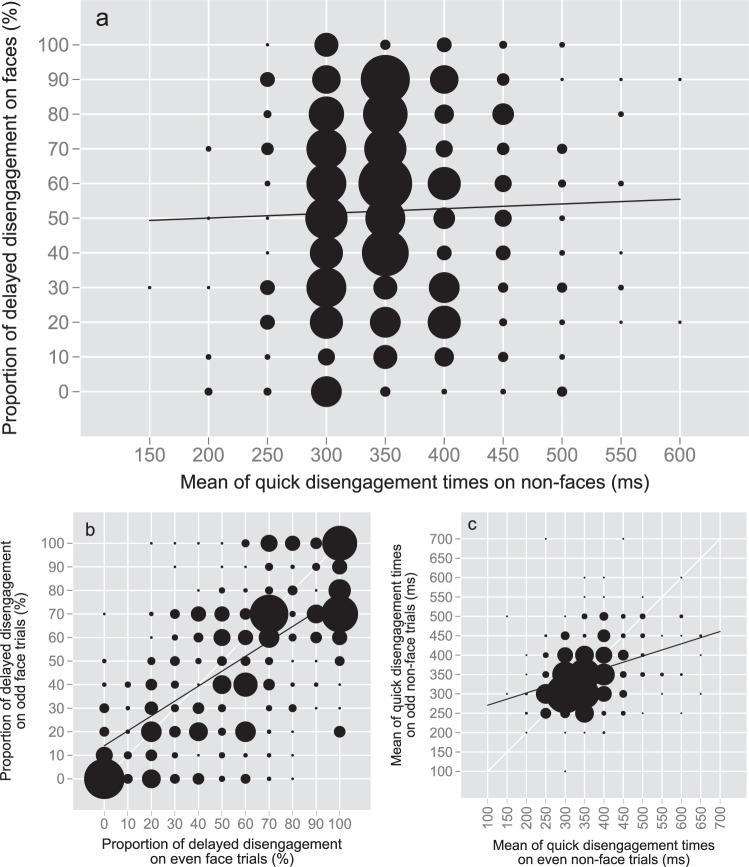
Infants are slower to disengage from faces than non-face patterns when distracted by novel competing stimuli. While this perceptual predilection for faces is well documented, its universality and mechanisms in relation to other aspects of attention are poorly understood. We analysed attention disengagement times for faces and non-face patterns in a large sample of 6-to 9-month-old infants (N = 637), pooled from eye tracking studies in socioculturally diverse settings (Finland, Malawi, South Africa). Disengagement times were classified into distinct groups of quick and delayed/censored responses by unsupervised clustering. Delayed disengagement was frequent for faces (52.1% of trials), but almost negligible for patterns (3.9% of trials) in all populations. The magnitude of this attentional bias varied by individuals, whereas the impact of situational factors and facial expression was small. Individual variations in disengagement from faces were moderately stable within testing sessions and independent from variations in disengagement times for patterns. These results point to a fundamental dissociation of face and pattern processing in infants and demonstrate that the bias for faces can be robust against distractors and habituation. The results raise the possibility that attention to faces varies as an independent, early-emerging social trait in populations.
当婴儿被新颖的竞争刺激物分散注意力时,他们比非面部模式更难从面部上转移注意力。虽然这种对人脸的感知偏好已得到充分证明,但人们对其普遍性及其与注意力其他方面的关系的机制仍知之甚少。我们分析了来自社会文化背景多样的(芬兰、马拉维、南非)眼动追踪研究的 6 至 9 个月大婴儿(N=637)样本中,人脸和非人脸模式的注意力脱离时间。通过无监督聚类将脱离时间分为快速和延迟/屏蔽反应的不同组。在所有人群中,人脸的延迟脱离很常见(52.1%的试验),但对于模式(3.9%的试验)几乎可以忽略不计。这种注意力偏差的大小因个体而异,而情境因素和面部表情的影响很小。在测试过程中,从人脸转移注意力的个体变化具有中等稳定性,并且与模式转移注意力的个体变化无关。这些结果表明,婴儿对面部和模式的处理存在根本的分离,并证明了对人脸的偏见可以抵抗干扰和习惯化。这些结果提出了一种可能性,即注意力对面部的变化作为一种独立的、早期出现的社会特征在人群中存在差异。