Mngumi Lazaro Eliyah
Institute of Human Settlements Studies (IHSS), Ardhi University, P.O. Box 35176, Dar es Salaam, Tanzania.
Faculty of Natural Resources and Agricultural Sciences, Swedish University of Agricultural Sciences (SLU), P.O. Box 7012, 750 07 Uppsala, Sweden.
GeoJournal. 2021;86(6):2671-2689. doi: 10.1007/s10708-020-10214-3. Epub 2020 May 20.
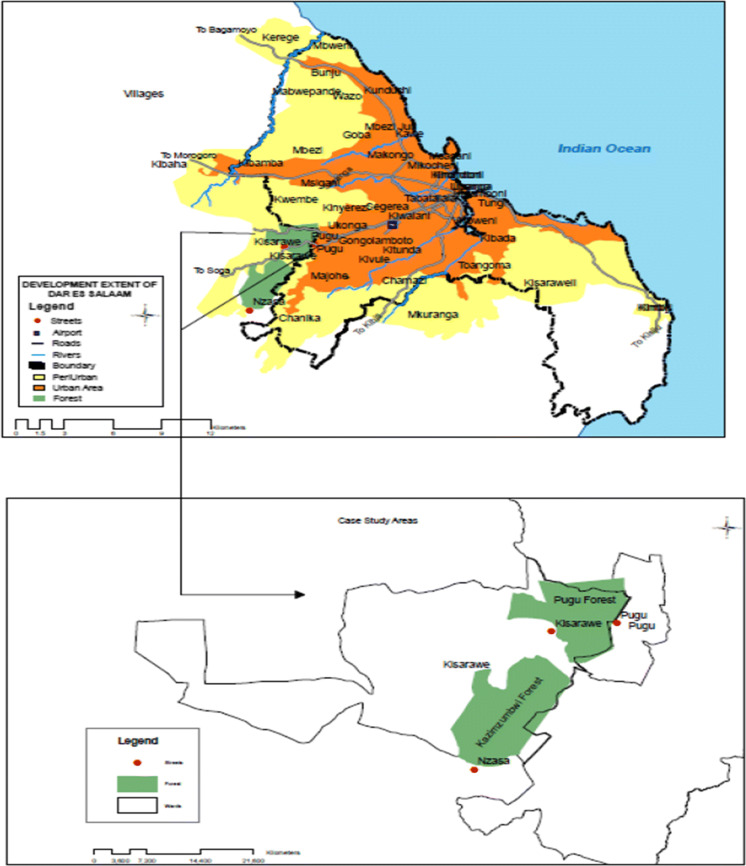
This article aims to contribute to the literature on the quest for resilient cities by focusing on the climate change resilience building discourse in peri-urban areas, and specifically by exploring the role of social capital-an under-researched topic. The article examines bonding social capital and bridging social capital, with a focus on how they can potentially contribute to, or inhibit, the socio-ecological system resilience building processes in the context of climate change reality in peri-urban areas. Theoretically, the author draws on the existing social capital and resilience related literatures; empirically, the article presents findings from a study conducted in the peri-urban areas of Pugu and Kazimzumbwi forest reserves on the outskirts of Dar es Salaam city in Tanzania. The study deployed a household survey and key informant interviews. It found that both bonding and bridging social capital were strong in the research area, suggesting the feasibility of building resilience to climate change effects. Examples are given of a number of resilience building interventions that were established through synergies between social capital actors and local communities, although some doubt is cast over the sustainability of these initiatives. Overall, both theoretical and empirical evidence suggests the importance of including a focus on social capital in exploring the building of climate change resilience pathways in peri-urban areas, and especially in the context of the global south.
本文旨在通过关注城郊地区的气候变化适应力建设话语,特别是通过探索社会资本的作用——一个研究较少的话题,为有关韧性城市探索的文献做出贡献。本文考察了联结型社会资本和桥接型社会资本,重点关注它们在城郊地区气候变化现实背景下如何可能促进或抑制社会生态系统适应力建设进程。从理论上讲,作者借鉴了现有的与社会资本和适应力相关的文献;从实证角度看,本文呈现了在坦桑尼亚达累斯萨拉姆市郊区的普古和卡齐姆祖姆维森林保护区的城郊地区进行的一项研究的结果。该研究采用了家庭调查和关键信息人访谈。研究发现,研究区域内的联结型和桥接型社会资本都很强,这表明建立应对气候变化影响的适应力是可行的。文中给出了一些通过社会资本行为体与当地社区协同合作建立的适应力建设干预措施的例子,不过有人对这些举措的可持续性表示怀疑。总体而言,理论和实证证据均表明,在探索城郊地区气候变化适应力建设路径时,尤其是在全球南方的背景下,关注社会资本具有重要意义。