McNamara James, Robinson Elizabeth J Z, Abernethy Katharine, Midoko Iponga Donald, Sackey Hannah N K, Wright Juliet H, Milner-Gulland E J
Conservation Research Consultants, London, UK.
Gabon Biodiversity Program, Smithsonian Conservation Biology Institute, Washington, DC USA.
Environ Resour Econ (Dordr). 2020;76(4):1045-1066. doi: 10.1007/s10640-020-00474-5. Epub 2020 Aug 4.
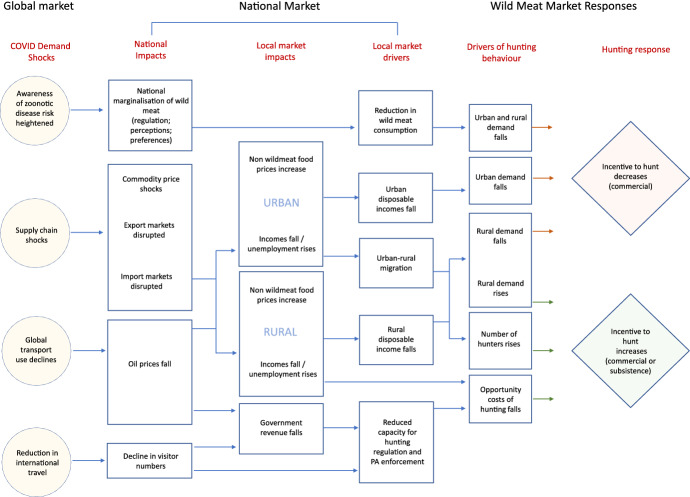
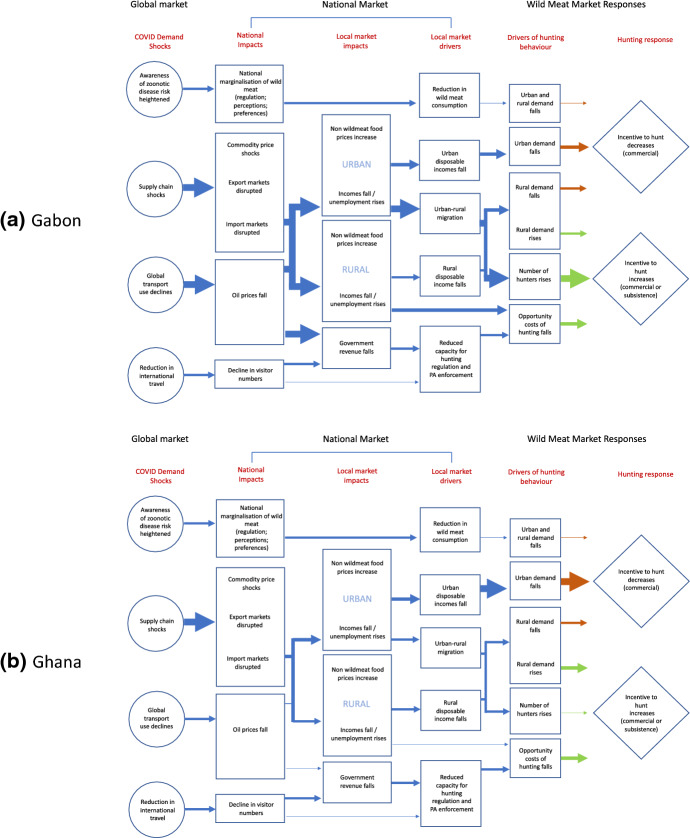
Wild animals play an integral and complex role in the economies and ecologies of many countries across the globe, including those of West and Central Africa, the focus of this policy perspective. The trade in wild meat, and its role in diets, have been brought into focus as a consequence of discussions over the origins of COVID-19. As a result, there have been calls for the closure of China's "wet markets"; greater scrutiny of the wildlife trade in general; and a spotlight has been placed on the potential risks posed by growing human populations and shrinking natural habitats for animal to human transmission of zoonotic diseases. However, to date there has been little attention given to what the consequences of the COVID-19 economic shock may be for the wildlife trade; the people who rely on it for their livelihoods; and the wildlife that is exploited. In this policy perspective, we argue that the links between the COVID-19 pandemic, rural livelihoods and wildlife are likely to be more complex, more nuanced, and more far-reaching, than is represented in the literature to date. We develop a causal model that tracks the likely implications for the wild meat trade of the systemic crisis triggered by COVID-19. We focus on the resulting economic shockwave, as manifested in the collapse in global demand for commodities such as oil, and international tourism services, and what this may mean for local African economies and livelihoods. We trace the shockwave through to the consequences for the use of, and demand for, wild meats as households respond to these changes. We suggest that understanding and predicting the complex dynamics of wild meat use requires increased collaboration between environmental and resource economics and the ecological and conservation sciences.
野生动物在全球许多国家的经济和生态中扮演着不可或缺且复杂的角色,包括西非和中非国家,这也是本政策视角的关注重点。由于对新冠病毒起源的讨论,野生动物肉贸易及其在饮食中的作用成为了焦点。因此,有人呼吁关闭中国的“湿货市场”;加强对一般野生动物贸易的审查;人们还关注到,人口增长和动物自然栖息地缩小可能带来人畜共患病从动物传播给人类的潜在风险。然而,迄今为止,几乎没有人关注新冠疫情带来的经济冲击对野生动物贸易、依赖其为生的人们以及被捕猎的野生动物可能产生的后果。在本政策视角中,我们认为,新冠疫情、农村生计和野生动物之间的联系可能比迄今为止文献中所呈现的更为复杂、更为微妙且影响更为深远。我们构建了一个因果模型,以追踪新冠疫情引发的系统性危机对野生动物肉贸易可能产生的影响。我们关注由此产生的经济冲击波,其表现为全球对石油等商品以及国际旅游服务需求的暴跌,以及这对非洲当地经济和生计可能意味着什么。我们追踪这一冲击波,直至家庭对这些变化做出反应时,对野生动物肉的使用和需求所产生的后果。我们认为,理解和预测野生动物肉使用的复杂动态需要环境与资源经济学以及生态与保护科学之间加强合作。