Kumar Surender, Managi Shunsuke
Department of Economics, Delhi School of Economics, University of Delhi, Delhi, 110007 India.
Urban Institute & Departments of Civil Engineering, Kyushu University, 744 Motooka, Nishi-ku, Fukuoka, 819-0395 Japan.
Econ Disaster Clim Chang. 2020;4(3):481-502. doi: 10.1007/s41885-020-00072-1. Epub 2020 Aug 15.
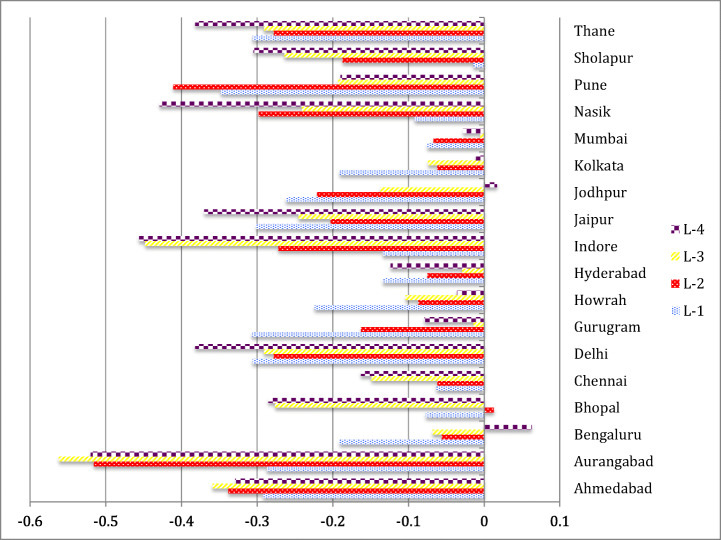
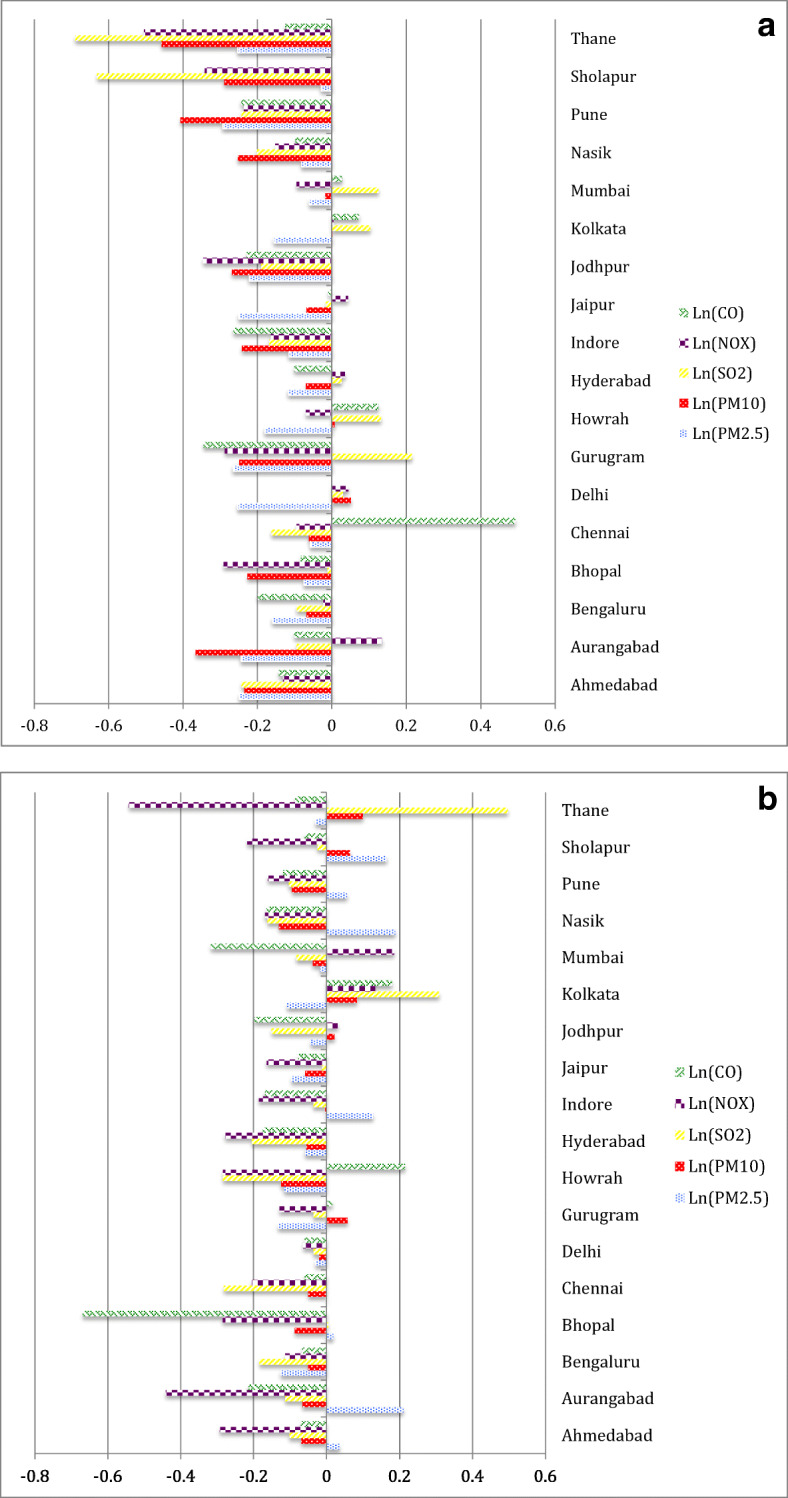
The precipitous spread of COVID-19 has created a conflict between human health and economic well-being. To contain the spread of its contagious effect, India imposed a stringent lockdown, and then the stringency was relaxed to some extent in its succeeding phases. We measure social benefits of the lockdown in terms of improved air quality in Indian cities by quantifying the effects with city-specific slope coefficients. We find that the containment measures have resulted in improvement in air quality, but it is not uniform across cities and across pollutants. The level of PM decreases from about 6 to 25% in many cities. Moreover, we observe that partial relaxations do not help in resuming economic and social activities. It should also be noted that counter-virus measures could not bring levels of the emissions to WHO standards; it highlights the importance of role of green production and consumption activities.
新冠疫情的迅速蔓延在人类健康与经济福祉之间引发了冲突。为遏制其传染性影响的传播,印度实施了严格的封锁措施,随后在后续阶段又在一定程度上放宽了限制。我们通过用特定城市的斜率系数量化影响,来衡量封锁措施在改善印度城市空气质量方面的社会效益。我们发现,防控措施已使空气质量得到改善,但在不同城市和不同污染物之间并不均匀。许多城市的细颗粒物(PM)水平下降了约6%至25%。此外,我们观察到部分放宽措施无助于恢复经济和社会活动。还应指出的是,抗疫措施未能使排放水平达到世界卫生组织的标准;这凸显了绿色生产和消费活动作用的重要性。