Faculty of Biology-Microbiology, Albert-Ludwigs-Universität Freiburg, Freiburg im Breisgau, Germany.
Insitute of Pharmaceutical Sciences, Albert-Ludwigs-Universität Freiburg, Freiburg im Breisgau, Germany.
mBio. 2020 Aug 25;11(4):e01259-20. doi: 10.1128/mBio.01259-20.
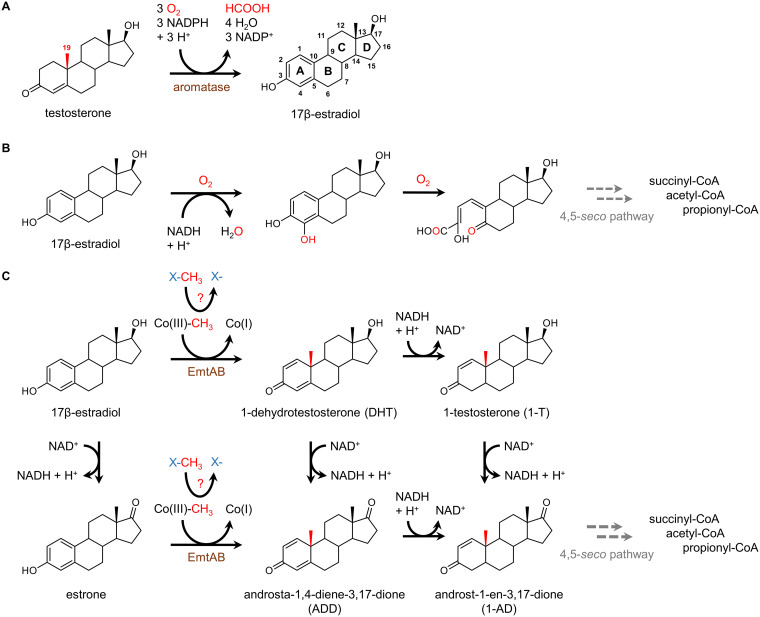
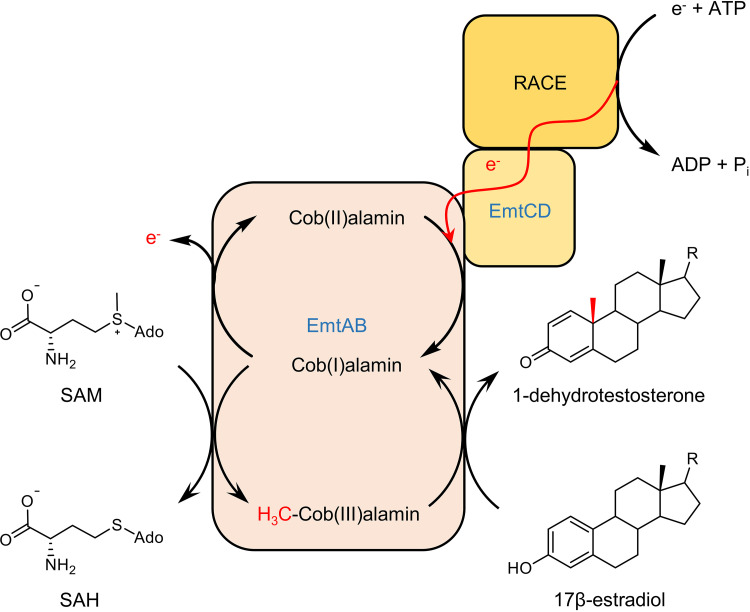
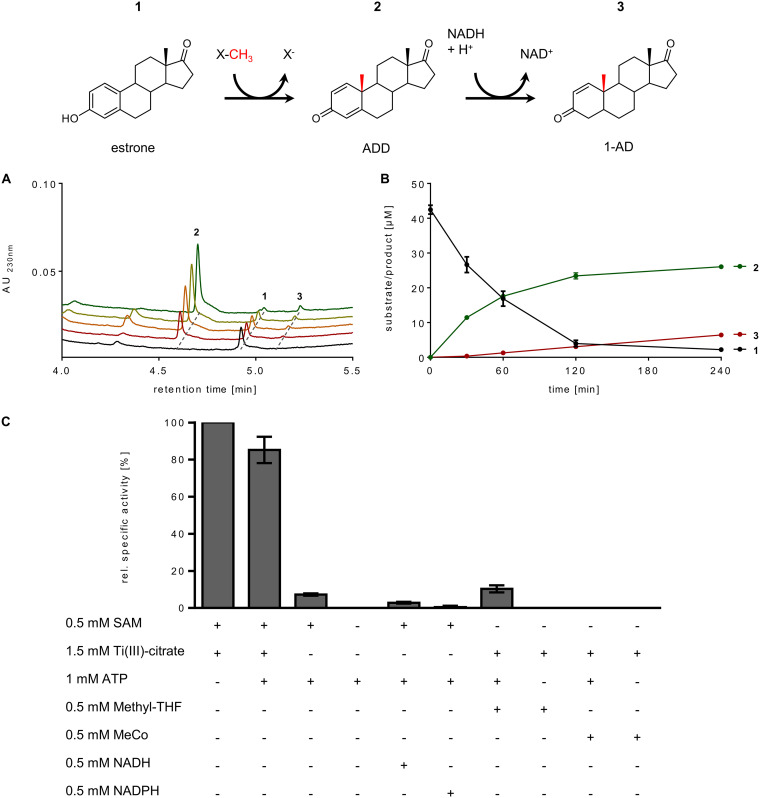
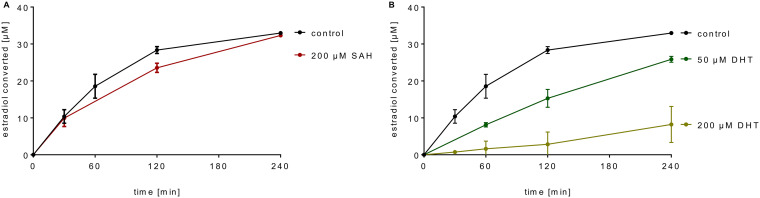
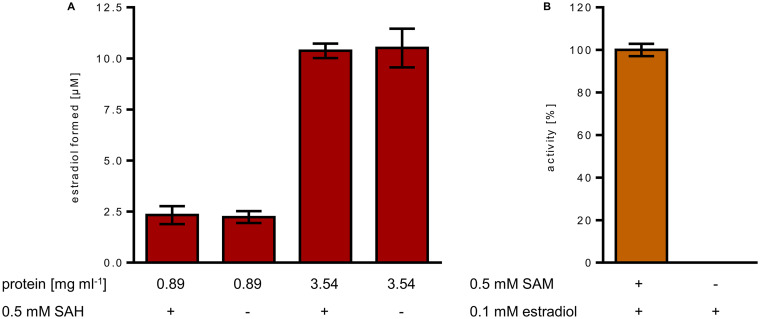
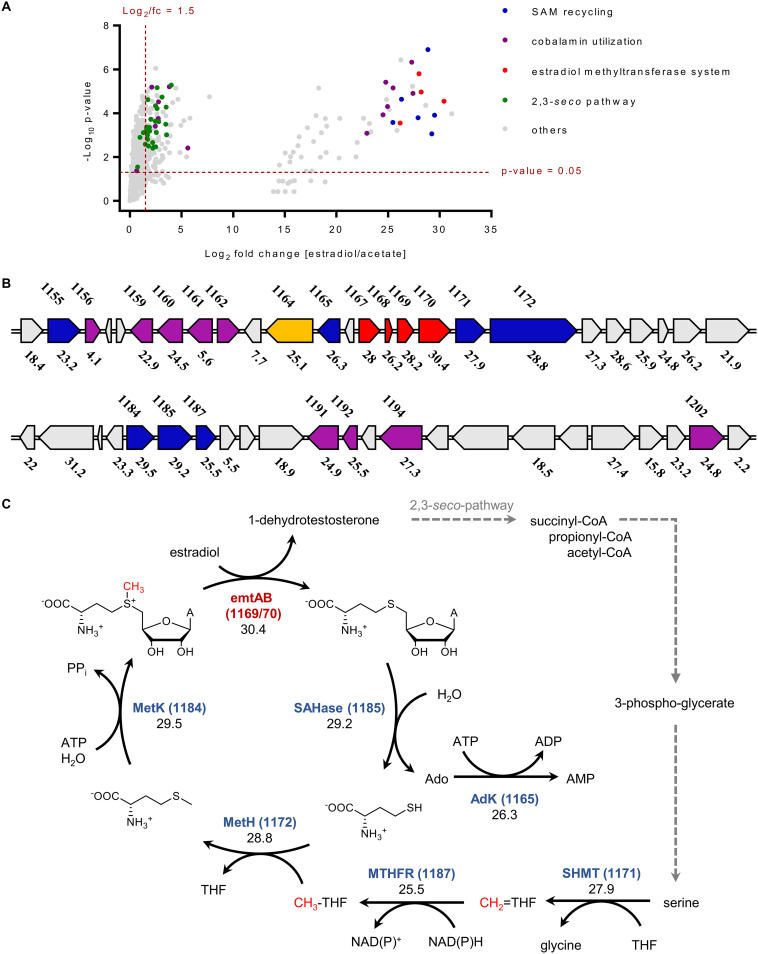
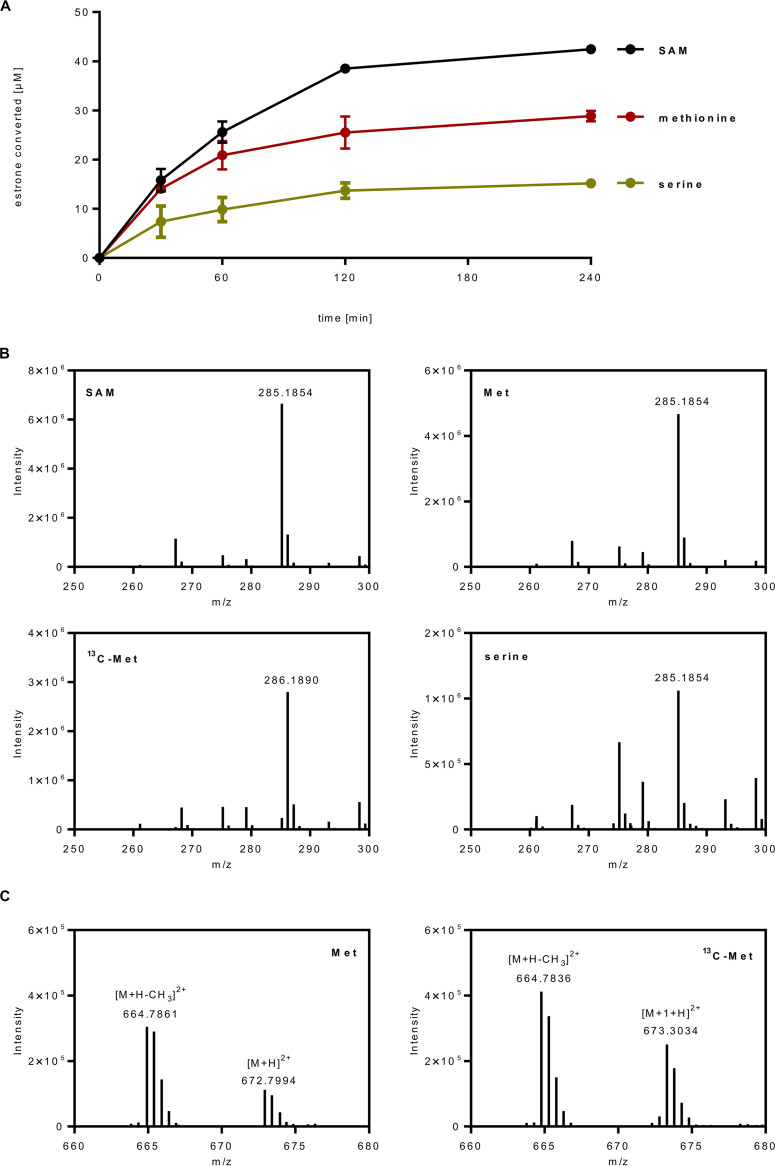
Bacterial degradation of endocrine disrupting and carcinogenic estrogens is essential for their elimination from the environment. Recent studies of the denitrifying, estrogen-degrading strain DHT3 revealed the conversion of estrogens to androgens by a putative cobalamin-dependent methyltransferase encoded by the genes. The methyl donor and its continuous regeneration to initiate estradiol catabolism have remained unknown. Here, large-scale cultivation of the denitrifying bacterium with estrogen provided the biomass required for quantitative biochemical analyses. Soluble fractions of extracts from estradiol-grown cells catalyzed the -adenosyl-l-methionine (SAM)- and Ti(III)-citrate-dependent conversion of 17β-estradiol/estrone to the respective androgens at 0.15 nmol minmg Kinetic studies of 17β-estradiol methylation and reverse 1-dehydrotestosterone demethylation reactions indicated that the exergonic methyl transfer from SAM to the putative cobalamin drives the endergonic methyl transfer from the methylcobalamin intermediate to the phenolic ring A. Based on a high-quality circular genome from , proteogenomic analyses identified a 17β-estradiol-induced gene cluster comprising genes together with genes involved in SAM regeneration via l-serine and l-methionine. Consistent with this finding, l-methionine/ATP or l-serine/ATP/tetrahydrofolate/l-homocysteine substituted for SAM as methyl donors, further confirmed by the incorporation of the C-methyl-group from C-l-methonine into methyl(III)cobalamine and the estrone methylation product androsta-1,4-diene-3-one. This work demonstrates that during bacterial estrogen catabolism, the C1 pool is channeled toward the initiating methyl transfer to ring A. The effective cellular SAM regeneration system may serve as a model for whole-cell SAM-dependent methylation reactions of biotechnological interest. Estrogens comprise a group of related hormones occurring in predominantly female vertebrates, with endocrine disrupting and carcinogenic potential. Microbial biodegradation of estrogens is essential for their elimination from surface waters and wastewater. Aerobic bacteria employ oxygenases for the initial cleavage of the aromatic ring A. In contrast, anaerobic degradation of estrogens is initiated by methyl transfer-dependent conversion into androgens involving a putative cobalamin-dependent methyltransferase system. The methyl donor for this unprecedented reaction and its stoichiometric regeneration have remained unknown. With the biomass obtained from large-scale fermentation of an estrogen-degrading denitrifying bacterium, we identified -adenosyl-methionine (SAM) as the methyl donor for the cobalamin-mediated methyl transfer to estrogens. To continuously supply C1 units to initiate estrogen degradation, genes for SAM regeneration from estradiol-derived catabolites are highly upregulated. Data presented here shed light into biochemical processes involved in the globally important microbial degradation of estrogens.
细菌对环境内分泌干扰物和致癌雌激素的降解对于它们的消除至关重要。最近对具有硝化作用、可降解雌激素的菌株 DHT3 的研究表明,雌激素通过假定的钴胺素依赖性甲基转移酶转化为雄激素,该酶由基因编码。甲基供体及其连续再生以启动雌二醇代谢仍不清楚。在这里,用雌激素对硝化细菌进行大规模培养,提供了进行定量生化分析所需的生物质。从雌二醇生长细胞的提取物的可溶性部分催化 17β-雌二醇/雌酮向各自的雄激素的 -腺嘌呤基-l-甲硫氨酸(SAM)和 Ti(III)-柠檬酸盐依赖性转化,在 0.15 nmol minmg 时具有活性。17β-雌二醇甲基化和反向 1-去氢睾酮去甲基化反应的动力学研究表明,从 SAM 到假定的钴胺素的放能甲基转移驱动从甲基钴胺素中间物到酚环 A 的吸能甲基转移。基于高质量的环状基因组,蛋白质基因组分析鉴定了一个 17β-雌二醇诱导的基因簇,该基因簇包含基因以及通过 l-丝氨酸和 l-蛋氨酸再生 SAM 的基因。与这一发现一致,l-蛋氨酸/ATP 或 l-丝氨酸/ATP/四氢叶酸/l-高半胱氨酸取代 SAM 作为甲基供体,通过从 C-l-蛋氨酸掺入甲基(III)钴胺素和雌酮甲基化产物雄甾-1,4-二烯-3-酮进一步证实。这项工作表明,在细菌雌激素代谢过程中,C1 池被引导朝向起始的环 A 甲基转移。有效的细胞内 SAM 再生系统可能成为具有生物技术意义的全细胞 SAM 依赖性甲基化反应的模型。雌激素是一组主要存在于脊椎动物中的相关激素,具有内分泌干扰和致癌潜力。雌激素的微生物生物降解对于它们从地表水中的消除至关重要。好氧细菌利用加氧酶初始切割芳香环 A。相比之下,雌激素的厌氧降解是通过依赖甲基转移的转化为雄激素而引发的,涉及到假定的钴胺素依赖性甲基转移酶系统。该反应的甲基供体及其化学计量再生仍然未知。利用从雌激素降解硝化细菌的大规模发酵中获得的生物质,我们确定 -腺嘌呤基-l-甲硫氨酸(SAM)是钴胺素介导的甲基转移到雌激素的甲基供体。为了连续供应 C1 单位以启动雌激素降解,从雌二醇衍生的代谢物中再生 SAM 的基因高度上调。这里呈现的数据阐明了在全球重要的雌激素微生物降解过程中涉及的生化过程。