Hattenbach Lars-Olof, Heinz Peter, Feltgen Nicolas, Hoerauf Hans, Kohnen Thomas, Priglinger Siegfried, Bachmann Werner, Rieks Johannes, Eter Nicole, Reinhard Thomas
Kommission Sektorenübergreifende Augenheilkunde von DOG (Deutsche Ophthalmologische Gesellschaft e. V.) und BVA (Berufsverband der Augenärzte Deutschlands e. V.), München/Düsseldorf, Deutschland.
Augenklinik, Klinikum Ludwigshafen, Bremserstr. 79, 67063, Ludwigshafen, Deutschland.
Ophthalmologe. 2020 Sep;117(9):892-904. doi: 10.1007/s00347-020-01220-4. Epub 2020 Aug 26.
Survey by the commission for cross-sectoral ophthalmology, as a joint commission of the German Ophthalmological Society (DOG) and the Professional Association of German Ophthalmologists (BVA) on the effects of the SARS-CoV‑2 pandemic on ophthalmological patient care in Germany.
Online-based survey.
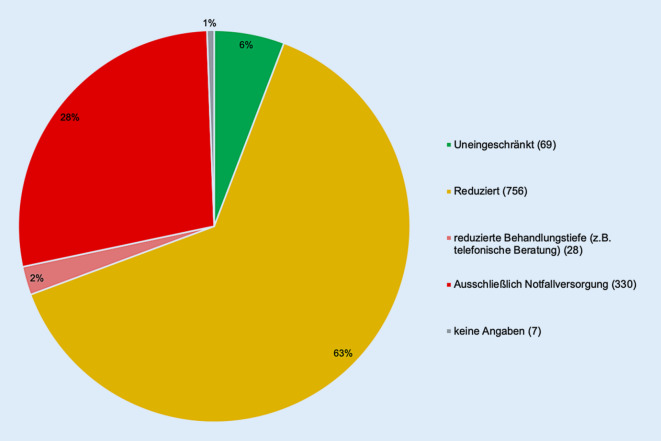
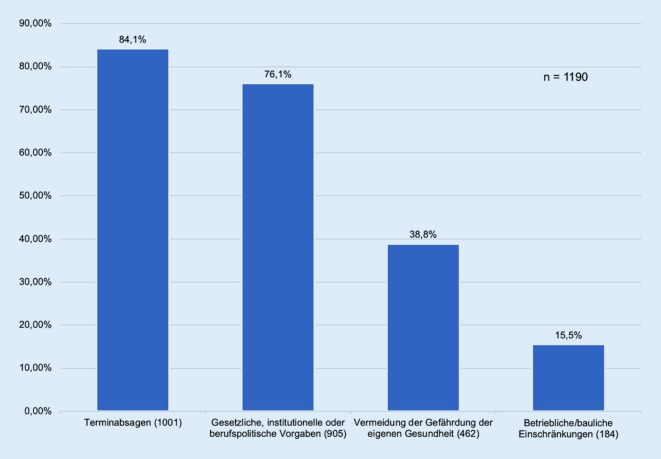
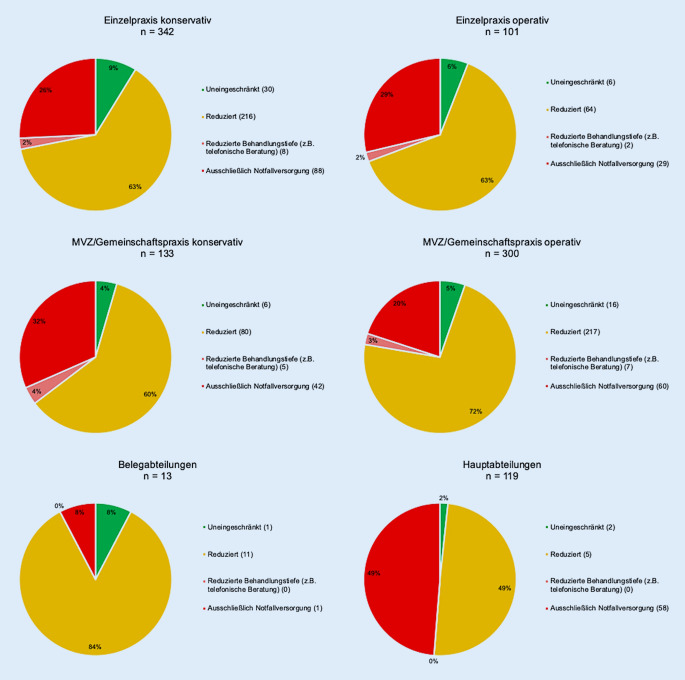
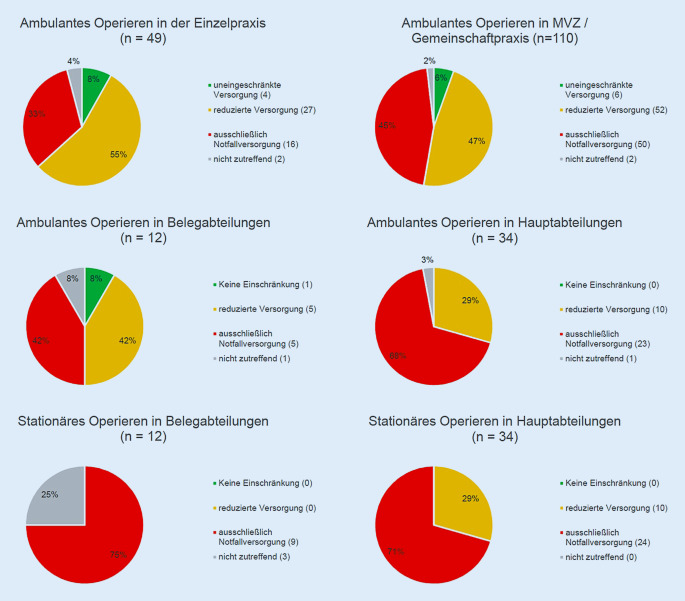
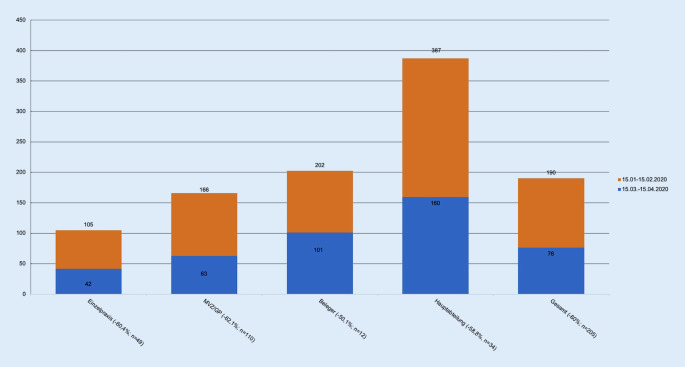
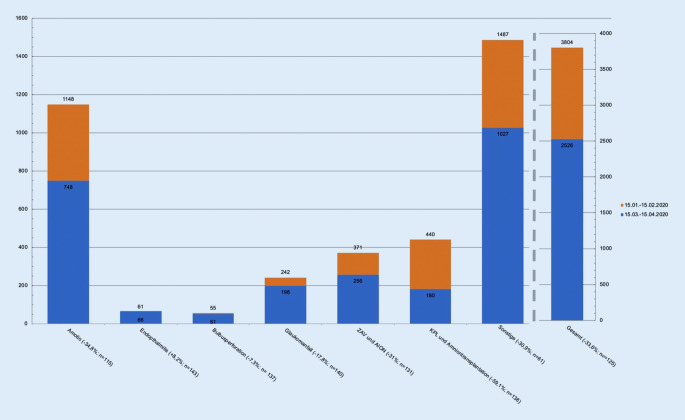
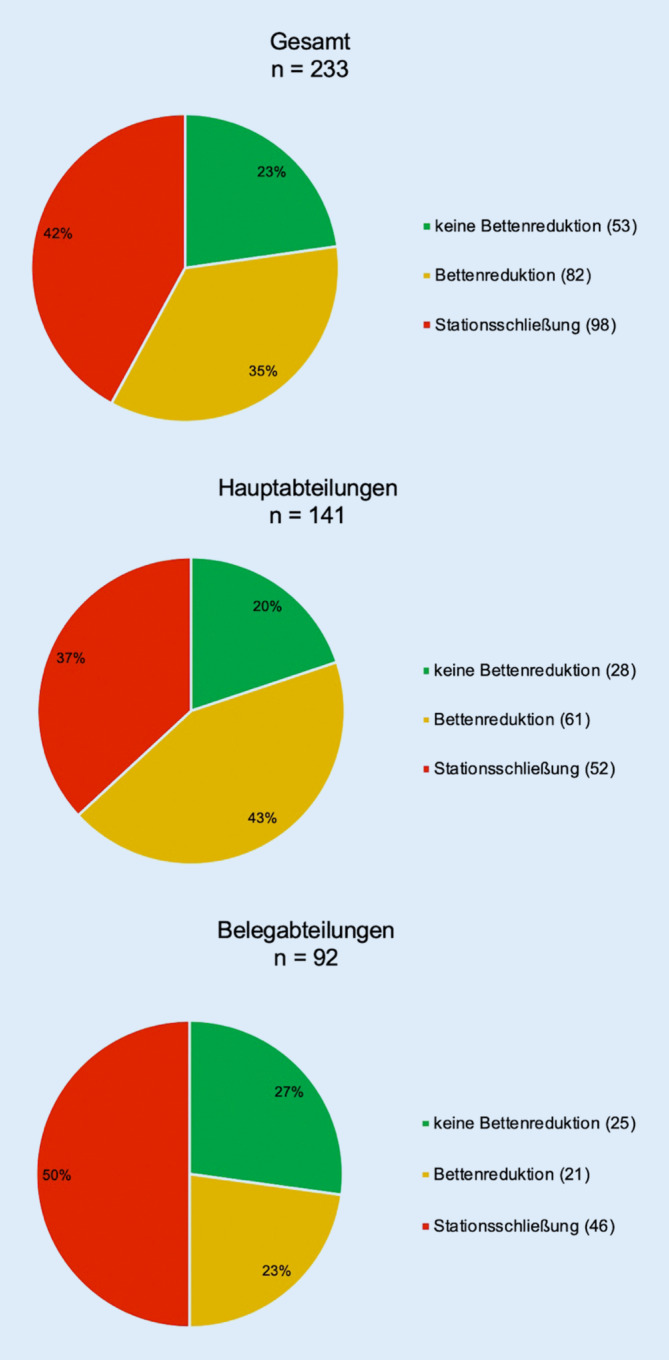
A total of 1190 questionnaires were (partly) answered. With respect to outpatient care and consultations from 15 March to 15 April 2020, a total of 69 (5.8%) participants indicated unlimited, 756 (63.5%) reduced and 330 (27.7%) emergency care only, independent of the type of institution. Outpatient surgery was restricted to emergency surgery in 68% of clinics, 42.0% of inpatient wards, 45.0% of surgical medical care centers and group practices and 33.0% of private practices. Inpatient procedures were limited to emergency care in 75.0% of inpatient wards and in 71.0% of clinics. With the exception of endophthalmitis (+8.2%), the number of urgent indications and emergencies declined: retinal detachment (-34.8%), perforating eyeball injuries (-7.3%), acute glaucoma (-17.8%), central retinal artery occlusion and anterior ischemic optic neuropathy (-31.0%), others (-30.9%), penetrating keratoplasty and amniotic membrane transplantation (-59.1%). Institutional or professional policy requirements (76.0%) and appointment cancellation by patients (84.0%) were the most common reasons for limitations in ophthalmic patient care.
The initial phase of the pandemic was characterized by a massive reduction in non-urgent conservative and surgical treatment that affected all areas of ophthalmology. Due to intensive care capacities required for COVID-19 patients, inpatient treatment was largely restricted to emergencies. Treatment of ophthalmological patients, including ocular emergencies and urgent treatment, was maintained across all sectors with a (considerable) decrease in the number of cases even in these groups.
跨部门眼科委员会开展的一项调查,该委员会是德国眼科协会(DOG)和德国眼科医生专业协会(BVA)的联合委员会,旨在调查SARS-CoV-2大流行对德国眼科患者护理的影响。
基于网络的调查。
共收到1190份(部分)回复问卷。关于2020年3月15日至4月15日的门诊护理和会诊,共有69名(5.8%)参与者表示不限号,756名(63.5%)参与者表示号源减少,330名(27.7%)参与者表示仅提供急诊护理,与机构类型无关。68%的诊所、42.0%的住院病房、45.0%的外科医疗中心和联合诊所、33.0%的私人诊所将门诊手术限制为急诊手术。75.0%的住院病房和71.0%的诊所将住院手术限制为急诊护理。除眼内炎(+8.2%)外,紧急指征和急诊数量均有所下降:视网膜脱离(-34.8%)、眼球穿孔伤(-7.3%)、急性青光眼(-17.8%)、视网膜中央动脉阻塞和前部缺血性视神经病变(-31.0%)、其他(-30.9%)、穿透性角膜移植术和羊膜移植术(-59.1%)。机构或专业政策要求(76.0%)以及患者取消预约(84.0%)是眼科患者护理受限的最常见原因。
大流行的初始阶段的特点是,非紧急的保守治疗和手术治疗大幅减少,这影响了眼科的各个领域。由于COVID-19患者需要重症监护能力,住院治疗在很大程度上仅限于急诊。所有部门都维持了眼科患者的治疗,包括眼部急诊和紧急治疗,即使在这些类别中,病例数量也(大幅)减少。