Kaniusas Eugenijus, Szeles Jozsef C, Kampusch Stefan, Alfageme-Lopez Nuria, Yucuma-Conde Daniela, Li Xie, Mayol Julio, Neumayer Christoph, Papa Michele, Panetsos Fivos
Faculty of Electrical Engineering and Information Technology, Institute of Electrodynamics, Microwave and Circuit Engineering, Vienna University of Technology, Vienna, Austria.
SzeleSTIM GmbH, Vienna, Austria.
Front Physiol. 2020 Jul 28;11:890. doi: 10.3389/fphys.2020.00890. eCollection 2020.
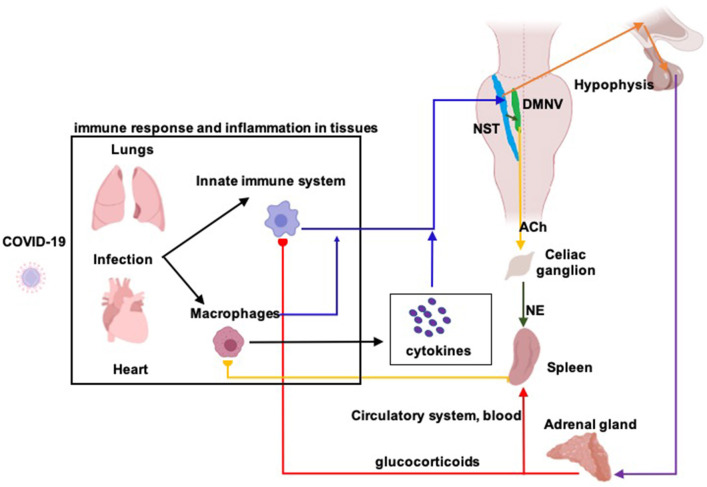
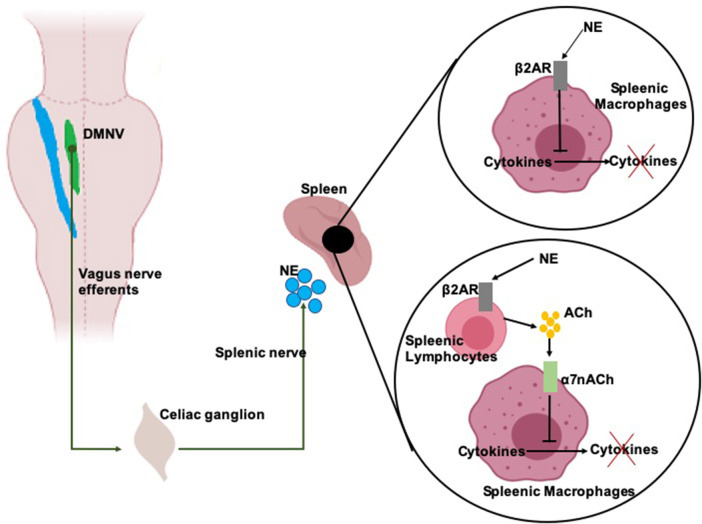
Covid-19 is an infectious disease caused by an invasion of the alveolar epithelial cells by coronavirus 19. The most severe outcome of the disease is the Acute Respiratory Distress Syndrome (ARDS) combined with hypoxemia and cardiovascular damage. ARDS and co-morbidities are associated with inflammatory cytokine storms, sympathetic hyperactivity, and respiratory dysfunction. In the present paper, we present and justify a novel potential treatment for Covid19-originated ARDS and associated co-morbidities, based on the non-invasive stimulation of the auricular branch of the vagus nerve. Auricular vagus nerve stimulation activates the parasympathetic system including anti-inflammatory pathways (the cholinergic anti-inflammatory pathway and the hypothalamic pituitary adrenal axis) while regulating the abnormal sympatho-vagal balance and improving respiratory control. Along the paper (1) we expose the role of the parasympathetic system and the vagus nerve in the control of inflammatory processes (2) we formulate our physiological and methodological hypotheses (3) we provide a large body of clinical and preclinical data that support the favorable effects of auricular vagus nerve stimulation in inflammation, sympatho-vagal balance as well as in respiratory and cardiac ailments, and (4) we list the (few) possible collateral effects of the treatment. Finally, we discuss auricular vagus nerve stimulation protective potential, especially in the elderly and co-morbid population with already reduced parasympathetic response. Auricular vagus nerve stimulation is a safe clinical procedure and it could be either an effective treatment for ARDS originated by Covid-19 and similar viruses or a supplementary treatment to actual ARDS therapeutic approaches.
新型冠状病毒肺炎(Covid-19)是一种由19型冠状病毒侵入肺泡上皮细胞引起的传染病。该疾病最严重的后果是急性呼吸窘迫综合征(ARDS)合并低氧血症和心血管损伤。ARDS及合并症与炎症细胞因子风暴、交感神经过度活跃和呼吸功能障碍有关。在本文中,我们提出并论证了一种基于对迷走神经耳支进行非侵入性刺激的针对Covid-19引发的ARDS及其相关合并症的新型潜在治疗方法。耳迷走神经刺激激活包括抗炎途径(胆碱能抗炎途径和下丘脑-垂体-肾上腺轴)在内的副交感神经系统,同时调节异常的交感-迷走平衡并改善呼吸控制。在本文中,(1)我们阐述了副交感神经系统和迷走神经在控制炎症过程中的作用;(2)我们提出了生理和方法学假设;(3)我们提供了大量临床和临床前数据,支持耳迷走神经刺激在炎症、交感-迷走平衡以及呼吸和心脏疾病方面的有益作用;(4)我们列出了该治疗(少数)可能的副作用。最后,我们讨论了耳迷走神经刺激的保护潜力,特别是在副交感反应已经减弱的老年人和合并症人群中。耳迷走神经刺激是一种安全的临床操作,它可能是治疗由Covid-19及类似病毒引发的ARDS的有效方法,或者是现有ARDS治疗方法的补充治疗。