Rinas Raven, Dresel Markus, Hein Julia, Janke Stefan, Dickhäuser Oliver, Daumiller Martin
Department of Psychology, University of Augsburg, Augsburg, Germany.
Department of Educational Psychology, University of Mannheim, Mannheim, Germany.
Front Psychol. 2020 Aug 7;11:1484. doi: 10.3389/fpsyg.2020.01484. eCollection 2020.
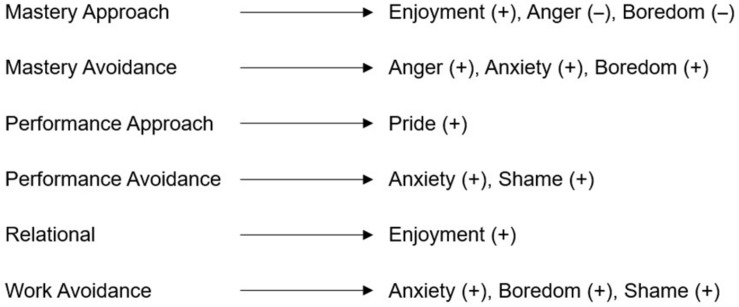
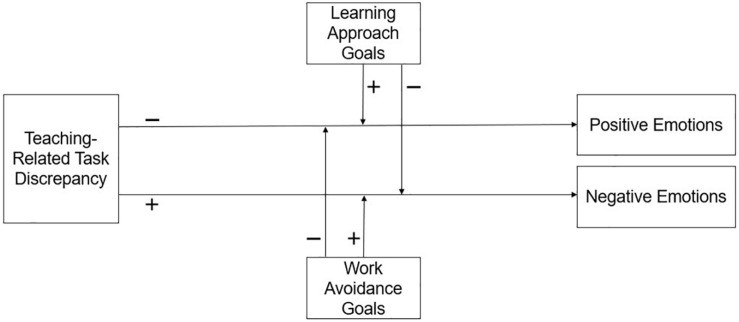
Emerging empirical evidence indicates that discrete emotions are associated with teaching practices and professional experiences of university instructors. However, further investigations are necessary given that university instructors often face high job demands and compromised well-being. Achievement goals, which frame achievement-related thoughts and actions, have been found to describe motivational differences in university instructors and are hypothesized to be associated with their discrete emotions. Moreover, as variation exists in how university instructors respond to job demands regarding their emotional experiences, certain goals may moderate this relationship on the basis of framing different interpretations and reactions to stressors. To investigate these links, 439 instructors (46.7% female) from German and Austrian universities completed a survey assessing their achievement goals, discrete emotions (enjoyment, pride, anger, anxiety, shame, and boredom), and job demands. As hypothesized, multiple regression analyses revealed that achievement goals were differentially and meaningfully associated with discrete emotions. Specifically, learning approach goals were positively related to enjoyment and negatively related to anger and boredom, while learning avoidance goals were positively related to anger. Performance (appearance) approach goals were positively related to pride, and performance (appearance) avoidance goals were positively related to anxiety and shame. Lastly, relational goals were positively related to shame and boredom, and work avoidance goals were negatively related to enjoyment and positively related to shame and boredom. Conclusive moderation effects on the relations between job demands and emotions were not found. Future research avenues aimed at further understanding the supportive role that achievement goals can have for university instructors' emotional experiences and well-being are discussed.
新出现的实证证据表明,离散情绪与大学教师的教学实践和职业经历相关。然而,鉴于大学教师经常面临高工作要求和幸福感受损的情况,有必要进行进一步调查。成就目标塑造了与成就相关的思想和行为,已被发现可描述大学教师的动机差异,并被假设与他们的离散情绪有关。此外,由于大学教师在如何应对与情绪体验相关的工作要求方面存在差异,某些目标可能会基于对压力源的不同解读和反应来调节这种关系。为了研究这些联系,来自德国和奥地利大学的439名教师(46.7%为女性)完成了一项调查,评估他们的成就目标、离散情绪(愉悦、自豪、愤怒、焦虑、羞耻和无聊)以及工作要求。如假设的那样,多元回归分析显示成就目标与离散情绪存在差异且有意义的关联。具体而言,学习方法目标与愉悦呈正相关,与愤怒和无聊呈负相关,而学习回避目标与愤怒呈正相关。成绩(外表)导向目标与自豪呈正相关,成绩(外表)回避目标与焦虑和羞耻呈正相关。最后,关系目标与羞耻和无聊呈正相关,工作回避目标与愉悦呈负相关,与羞耻和无聊呈正相关。未发现对工作要求与情绪之间关系的决定性调节作用。讨论了旨在进一步理解成就目标对大学教师情绪体验和幸福感所起支持作用的未来研究途径。