Mooshammer Maria, Alves Ricardo J E, Bayer Barbara, Melcher Michael, Stieglmeier Michaela, Jochum Lara, Rittmann Simon K-M R, Watzka Margarete, Schleper Christa, Herndl Gerhard J, Wanek Wolfgang
Centre for Microbiology and Environmental Systems Science, University of Vienna, Vienna, Austria.
Department of Functional and Evolutionary Ecology, University of Vienna, Vienna, Austria.
Front Microbiol. 2020 Jul 28;11:1710. doi: 10.3389/fmicb.2020.01710. eCollection 2020.
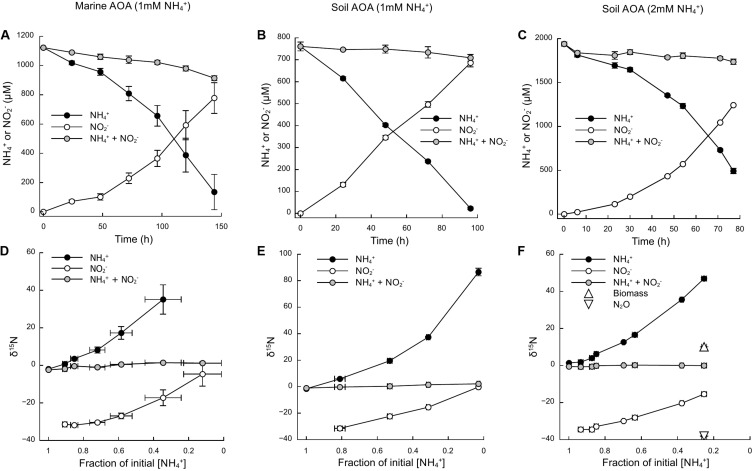
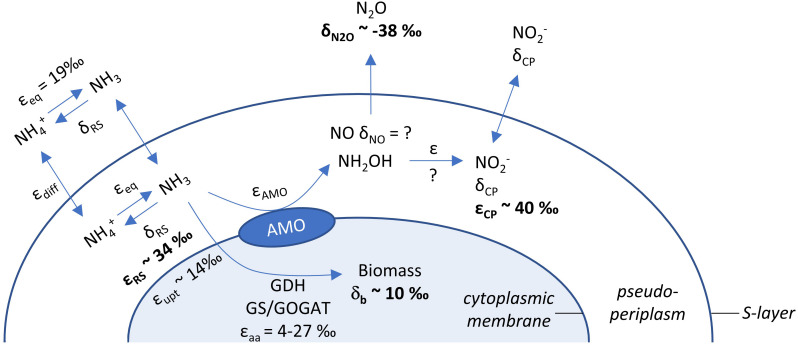
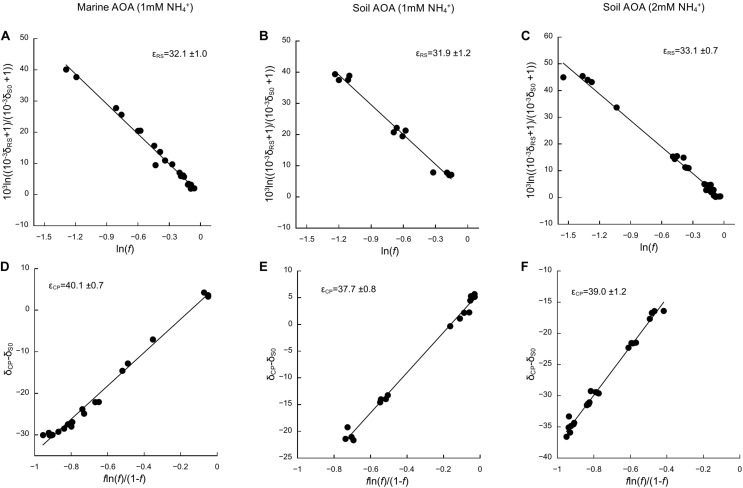
The naturally occurring nitrogen (N) isotopes, N and N, exhibit different reaction rates during many microbial N transformation processes, which results in N isotope fractionation. Such isotope effects are critical parameters for interpreting natural stable isotope abundances as proxies for biological process rates in the environment across scales. The kinetic isotope effect of ammonia oxidation (AO) to nitrite (NO ), performed by ammonia-oxidizing archaea (AOA) and ammonia-oxidizing bacteria (AOB), is generally ascribed to the enzyme ammonia monooxygenase (AMO), which catalyzes the first step in this process. However, the kinetic isotope effect of AMO, or ε , has been typically determined based on isotope kinetics during product formation (cumulative product, NO ) alone, which may have overestimated ε due to possible accumulation of chemical intermediates and alternative sinks of ammonia/ammonium (NH/NH ). Here, we analyzed N isotope fractionation during archaeal ammonia oxidation based on both isotopic changes in residual substrate (RS, NH ) and cumulative product (CP, NO ) pools in pure cultures of the soil strain EN76 and in highly enriched cultures of the marine strain NF5, under non-limiting substrate conditions. We obtained ε values of 31.9-33.1‰ for both strains based on RS (δNH ) and showed that estimates based on CP (δNO ) give larger isotope fractionation factors by 6-8‰. Complementary analyses showed that, at the end of the growth period, microbial biomass was N-enriched (10.1‰), whereas nitrous oxide (NO) was highly N depleted (-38.1‰) relative to the initial substrate. Although we did not determine the isotope effect of NH assimilation (biomass formation) and NO production by AOA, our results nevertheless show that the discrepancy between ε estimates based on RS and CP might have derived from the incorporation of N-enriched residual NH after AMO reaction into microbial biomass and that NO production did not affect isotope fractionation estimates significantly.
天然存在的氮(N)同位素,即¹⁴N和¹⁵N,在许多微生物氮转化过程中表现出不同的反应速率,这导致了氮同位素分馏。这种同位素效应是解释自然稳定同位素丰度作为跨尺度环境中生物过程速率代理的关键参数。由氨氧化古菌(AOA)和氨氧化细菌(AOB)进行的氨氧化(AO)生成亚硝酸盐(NO₂⁻)的动力学同位素效应,通常归因于酶氨单加氧酶(AMO),它催化该过程的第一步。然而,AMO的动力学同位素效应,即εₐₘₒ,通常仅基于产物形成过程中的同位素动力学(累积产物,NO₂⁻)来确定,由于化学中间体的可能积累以及氨/铵(NH₃/NH₄⁺)的替代汇,这可能高估了εₐₘₒ。在这里,我们在非限制性底物条件下,基于土壤菌株EN76的纯培养物和海洋菌株NF5的高度富集培养物中残留底物(RS,NH₃)和累积产物(CP,NO₂⁻)池中的同位素变化,分析了古菌氨氧化过程中的氮同位素分馏。基于RS(δNH₃),我们获得了两种菌株的εₐₘₒ值为31.9 - 33.1‰,并表明基于CP(δNO₂⁻)的估计给出的同位素分馏因子大6 - 8‰。补充分析表明,在生长末期,微生物生物量富含¹⁵N(10.1‰),而相对于初始底物,一氧化二氮(N₂O)高度贫¹⁵N(-38.1‰)。尽管我们没有确定AOA对NH₃同化(生物量形成)和N₂O产生的同位素效应,但我们的结果仍然表明,基于RS和CP的εₐₘₒ估计之间的差异可能源于AMO反应后富含¹⁵N的残留NH₃掺入微生物生物量,并且N₂O产生对同位素分馏估计没有显著影响。