Savvichev Alexander S, Kadnikov Vitaly V, Rusanov Igor I, Beletsky Alexey V, Krasnova Elena D, Voronov Dmitry A, Kallistova Anna Yu, Veslopolova Elena F, Zakharova Elena E, Kokryatskaya Nataliya M, Losyuk Galina N, Demidenko Nikolai A, Belyaev Nikolai A, Sigalevich Pavel A, Mardanov Andrey V, Ravin Nikolai V, Pimenov Nikolay V
Winogradsky Institute of Microbiology, Research Center of Biotechnology, Russian Academy of Sciences, Moscow, Russia.
Institute of Bioengineering, Research Center of Biotechnology, Russian Academy of Sciences, Moscow, Russia.
Front Microbiol. 2020 Aug 11;11:1945. doi: 10.3389/fmicb.2020.01945. eCollection 2020.
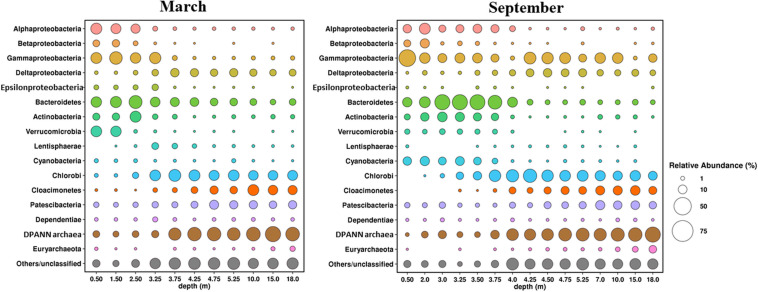
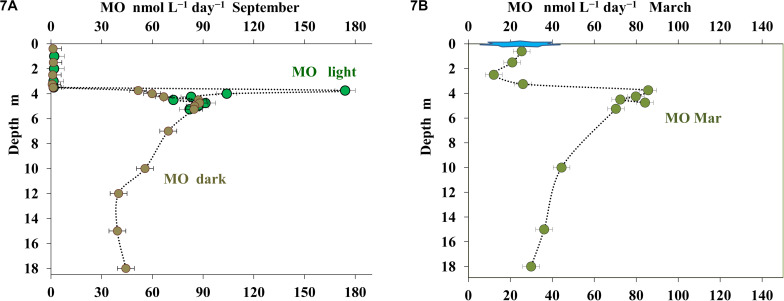
Microbiological, molecular ecological, biogeochemical, and isotope geochemical research was carried out at the polar Lake Bol'shie Khruslomeny at the coast of the Kandalaksha Bay, White Sea in March and September 2017. The uppermost mixolimnion was oxic, with low salinity (3-5%). The lower chemocline layer was brown-green colored, with very high content of particulate organic matter (up to 11.8 mg C L). The lowermost monimolimnion had marine salinity (22-24%) and very high concentrations of sulfide (up to 18 mmol L) and CH (up to 1.8 mmol L). In the chemocline, total microbial abundance and the rate of anoxygenic photosynthesis were 8.8 × 10 cells mL and 34.4 μmol C L day, respectively. Both in March and September, sulfate reduction rate increased with depth, peaking (up to 0.6-1.1 μmol S L day) in the lower chemocline. Methane oxidation rates in the chemocline were up to 85 and 180 nmol CH L day in March and September, respectively; stimulation of this process by light was observed in September. The percentages of cyanobacteria and methanotrophs in the layer where light-induced methane oxidation occurred were similar, ∼2.5% of the microbial community. Light did not stimulate methane oxidation in deeper layers. The carbon isotope composition of particulate organic matter (δC-Corg), dissolved carbonates (δC-DIC), and methane (δC- CH) indicated high microbial activity in the chemocline. Analysis of the 16S rRNA gene sequences revealed predominance of Cyanobium cyanobacteria (order Synechococcales) in the mixolimnion. Green sulfur bacteria capable of anoxygenic photosynthesis constituted ∼20% of the chemocline community both in March and in September. (family Methylomonaceae) were present in the upper chemocline, where active methane oxidation occurred. During winter, cyanobacteria were less abundant in the chemocline, while methanotrophs occurred in higher horizons, including the under-ice layer. Chemolithotrophic gammaproteobacteria of the genus Thiomicrorhabdus, oxidizing reduced sulfur compounds at low oxygen concentrations, were revealed in the chemocline in March. Both in March and September archaea constituted up to 50% of all microorganisms in the hypolimnion. The percentage of putative methanogens in the archaeal community was low, and they occurred mainly in near-bottom horizons.
2017年3月和9月,在白海坎达拉克沙湾海岸的极地大赫鲁斯洛梅尼湖开展了微生物学、分子生态学、生物地球化学和同位素地球化学研究。最上层的混合湖层为有氧环境,盐度较低(3 - 5%)。下层的化学跃层呈棕绿色,颗粒有机物含量极高(高达11.8毫克碳/升)。最下层的静水层具有海洋盐度(22 - 24%),硫化物浓度极高(高达18毫摩尔/升),甲烷浓度也很高(高达1.8毫摩尔/升)。在化学跃层中,微生物总丰度和无氧光合作用速率分别为8.8×10⁶个细胞/毫升和34.4微摩尔碳/升·天。在3月和9月,硫酸盐还原速率均随深度增加,在下层化学跃层达到峰值(高达0.6 - 1.1微摩尔硫/升·天)。化学跃层中的甲烷氧化速率在3月和9月分别高达85和180纳摩尔甲烷/升·天;9月观察到光照对该过程有促进作用。在光照诱导甲烷氧化发生的层中,蓝细菌和甲烷氧化菌的比例相似,约占微生物群落的2.5%。光照对更深层的甲烷氧化没有促进作用。颗粒有机物(δ¹³C - Corg)、溶解碳酸盐(δ¹³C - DIC)和甲烷(δ¹³C - CH₄)的碳同位素组成表明化学跃层中微生物活性较高。对16S rRNA基因序列的分析显示,混合湖层中蓝藻属蓝细菌(聚球藻目)占优势。能够进行无氧光合作用的绿硫细菌在3月和9月均占化学跃层群落的约20%。甲基单胞菌科(Methylomonaceae)存在于上层化学跃层中,该层发生活跃的甲烷氧化。冬季,化学跃层中的蓝细菌数量较少,而甲烷氧化菌出现在更高的水层,包括冰层下。3月在化学跃层中发现了硫微螺菌属(Thiomicrorhabdus)的化能自养γ - 变形菌,它们在低氧浓度下氧化还原态硫化合物。3月和9月,古菌在湖下层中均占所有微生物的50%。古菌群落中假定产甲烷菌的比例较低,它们主要出现在近底部水层。