Univ. Lille, Inserm, CHU Lille, Institut Pasteur de Lille, U1011- EGID, Lille, France.
Front Endocrinol (Lausanne). 2021 Feb 25;12:630536. doi: 10.3389/fendo.2021.630536. eCollection 2021.
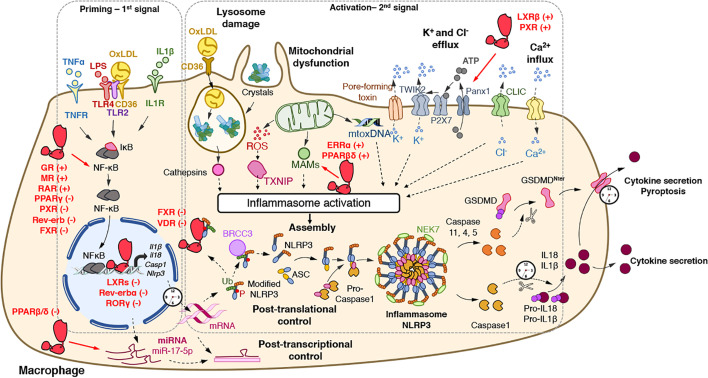
The innate immune system is the first line of defense specialized in the clearing of invaders whether foreign elements like microbes or self-elements that accumulate abnormally including cellular debris. Inflammasomes are master regulators of the innate immune system, especially in macrophages, and are key sensors involved in maintaining cellular health in response to cytolytic pathogens or stress signals. Inflammasomes are cytoplasmic complexes typically composed of a sensor molecule such as NOD-Like Receptors (NLRs), an adaptor protein including ASC and an effector protein such as caspase 1. Upon stimulation, inflammasome complex components associate to promote the cleavage of the pro-caspase 1 into active caspase-1 and the subsequent activation of pro-inflammatory cytokines including IL-18 and IL-1β. Deficiency or overactivation of such important sensors leads to critical diseases including Alzheimer diseases, chronic inflammatory diseases, cancers, acute liver diseases, and cardiometabolic diseases. Inflammasomes are tightly controlled by a two-step activation regulatory process consisting in a priming step, which activates the transcription of inflammasome components, and an activation step which leads to the inflammasome complex formation and the subsequent cleavage of pro-IL1 cytokines. Apart from the NF-B pathway, nuclear receptors have recently been proposed as additional regulators of this pathway. This review will discuss the role of nuclear receptors in the control of the NLRP3 inflammasome and the putative beneficial effect of new modulators of inflammasomes in the treatment of inflammatory diseases including colitis, fulminant hepatitis, cardiac ischemia-reperfusion and brain diseases.
固有免疫系统是专门清除外来入侵物(包括微生物或异常积累的细胞碎片等自身元素)的第一道防线。炎性小体是固有免疫系统的主要调节因子,特别是在巨噬细胞中,是参与维持细胞健康的关键传感器,可响应细胞溶解病原体或应激信号。炎性小体是通常由传感器分子(如 NOD 样受体(NLRs))、衔接蛋白(包括 ASC)和效应蛋白(如 caspase 1)组成的细胞质复合物。在受到刺激后,炎性小体复合物成分结合在一起,促进前胱天蛋白酶 1 切割为活性胱天蛋白酶 1,并随后激活包括 IL-18 和 IL-1β在内的促炎细胞因子。这些重要传感器的缺乏或过度激活会导致严重疾病,包括阿尔茨海默病、慢性炎症性疾病、癌症、急性肝病和心血管代谢疾病。炎性小体的激活受到两步激活调控过程的严格控制,包括激活炎性小体成分转录的初始步骤,以及导致炎性小体复合物形成和随后切割前 IL1 细胞因子的激活步骤。除了 NF-B 途径外,核受体最近被提议作为该途径的额外调节剂。这篇综述将讨论核受体在 NLRP3 炎性小体控制中的作用,以及炎性小体新调节剂在治疗炎症性疾病(包括结肠炎、暴发性肝炎、心脏缺血再灌注和脑部疾病)中的潜在有益作用。