Lai Xiaowei, Li Qian, Wu Fang, Lin Jiechun, Chen Jiekai, Zheng Hui, Guo Lin
CAS Key Laboratory of Regenerative Biology, Guangzhou Institutes of Biomedicine and Health, Chinese Academy of Sciences, Guangzhou, China.
Bioland Laboratory (Guangzhou Regenerative Medicine and Health Guangdong Laboratory), Guangzhou, China.
Front Cell Dev Biol. 2020 Aug 6;8:760. doi: 10.3389/fcell.2020.00760. eCollection 2020.
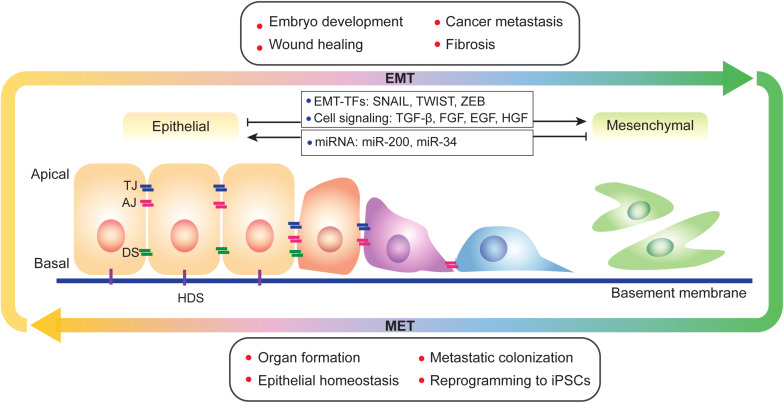
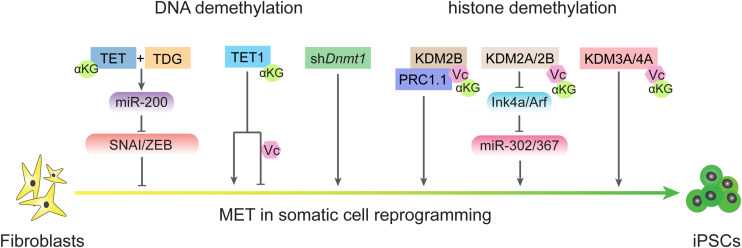
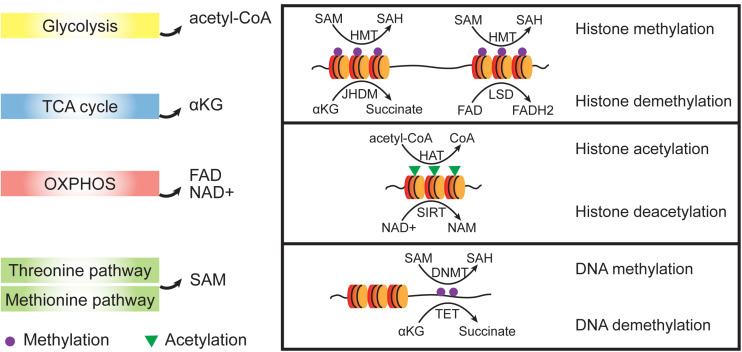
Epithelial-mesenchymal transition (EMT) and its critical roles during cancer progression have long been recognized and extensively reviewed. Recent studies on the generation of induced pluripotent stem cells (iPSCs) have established the connections among EMT, energy metabolism, DNA methylation, and histone modification. Since energy metabolism, DNA methylation, and histone modification are important for cancer development and there are common characteristics between cancer cells and stem cells, it is reasonable to identify mechanisms that have been established during both reprogramming and cancer progression. In the current review, we start from a brief review on EMT and related processes during cancer progression, and then switch to the EMT during somatic cell reprogramming. We summarize the connection between EMT and metabolic switch during reprogramming, and further review the involvements of DNA methylation and cell proliferation. The connections between EMT and mesenchymal-epithelial transition (MET) and cellular aspects including DNA methylation, histone modification and energy metabolism may provide potential new targets for cancer diagnosis and treatment.
上皮-间质转化(EMT)及其在癌症进展过程中的关键作用早已得到认可,并被广泛综述。最近关于诱导多能干细胞(iPSC)生成的研究已经建立了EMT、能量代谢、DNA甲基化和组蛋白修饰之间的联系。由于能量代谢、DNA甲基化和组蛋白修饰对癌症发展很重要,并且癌细胞和干细胞之间存在共同特征,因此确定在重编程和癌症进展过程中都已建立的机制是合理的。在当前的综述中,我们首先简要回顾一下癌症进展过程中的EMT及相关过程,然后转向体细胞重编程过程中的EMT。我们总结了重编程过程中EMT与代谢转换之间的联系,并进一步综述了DNA甲基化和细胞增殖的参与情况。EMT与间质-上皮转化(MET)之间的联系以及包括DNA甲基化、组蛋白修饰和能量代谢在内的细胞方面可能为癌症诊断和治疗提供潜在的新靶点。