Hidru Hagos Degefa, Berwo Mengesha Meresa, Hailesilassie Yared, Tekulu Welay Fissaha
College of Medicine and Health Sciences, Department of Public Health, Adigrat University, Adigrat, Ethiopia.
College of Medicine and Health Sciences, Department of Midwifery, Adigrat University, Adigrat, Ethiopia.
J Nutr Metab. 2020 Aug 14;2020:1272393. doi: 10.1155/2020/1272393. eCollection 2020.
Inadequate dietary diversity intake during pregnancy results in increased risks of negative maternal and perinatal outcomes. About one million neonates die on the first day of life due to inadequate dietary intake during pregnancy as a result of maternal complication and adverse birth outcomes. This review summarizes the burden of inadequate dietary diversity and its determinants among pregnant women at the national level of Ethiopia.
Studies were retrieved from selected electronic databases, including PubMed, Cochrane Library, and Google Scholar. Random-effects model meta-analysis was used to estimate the pooled burden of inadequate dietary diversity and its determinants at a 95% confidence interval with its respective odds ratio (OR) using statistical R-software version 3.6.1. Moreover, quality appraisal of the included studies, publication bias, and level of heterogeneity were checked with subgroup analysis and sensitivity influential test. The searches were restricted to articles published in the English language only, and Medical Subject Headings (MeSH terms) was used to help expand the search in advanced PubMed search.
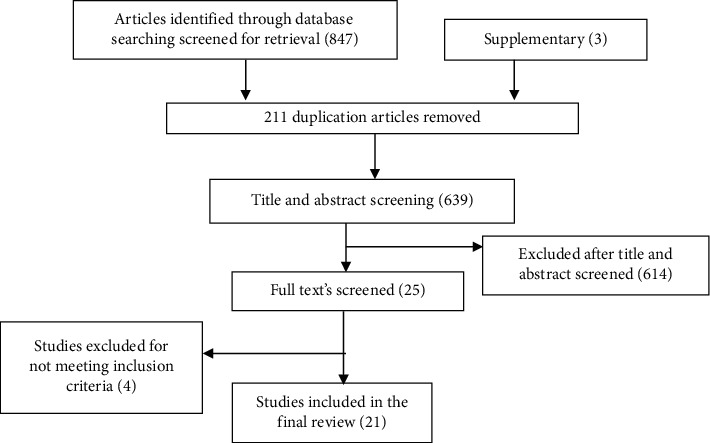
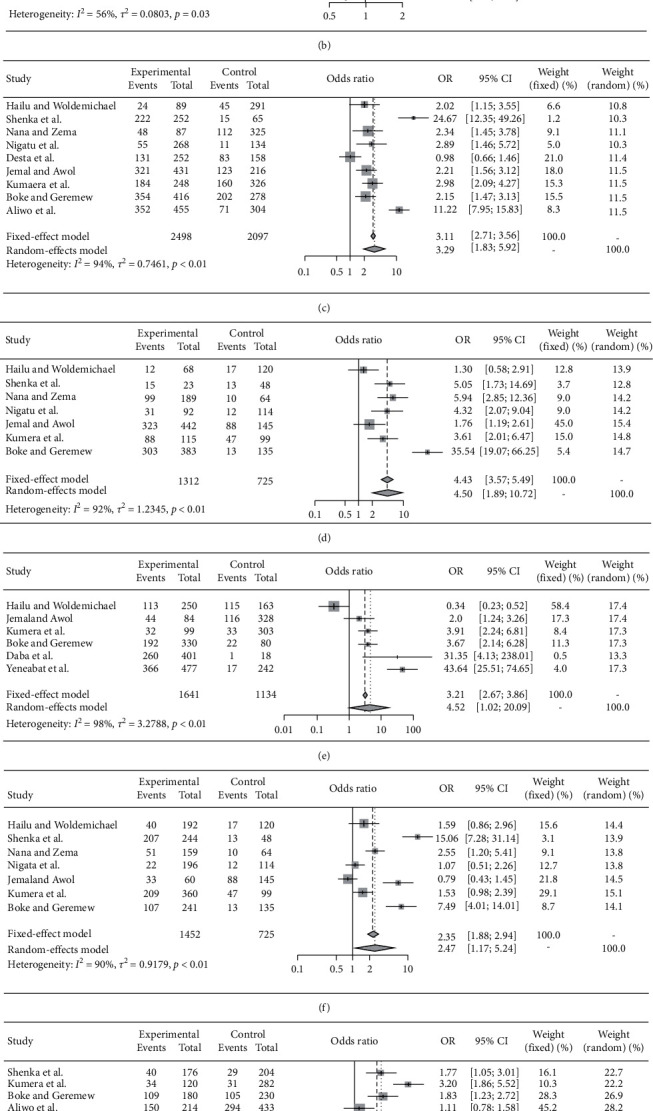
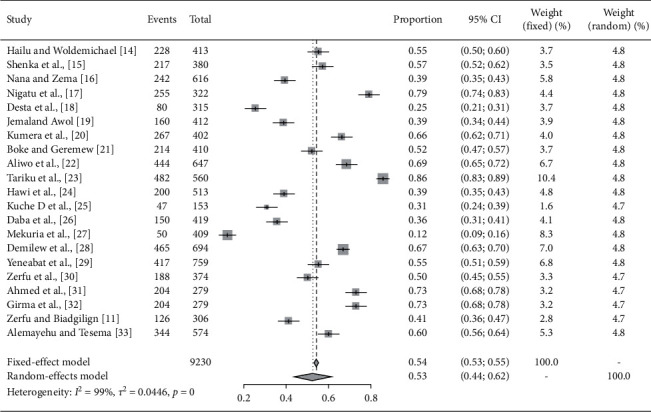
A total of 850 articles were identified through the initial search of which 21 studies were included in the final review yielding a total sample size of 9,230 pregnant women. The pooled prevalence of inadequate dietary diversity was 53% (95% CI: 44%, 62%). Food insecurity [AOR = 2.18, (95% CI: 1.02, 4.63)], family size of greater than four [AOR = 1.46, (95% CI: 1.10, 1.95)], rural residence [AOR = 4.52, (95% CI: 1.02, 20.09)], no formal educational status [AOR = 4.50, (95% CI: 1.02, 20.09)], and a lack of counseling about dietary diversity [AOR = 2.75, (95% CI: 2.17, 3.48)] were among the significantly associated factors for inadequate dietary diversity.
In this review, there was a high prevalence of inadequate dietary diversity among pregnant women at the national level in Ethiopia. Therefore, strengthening early counseling and diagnosis of dietary intake and undernutrition during the antenatal care period is important.
孕期饮食多样性摄入不足会增加孕产妇和围产期出现不良后果的风险。由于孕产妇并发症和不良分娩结局导致孕期饮食摄入不足,约有100万新生儿在出生第一天死亡。本综述总结了埃塞俄比亚全国范围内孕妇饮食多样性不足的负担及其决定因素。
从选定的电子数据库中检索研究,包括PubMed、Cochrane图书馆和谷歌学术。使用随机效应模型荟萃分析,通过统计R软件3.6.1版本,在95%置信区间内估计饮食多样性不足及其决定因素的合并负担及其各自的比值比(OR)。此外,通过亚组分析和敏感性影响测试检查纳入研究的质量评估、发表偏倚和异质性水平。搜索仅限于仅以英文发表的文章,并使用医学主题词(MeSH词)来帮助在高级PubMed搜索中扩展搜索范围。
通过初步搜索共识别出850篇文章,其中21项研究纳入最终综述,总样本量为9230名孕妇。饮食多样性不足的合并患病率为53%(95%CI:44%,62%)。粮食不安全[AOR = 2.18,(95%CI:1.02,4.63)]、家庭规模大于四人[AOR = 1.46,(95%CI:1.10,1.95)]、农村居住[AOR = 4.52,(95%CI:1.02,20.09)]、未接受正规教育[AOR = 4.50,(95%CI:1.02,20.09)]以及缺乏饮食多样性咨询[AOR = 2.75,(95%CI:2.17,3.48)]是饮食多样性不足的显著相关因素。
在本综述中,埃塞俄比亚全国范围内孕妇饮食多样性不足的患病率很高。因此,在产前护理期间加强对饮食摄入和营养不良的早期咨询和诊断非常重要。