Department of Pathology, 74647The Affiliated Hospital of Southwest Medical University, Luzhou, People's Republic of China.
Department of Oncology, 74647The Affiliated hospital of Southwest Medical University, Luzhou, People's Republic of China.
Technol Cancer Res Treat. 2020 Jan-Dec;19:1533033820942298. doi: 10.1177/1533033820942298.
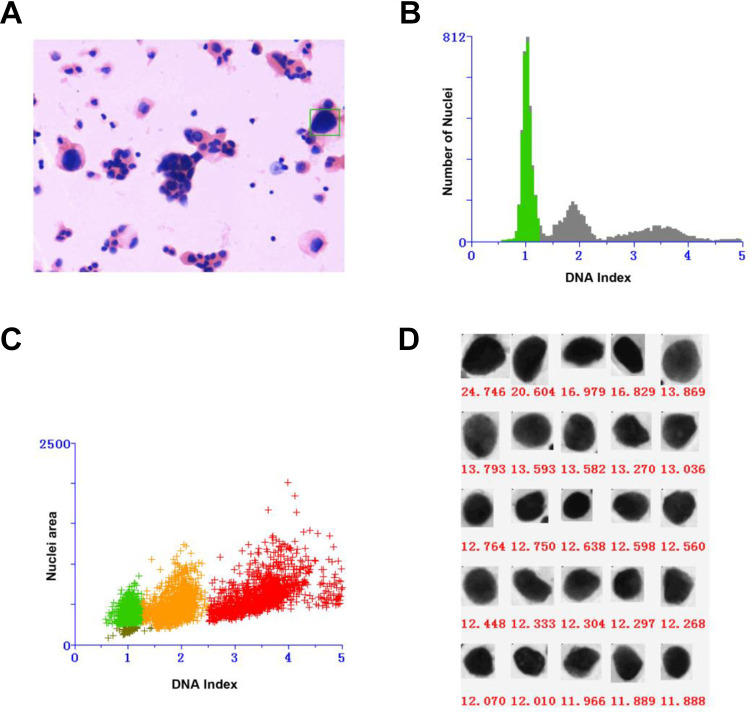
Liquid-based cytology is one of the most useful methods to diagnose a patient with serous effusion, especially when malignancy is suspected. As an alternative to the use of liquid-based cytology only, the serous effusion can be further processed using the technique of DNA image cytometry, which may augment diagnostic utility. The aim of this study was to compare the diagnostic yields of liquid-based cytology, DNA image cytometry, and both in combination, regardless of serous-effusion etiology.
We conducted a descriptive study on patients with serous effusions from July 2016 to June 2018. All samples were submitted for liquid-based cytology and DNA image cytometry techniques. We compared the results of cytopathological studies to the final diagnoses.
For a total of 798 samples, final diagnoses included 412 (51.6%) malignancies, 280 (35.1.%) inflammatory diseases, and 106 (13.3%) transudative serous effusions. Liquid-based cytology had a more sensitive diagnostic yield than DNA image cytometry did (38.8% vs 30.7%; < .05), but the combination of both had a higher yield (43.7%; < .05) compared with that of liquid-based cytology alone. For the 412 malignant serous effusions, diagnostic yields of liquid-based cytology and DNA image cytometry were 73.8% and 59.5%, respectively. The difference in sensitivity was significant ( < .05). Combined liquid-based cytology + DNA image cytometry improved diagnostic yield to 83.3% ( < .05). However, both liquid-based cytology and DNA image cytometry had low diagnostic yields for inflammatory diseases and transudative serous effusions.
In serous effusion, liquid-based cytology's diagnostic performance is better than that of DNA image cytometry. Application of both techniques can significantly increase diagnostic yield.
液基细胞学是诊断浆膜腔积液患者的最有用方法之一,尤其是在怀疑恶性肿瘤时。作为仅使用液基细胞学的替代方法,可以使用 DNA 图像细胞术进一步处理浆膜腔积液,这可能会增加诊断的实用性。本研究的目的是比较液基细胞学、DNA 图像细胞术以及两者联合应用在诊断浆膜腔积液中的诊断效果,而不考虑浆膜腔积液的病因。
我们对 2016 年 7 月至 2018 年 6 月期间患有浆膜腔积液的患者进行了描述性研究。所有样本均进行液基细胞学和 DNA 图像细胞术检查。我们将细胞学研究结果与最终诊断进行比较。
共有 798 例样本,最终诊断包括 412 例(51.6%)恶性肿瘤、280 例(35.1%)炎症性疾病和 106 例(13.3%)渗出性浆膜腔积液。液基细胞学的诊断敏感性高于 DNA 图像细胞术(38.8% vs 30.7%; <.05),但两者联合应用的诊断敏感性更高(43.7%; <.05),高于单独使用液基细胞学。对于 412 例恶性浆膜腔积液,液基细胞学和 DNA 图像细胞术的诊断敏感性分别为 73.8%和 59.5%,差异有统计学意义( <.05)。联合应用液基细胞学+DNA 图像细胞术可提高诊断敏感性至 83.3%( <.05)。然而,液基细胞学和 DNA 图像细胞术对炎症性疾病和渗出性浆膜腔积液的诊断敏感性均较低。
在浆膜腔积液中,液基细胞学的诊断性能优于 DNA 图像细胞术。联合应用两种技术可显著提高诊断敏感性。