Department of Neurology, Xinhua Hospital Affiliated to Shanghai Jiao Tong University School of Medicine, 1665 Kong jiang Road, Shanghai, 200092, People's Republic of China.
Ann Clin Transl Neurol. 2020 Sep;7(9):1692-1701. doi: 10.1002/acn3.51159. Epub 2020 Aug 28.
The objective of this study was to assess the relationship between white matter hyperintensities (WMH) and the occurrence and progression of apathy in Parkinson's disease (PD).
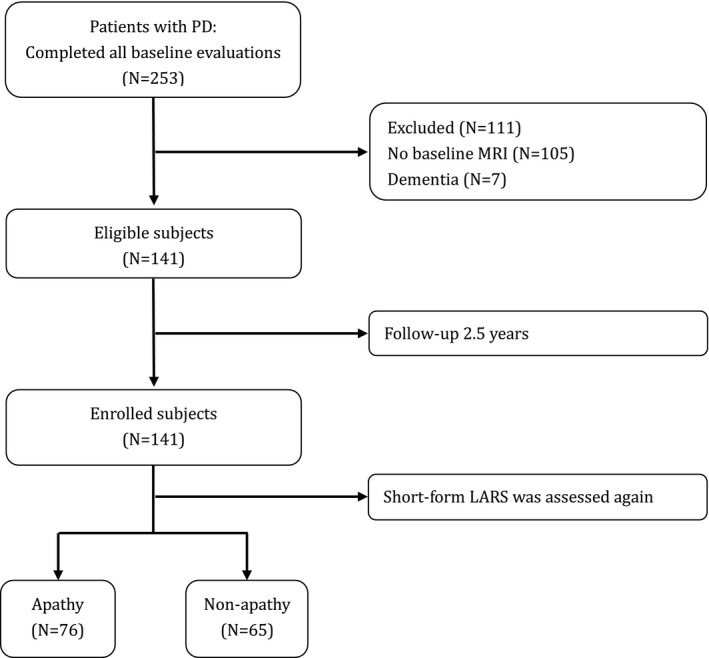
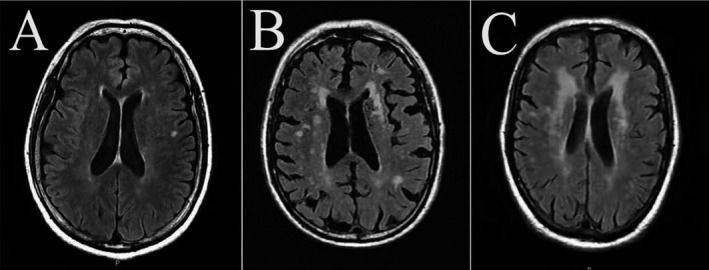
We recruited patients with PD who underwent baseline evaluation, which included apathy assessment and magnetic resonance imaging (MRI) head scans. After 2.5 years of follow-up, we re-evaluated patient apathy symptoms. The severity and location of WMH were assessed with fluid-attenuated inversion recovery (FLAIR) sequences using the Fazekas visual rating scale. Logistic regression and linear regression analyses of baseline WMH characteristics were conducted to explore the potential association between apathy and WMH.
A total of 141 PD patients were recruited. The apathy group had a higher proportion of male patients, advanced disease, and depression, which was coupled with a lower quality of life. Morever, higher WMH severity was significantly associated with apathy. Logistic regression analyses demonstrated that WMH severity was a risk factor for apathy. In addition, linear regression analysis also suggests that apathy severity is positively correlated with baseline WMH Fazekas scales (ϐ = 0.959, P < 0.001). Baseline WMH severity was also a risk factor for apathy progression.
WMH is associated with apathy and could be a promising marker to predict apathy progression in PD.
本研究旨在评估帕金森病(PD)患者脑白质高信号(WMH)与淡漠发生和进展之间的关系。
我们招募了接受基线评估的 PD 患者,其中包括淡漠评估和磁共振成像(MRI)头部扫描。经过 2.5 年的随访后,我们重新评估了患者的淡漠症状。采用液体衰减反转恢复(FLAIR)序列,使用 Fazekas 视觉评分量表评估 WMH 的严重程度和位置。对基线 WMH 特征进行逻辑回归和线性回归分析,以探讨淡漠与 WMH 之间的潜在关联。
共纳入 141 例 PD 患者。淡漠组男性患者比例较高,疾病进展程度较高,且抑郁症状较为明显,生活质量较低。此外,较高的 WMH 严重程度与淡漠显著相关。逻辑回归分析表明,WMH 严重程度是淡漠的危险因素。此外,线性回归分析还表明,淡漠严重程度与基线 WMH Fazekas 量表呈正相关(β=0.959,P<0.001)。基线 WMH 严重程度也是淡漠进展的危险因素。
WMH 与淡漠有关,可能是预测 PD 患者淡漠进展的有前途的标志物。