Department of Pathology, University of Pittsburgh, 200 Lothrop St, Pittsburgh, PA 15213, USA; Department of Pathology, University of Pittsburgh Medical Center, 3477 Euler Way, Pittsburgh, 15213 PA, USA.
Department of Pathology, University of Pittsburgh, 200 Lothrop St, Pittsburgh, PA 15213, USA.
Clin Biochem. 2020 Dec;86:8-14. doi: 10.1016/j.clinbiochem.2020.08.008. Epub 2020 Aug 26.
Humoral immune response to SARS-CoV-2 infection has been reported in several patient cohorts with results that vary by method and population studied due to the lack of reliable commercial assays available as the pandemic initially spread. We sought to clinically assess commercial prototype SARS-CoV-2 IgG and IgA assays for use in screening for prior infection and convalescent plasma donation.
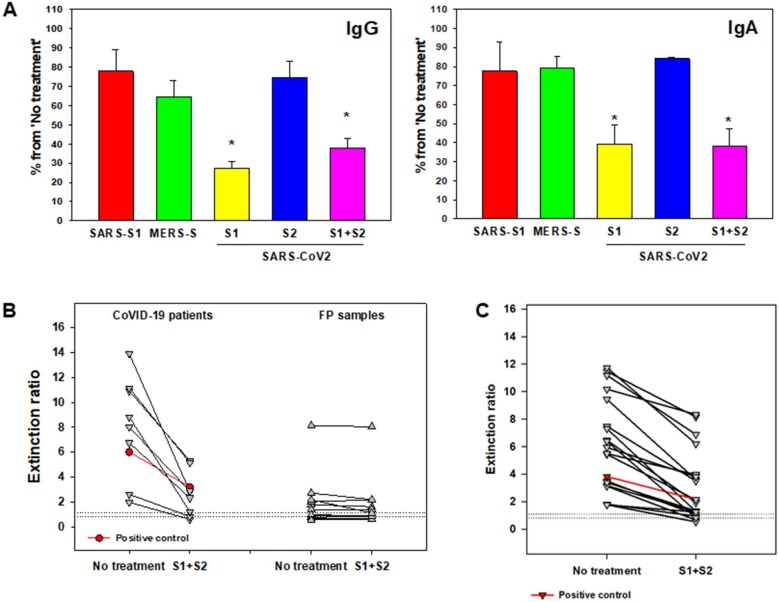
Prototype SARS-CoV-2 IgG and IgA assays from Euroimmun were assessed utilizing remnant specimens. Specificity testing used specimens in their convalescent window for the common coronaviruses and other infectious diseases known to be associated with increased non-specificity in serologic assays. Sensitivity testing utilized serial specimens from molecularly confirmed SARS-CoV-2 critically ill patients to assess seroconversion. Utilizing recombinant spike protein we also developed a competitive confirmation procedure to increase assay specificity.
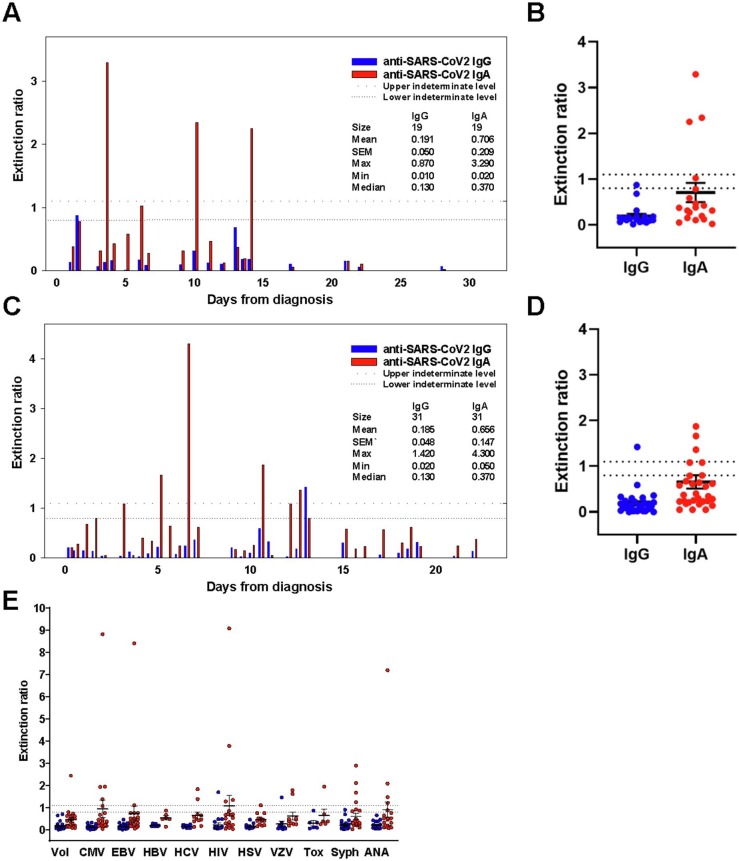
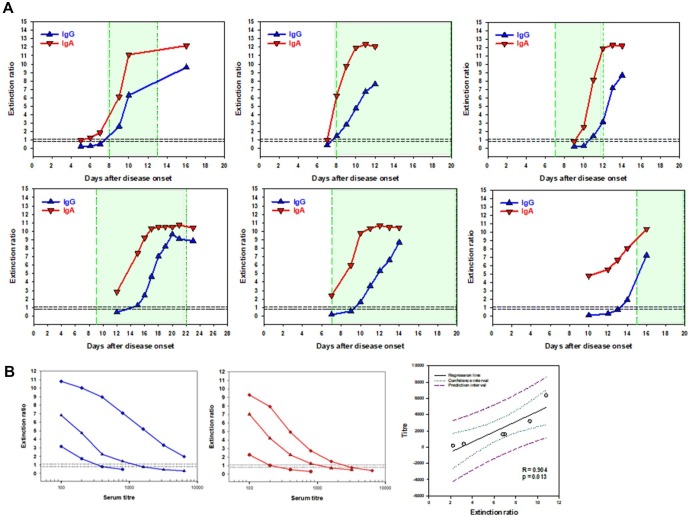
We determined specificity to be 97% and 81%, respectively, when indeterminate samples were considered positive and 99% and 86% when indeterminate samples were considered negative. We developed a new confirmation methodology to enhance the specificity of the assays with an anticipated specificity of 98% for IgA. Valuation of hospitalized COVID-19 patients determined median IgA seroconversion to be 8 days and IgG 10 days. Neither level nor timing of antibody response correlated with days on ventilation. End titer measurements indicate that validated improved assays may be capable of semi-quantitative measurement.
We found these assays to be clinically acceptable for the high prevalence population tested, for instance, for convalescent plasma donation.
在多个患者队列中报告了针对 SARS-CoV-2 感染的体液免疫反应,但由于最初大流行期间缺乏可靠的商业检测方法,由于缺乏可靠的商业检测方法,因此由于方法和研究人群的不同,研究结果也有所不同。我们试图临床评估用于筛查既往感染和恢复期血浆捐献的商业原型 SARS-CoV-2 IgG 和 IgA 检测。
利用剩余标本评估了 Euroimmun 的原型 SARS-CoV-2 IgG 和 IgA 检测。特异性测试使用恢复期窗口内的标本,用于常见的冠状病毒和其他已知与血清学检测中增加非特异性相关的传染病。敏感性测试利用分子确认的 SARS-CoV-2 危重症患者的连续标本来评估血清转化。利用重组刺突蛋白,我们还开发了一种竞争性确认程序来提高检测的特异性。
当将不确定样本视为阳性时,我们分别确定特异性为 97%和 81%,而当将不确定样本视为阴性时,特异性为 99%和 86%。我们开发了一种新的确认方法,以提高检测的特异性,预计 IgA 的特异性为 98%。对住院 COVID-19 患者的评估确定了 IgA 的中位数血清转化为 8 天,IgG 为 10 天。抗体反应的水平和时间均与通气天数无关。终末滴度测量表明,经过验证的改进检测方法可能能够进行半定量测量。
我们发现这些检测方法在我们所测试的高流行人群中具有临床可接受性,例如,用于恢复期血浆捐献。