Hospital Sírio-Libanês Blood Bank, São Paulo, Brazil.
Hospital Israelita Albert Einstein Blood Bank, São Paulo, Brazil.
Transfusion. 2020 Dec;60(12):2938-2951. doi: 10.1111/trf.16065. Epub 2020 Sep 16.
Coronavirus disease 2019 (COVID-19) convalescent plasma (CCP) collection began in two Brazilian hospitals for treatment of severe/critical patients.
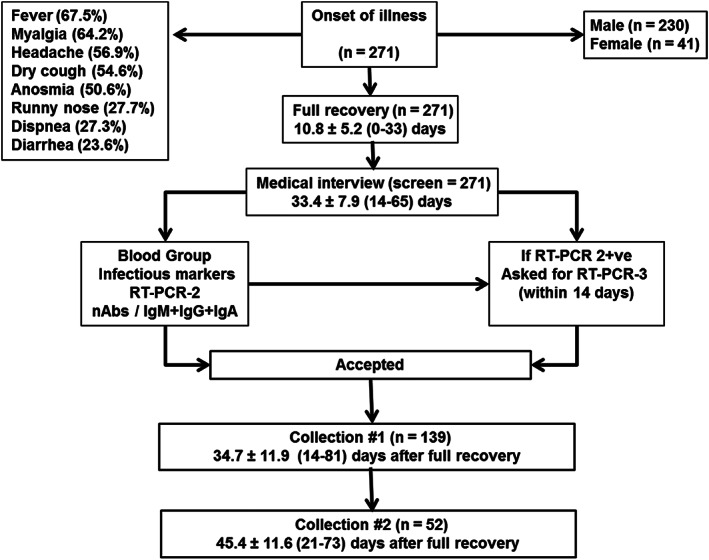
Mild/moderate COVID-19 convalescents were selected as CCP donors after reverse transcription polymerase chain reaction (RT-PCR) confirmed severe acute respiratory syndrome coronavirus 2 (SARS-CoV-2) infection and absence of symptoms for ≥14 days plus (a) age (18-60 years), body weight greater than 55 kg; (b) immunohematological studies; (c) no infectious markers of hepatitis B virus, hepatitis C virus, human immunodeficiency virus, human T-lymphotropic virus-1/2, Chagas and syphilis infection; (d) no HLA antibodies (multiparous); (e) second RT-PCR (nasopharyngeal swab and/or blood) negativity; (f) virus neutralization test (cytopathic effect-based virus neutralization test neutralizing antibody) and anti-nucleocapsid protein SARS-CoV-2 IgM, IgG, and IgA enzyme-linked immunosorbent assays.
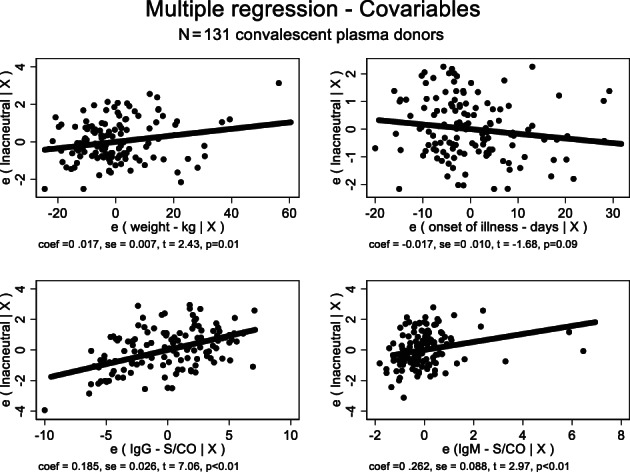
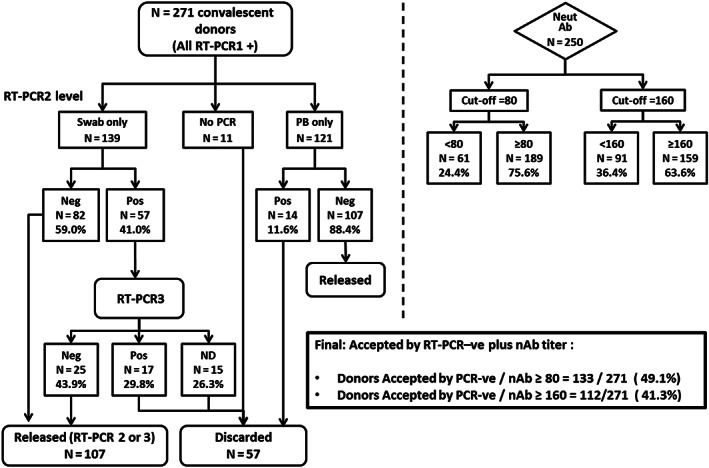
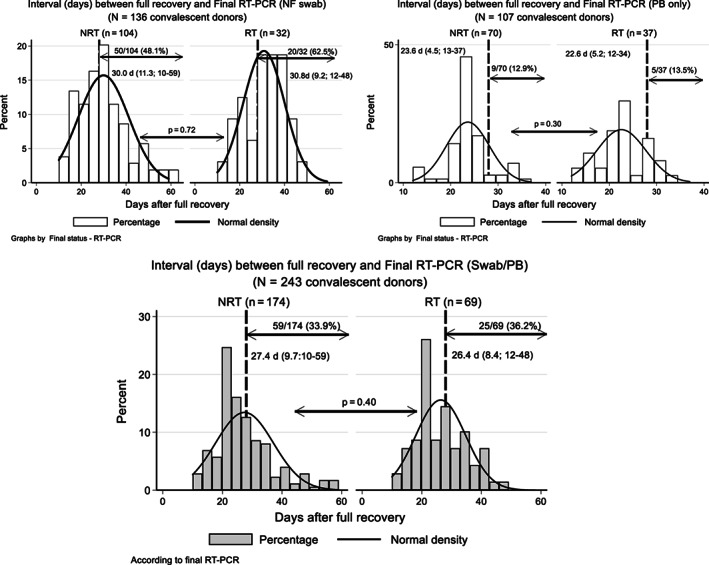
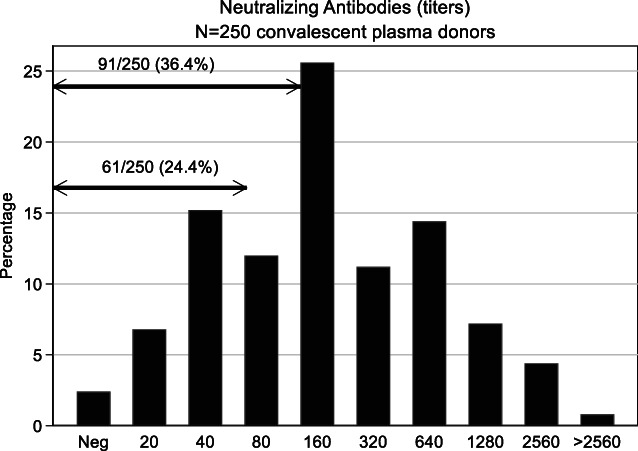
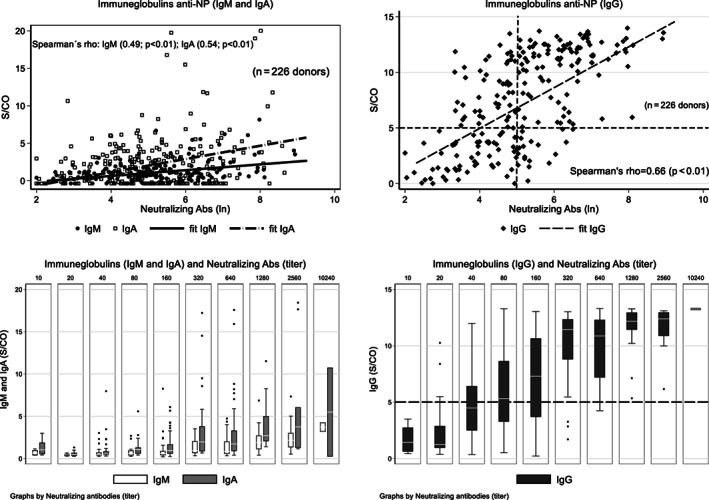
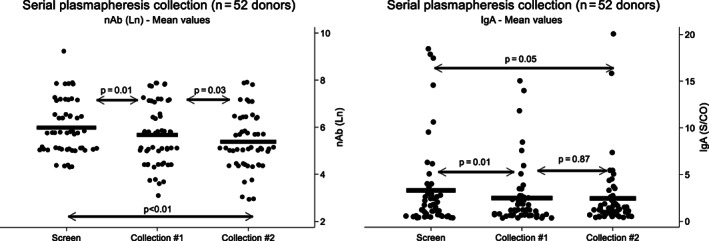
Among 271 donors (41 females, 230 males), 250 presented with neutralizing antibodies. Final RT-PCR was negative on swab (77.0%) or blood (88.4%; P = .46). Final definition of RT-PCR was only defined at more than 28 days after full recovery in 59 of 174 (33.9%) RT-PCR -ve, and 25/69 RT-PCR +ve (36.2%; 13 between 35 and 48 days). Neutralizing antibody titers of 160 or greater were found in 63.6%. Correlation between IgG signal/cutoff of 5.0 or greater and neutralizing antibody of 160 or greater was 82.4%. Combination of final RT-PCR -ve with neutralizing antibody ≥160 was 41.3% (112/271). Serial plasma collection showed decline in neutralizing antibody titers and IgA levels (P < .05), probably denoting a "golden period" for CCP collection (≤28 days after joining the program); IgA might have an important role as neutralizing antibody. Donor's weight, days between disease onset and serial plasma collection, and IgG and IgM levels are important predictors for neutralizing antibody titer.
RT-PCR +ve cases are still detected in 36.2% within 28 to 48 days after recovery. High anti-nucleocapsid protein IgG levels may be used as a surrogate marker to neutralizing antibody.
为治疗重症/危重症患者,巴西的两家医院开始采集 2019 年冠状病毒病(COVID-19)恢复期血浆(CCP)。
经逆转录聚合酶链反应(RT-PCR)确认严重急性呼吸综合征冠状病毒 2(SARS-CoV-2)感染和症状消失后≥14 天,选择轻症/中度 COVID-19 康复者作为 CCP 供体,且满足以下条件:(a)年龄(18-60 岁),体重>55kg;(b)免疫血液学检查;(c)无乙型肝炎病毒、丙型肝炎病毒、人类免疫缺陷病毒、人嗜 T 淋巴细胞病毒 1/2、恰加斯病和梅毒感染的传染性标志物;(d)无 HLA 抗体(多胎);(e)第 2 次 RT-PCR(鼻咽拭子和/或血液)阴性;(f)病毒中和试验(基于细胞病变效应的病毒中和试验中和抗体)和抗核衣壳蛋白 SARS-CoV-2 IgM、IgG 和 IgA 酶联免疫吸附试验。
在 271 名供体(41 名女性,230 名男性)中,有 250 名具有中和抗体。最终 RT-PCR 拭子(77.0%)或血液(88.4%;P=0.46)均为阴性。174 名最终 RT-PCR 阴性者中,59 名(33.9%)在完全康复后 28 天以上才定义为 RT-PCR 阴性,69 名 RT-PCR 阳性者中,25 名(36.2%;35-48 天内 13 名)为 RT-PCR 阳性(P=0.46)。发现中和抗体滴度≥160 的有 63.6%。IgG 信号/截取值≥5.0 与中和抗体≥160 的相关性为 82.4%。最终 RT-PCR 阴性和中和抗体≥160 的联合率为 41.3%(112/271)。连续采集血浆显示中和抗体滴度和 IgA 水平下降(P<0.05),可能提示 CCP 采集的“黄金时期”为≤28 天加入项目后;IgA 可能在中和抗体中发挥重要作用。供体体重、疾病发作与连续采集血浆之间的天数以及 IgG 和 IgM 水平是中和抗体滴度的重要预测因素。
在康复后 28-48 天内,仍有 36.2%的病例 RT-PCR 阳性。高抗核衣壳蛋白 IgG 水平可作为中和抗体的替代标志物。