Heart and Vascular Institute, John W. Deming Department of Medicine, Tulane University School of Medicine, 1430 Tulane Ave SL-48, New Orleans, LA 70112, USA.
Department of Physiology, Tulane University School of Medicine, 1430 Tulane Ave, New Orleans, LA 70112, USA.
Cells. 2020 Aug 26;9(9):1970. doi: 10.3390/cells9091970.
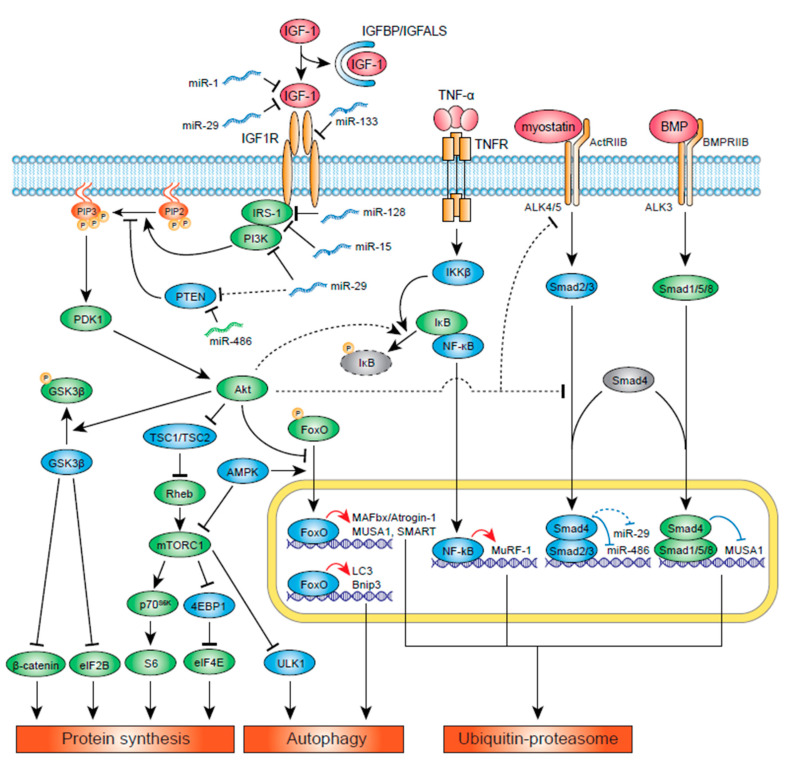
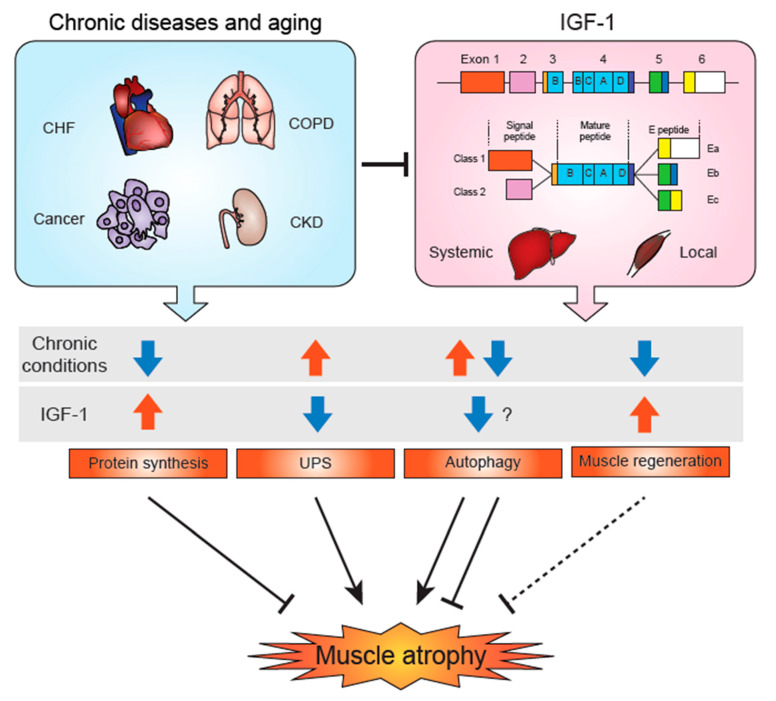
Insulin-like growth factor-1 (IGF-1) is a key growth factor that regulates both anabolic and catabolic pathways in skeletal muscle. IGF-1 increases skeletal muscle protein synthesis via PI3K/Akt/mTOR and PI3K/Akt/GSK3β pathways. PI3K/Akt can also inhibit FoxOs and suppress transcription of E3 ubiquitin ligases that regulate ubiquitin proteasome system (UPS)-mediated protein degradation. Autophagy is likely inhibited by IGF-1 via mTOR and FoxO signaling, although the contribution of autophagy regulation in IGF-1-mediated inhibition of skeletal muscle atrophy remains to be determined. Evidence has suggested that IGF-1/Akt can inhibit muscle atrophy-inducing cytokine and myostatin signaling via inhibition of the NF-κΒ and Smad pathways, respectively. Several miRNAs have been found to regulate IGF-1 signaling in skeletal muscle, and these miRs are likely regulated in different pathological conditions and contribute to the development of muscle atrophy. IGF-1 also potentiates skeletal muscle regeneration via activation of skeletal muscle stem (satellite) cells, which may contribute to muscle hypertrophy and/or inhibit atrophy. Importantly, IGF-1 levels and IGF-1R downstream signaling are suppressed in many chronic disease conditions and likely result in muscle atrophy via the combined effects of altered protein synthesis, UPS activity, autophagy, and muscle regeneration.
胰岛素样生长因子-1(IGF-1)是一种关键的生长因子,可调节骨骼肌中的合成代谢和分解代谢途径。IGF-1 通过 PI3K/Akt/mTOR 和 PI3K/Akt/GSK3β途径增加骨骼肌蛋白合成。PI3K/Akt 还可以抑制 FoxOs 并抑制调节泛素蛋白酶体系统(UPS)介导的蛋白降解的 E3 泛素连接酶的转录。IGF-1 通过 mTOR 和 FoxO 信号可能抑制自噬,尽管自噬调节在 IGF-1 介导的骨骼肌萎缩抑制中的作用仍有待确定。有证据表明,IGF-1/Akt 可以通过抑制 NF-κB 和 Smad 途径分别抑制肌肉萎缩诱导细胞因子和肌肉生长抑制素信号。已经发现几种 miRNA 可以调节骨骼肌中的 IGF-1 信号,并且这些 miR 可能在不同的病理条件下受到调节,并有助于肌肉萎缩的发展。IGF-1 还通过激活骨骼肌干细胞(卫星细胞)来增强骨骼肌再生,这可能有助于肌肉肥大和/或抑制萎缩。重要的是,许多慢性疾病条件下 IGF-1 水平和 IGF-1R 下游信号被抑制,并且可能通过改变蛋白合成、UPS 活性、自噬和肌肉再生的综合效应导致肌肉萎缩。