Department of Psychiatry and Mental Health, University of Cape Town, South Africa.
Department of Paediatrics and Child Health, Red Cross War Memorial Children's Hospital, University of Cape Town, South Africa; Neuroscience Institute, University of Cape Town, South Africa; Department of Clinical Research, London School of Hygiene & Tropical Medicine, London, UK.
Brain Behav Immun. 2021 Jan;91:65-73. doi: 10.1016/j.bbi.2020.08.021. Epub 2020 Aug 26.
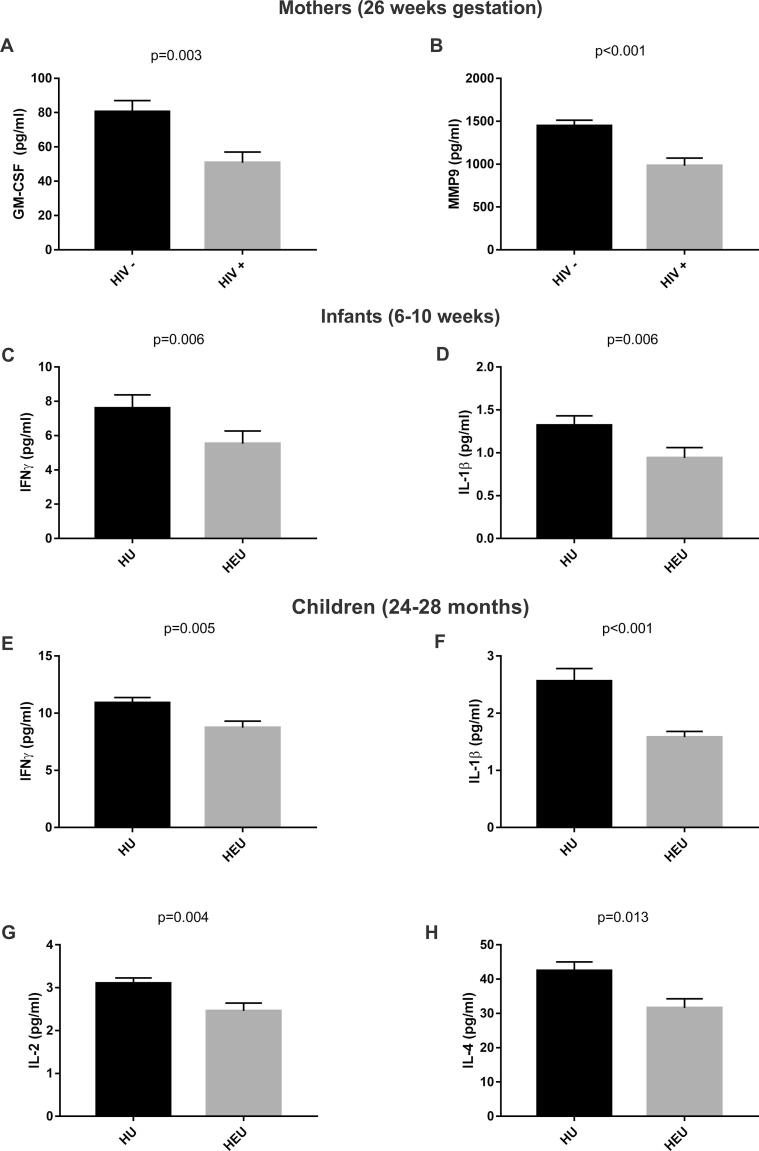
HIV-exposed uninfected (HEU) children may have altered immune regulation and poorer neurodevelopment outcomes compared to their HIV-unexposed (HU) counterparts. However, studies investigating the association of maternal and infant inflammation with neurodevelopment in HEU children are limited and longitudinal data are lacking. This study investigated serum inflammatory markers in women living with HIV vs. HIV-uninfected women during pregnancy and in their children, as well as associations with neurodevelopmental outcomes at two years of age in an African birth cohort study. A sub-group of mother-child dyads from the Drakenstein Child Health Study had serum inflammatory markers measured at ≈26 week's gestation (n = 77 HIV-infected mothers; n = 190 HIV-uninfected mothers), at 6-10 weeks (n = 63 HEU infants and n = 159 HU infants) and at 24-28 months (n = 77 HEU children and n = 190 HU children). Serum inflammatory markers [granulocyte-macrophage colony-stimulating factor (GM-CSF), interferon-γ (IFN-γ), interleukin IL-1β, IL-2, IL-4, IL-5, IL-6, IL-7, IL-8, IL-10, IL-12p70, IL-13, tumor necrosis factor-α (TNF-α), neutrophil gelatinase-associated lipocalin (NGAL) and metalloproteinase-9 (MMP-9)] were analyzed with a multiplex bead array and ELISA assays. The Bayley Scales of Infant and Toddler Development, third edition, was used to assess neurodevelopment at 24-28 months. After correcting for multiple comparisons, HIV infection during pregnancy was associated with lower serum levels of inflammatory markers in mothers at 26 weeks gestation (GM-CSF and MMP-9, p < 0.05) and HEU children at 6-10 weeks (IFN-γ and IL-1β, p < 0.01), and at 24-28 months (IFN-γ, IL-1β, IL-2 and IL-4, p < 0.05) compared to HIV-uninfected mothers and HU children. In HEU infants at 6-10 weeks, inflammatory markers (GM-CSF, IFN-γ, IL-10, IL-12p70, IL-1β, IL-2, IL-4, IL-6 and NGAL, all p < 0.05) were associated with poorer motor function at two years of age. This is the first study to evaluate the associations of follow-up immune markers in HEU children with neurodevelopment. These findings suggest that maternal HIV infection is associated with immune dysregulation in mothers and their children through two years of age. An altered immune system in HEU infants is associated with poorer follow-up motor neurodevelopment. These data highlight the important role of the immune system in early neurodevelopment and provide a foundation for future research.
HIV 暴露未感染(HEU)的儿童与未暴露于 HIV(HU)的儿童相比,其免疫调节可能发生改变,神经发育结局可能更差。然而,目前研究母婴炎症与 HEU 儿童神经发育关系的研究有限,且缺乏纵向数据。本研究在一个非洲出生队列研究中,调查了感染 HIV 的女性与未感染 HIV 的女性在怀孕期间及其子女血清中的炎症标志物,并调查了这些标志物与 2 岁时神经发育结局的相关性。Drakenstein 儿童健康研究的子组母亲-儿童对在妊娠约 26 周(n=77 名感染 HIV 的母亲;n=190 名未感染 HIV 的母亲)、6-10 周(n=63 名 HEU 婴儿;n=159 名 HU 婴儿)和 24-28 个月(n=77 名 HEU 儿童;n=190 名 HU 儿童)时进行了血清炎症标志物(粒巨噬细胞集落刺激因子(GM-CSF)、干扰素-γ(IFN-γ)、白细胞介素 IL-1β、IL-2、IL-4、IL-5、IL-6、IL-7、IL-8、IL-10、IL-12p70、IL-13、肿瘤坏死因子-α(TNF-α)、中性粒细胞明胶酶相关脂质运载蛋白(NGAL)和基质金属蛋白酶-9(MMP-9))的分析。采用多重珠粒阵列和 ELISA 检测法对血清炎症标志物进行分析。贝利婴幼儿发育量表,第三版,用于评估 24-28 个月的神经发育情况。在对多重比较进行校正后,发现与未感染 HIV 的母亲和 HU 儿童相比,孕妇在妊娠 26 周时(GM-CSF 和 MMP-9,p<0.05)和 HEU 儿童在 6-10 周时(IFN-γ和 IL-1β,p<0.01),以及在 24-28 个月时(IFN-γ、IL-1β、IL-2 和 IL-4,p<0.05)感染 HIV 与母亲血清中炎症标志物水平较低有关。在 6-10 周的 HEU 婴儿中,炎症标志物(GM-CSF、IFN-γ、IL-10、IL-12p70、IL-1β、IL-2、IL-4、IL-6 和 NGAL,均 p<0.05)与 2 岁时运动功能较差有关。这是第一项评估 HEU 儿童随访免疫标志物与神经发育关系的研究。这些发现表明,母婴 HIV 感染通过 2 岁时的免疫失调与儿童的免疫失调有关。HEU 婴儿的免疫系统改变与后续的运动神经发育较差有关。这些数据强调了免疫系统在早期神经发育中的重要作用,并为未来的研究提供了基础。