Department of Epidemiology, Rollins School of Public Health, Emory University, Atlanta, GA, USA.
Department of Epidemiology, Rollins School of Public Health, Emory University, Atlanta, GA, USA; Gangarosa Department of Environmental Health, Rollins School of Public Health, Emory University, Atlanta, GA, USA.
Environ Res. 2024 Jul 1;252(Pt 1):118822. doi: 10.1016/j.envres.2024.118822. Epub 2024 Mar 31.
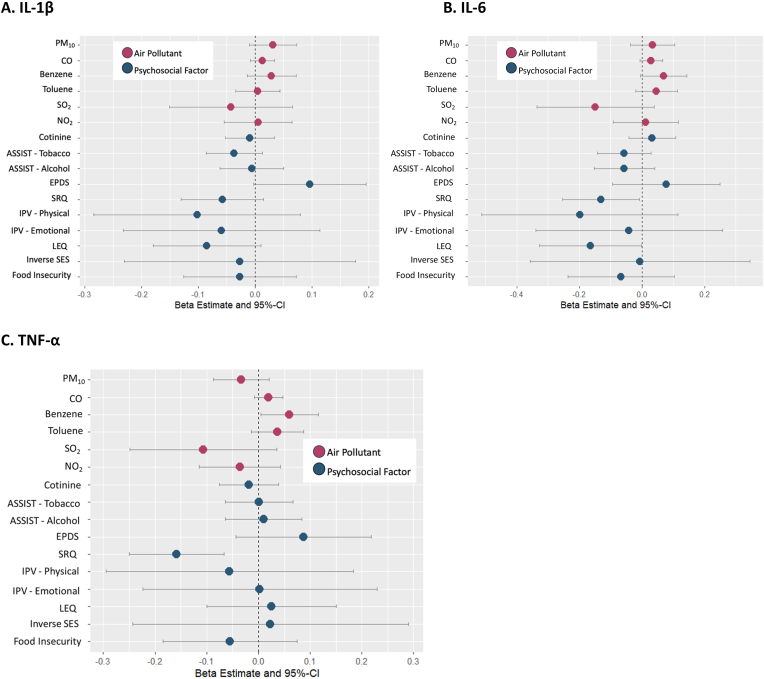
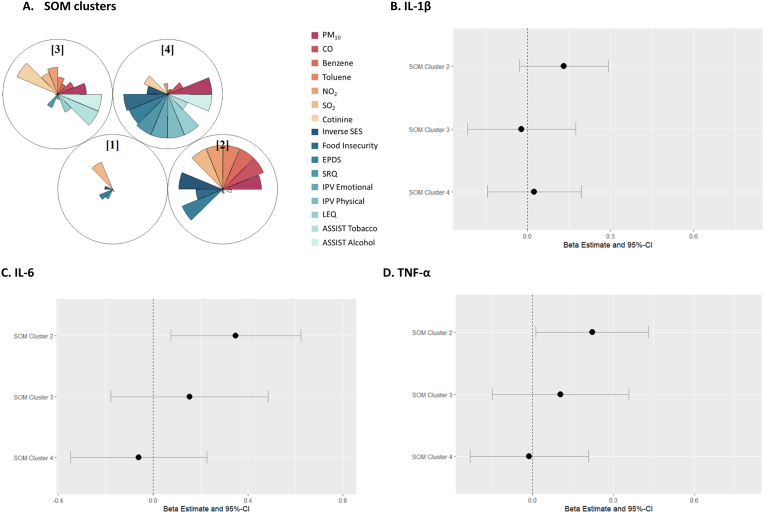
It is hypothesized that air pollution and stress impact the central nervous system through neuroinflammatory pathways Despite this, the association between prenatal exposure to indoor air pollution and psychosocial factors on inflammatory markers in infancy has been underexplored in epidemiology studies. This study investigates the individual and joint effects of prenatal exposure to indoor air pollution and psychosocial factors on early life inflammation (interleukin-1β (IL-1β), interleukin-6 (IL-6), and tumor necrosis factor-α (TNF-α)). We analyzed data from the South African Drakenstein Child Health Study (N = 225). Indoor air pollution and psychosocial factor measurements were taken in the 2nd trimester of pregnancy. Circulating inflammatory markers (IL-1β, Il-6, and TNF-α) were measured in serum in the infants at 6 weeks postnatal. Linear regression models were used to investigate associations between individual exposures and inflammatory markers. To investigate joint effects of environmental and psychosocial factors, Self-Organizing Maps (SOM) were used to create exposure profile clusters. These clusters were added to linear regression models to investigate the associations between exposure profiles and inflammatory markers. All models were adjusted for maternal age, maternal HIV status, and ancestry to control for confounding. Most indoor air pollutants were positively associated with inflammatory markers, particularly benzene and TNF-α in single pollutant models. No consistent patterns were found for psychosocial factors in single-exposure linear regression models. In joint effects analyses, the SOM profile with high indoor air pollution, low SES, and high maternal depressive symptoms were associated with higher inflammation. Indoor air pollutants were consistently associated with increased inflammation in both individual and joint effects models, particularly in combination with low SES and maternal depressive symptoms. The trend for individual psychosocial factors was not as clear, with mainly null associations. As we have observed pro- and anti-inflammatory effects, future research should investigate joint effects of these exposures on inflammation and their health effects.
据推测,空气污染和压力通过神经炎症途径影响中枢神经系统。尽管如此,在流行病学研究中,产前暴露于室内空气污染和心理社会因素与婴儿期炎症标志物之间的关联仍未得到充分探索。本研究调查了产前暴露于室内空气污染和心理社会因素对婴儿早期炎症(白细胞介素-1β (IL-1β)、白细胞介素-6 (IL-6)和肿瘤坏死因子-α (TNF-α))的单独和联合影响。我们分析了南非德肯斯坦儿童健康研究(N=225)的数据。在妊娠中期测量室内空气污染和心理社会因素。在婴儿出生后 6 周时,测量血清中的循环炎症标志物(IL-1β、IL-6 和 TNF-α)。使用线性回归模型研究单个暴露与炎症标志物之间的关联。为了研究环境和心理社会因素的联合效应,使用自组织映射 (SOM) 创建暴露概况聚类。将这些聚类添加到线性回归模型中,以研究暴露概况与炎症标志物之间的关联。所有模型均调整了母亲年龄、母亲 HIV 状态和祖源,以控制混杂因素。大多数室内空气污染物与炎症标志物呈正相关,特别是苯和 TNF-α 在单一污染物模型中。在单一暴露线性回归模型中,心理社会因素没有一致的模式。在联合效应分析中,室内空气污染高、社会经济地位低和产妇抑郁症状高的 SOM 图谱与更高的炎症有关。室内空气污染物在个体和联合效应模型中均与炎症增加相关,尤其是与低社会经济地位和产妇抑郁症状相结合时。个体心理社会因素的趋势并不明显,主要为阴性关联。由于我们观察到促炎和抗炎作用,未来的研究应该调查这些暴露对炎症及其健康影响的联合效应。