INFANT Research Centre, University College Cork, Cork, Ireland; Department of Paediatrics and Child Health, University College Cork, Cork, Ireland.
Institute for Women's Health, University College London, London, UK.
Lancet Child Adolesc Health. 2020 Oct;4(10):740-749. doi: 10.1016/S2352-4642(20)30239-X. Epub 2020 Aug 27.
Despite the availability of continuous conventional electroencephalography (cEEG), accurate diagnosis of neonatal seizures is challenging in clinical practice. Algorithms for decision support in the recognition of neonatal seizures could improve detection. We aimed to assess the diagnostic accuracy of an automated seizure detection algorithm called Algorithm for Neonatal Seizure Recognition (ANSeR).
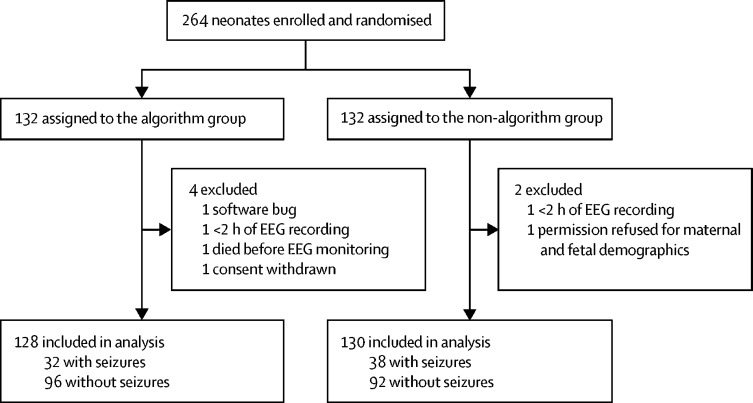
This multicentre, randomised, two-arm, parallel, controlled trial was done in eight neonatal centres across Ireland, the Netherlands, Sweden, and the UK. Neonates with a corrected gestational age between 36 and 44 weeks with, or at significant risk of, seizures requiring EEG monitoring, received cEEG plus ANSeR linked to the EEG monitor displaying a seizure probability trend in real time (algorithm group) or cEEG monitoring alone (non-algorithm group). The primary outcome was diagnostic accuracy (sensitivity, specificity, and false detection rate) of health-care professionals to identify neonates with electrographic seizures and seizure hours with and without the support of the ANSeR algorithm. Neonates with data on the outcome of interest were included in the analysis. This study is registered with ClinicalTrials.gov, NCT02431780.
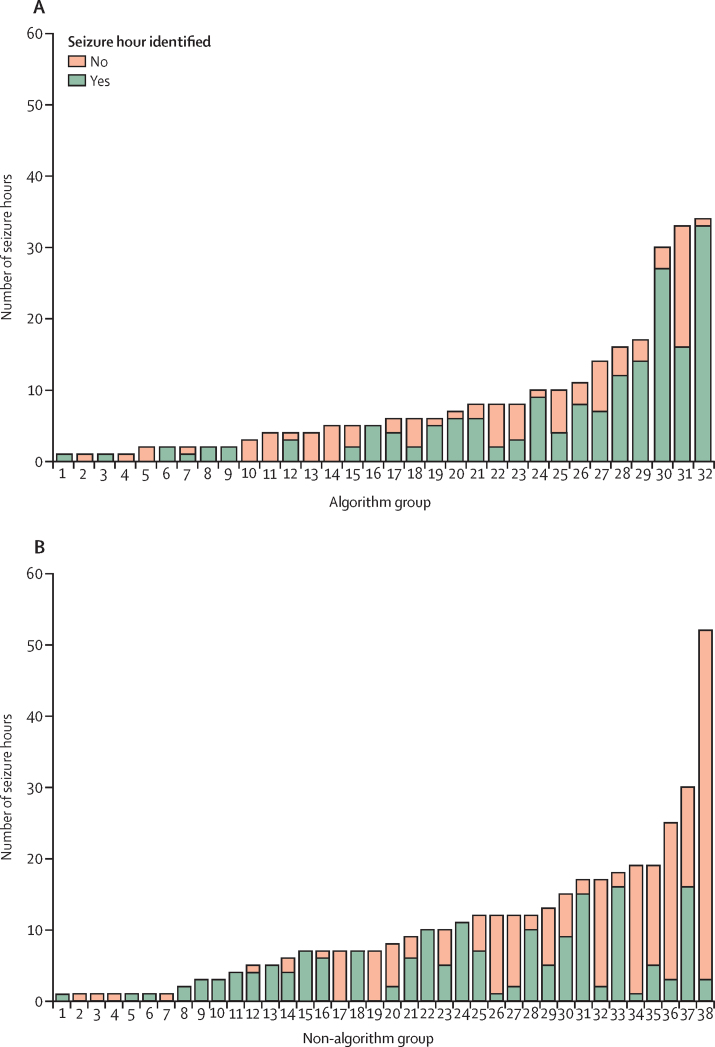
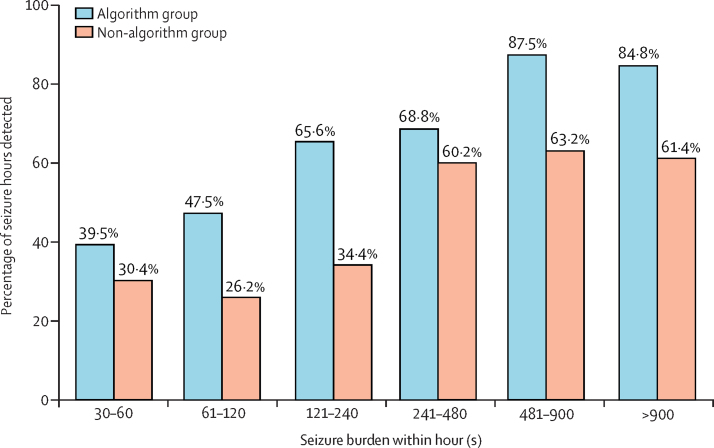
Between Feb 13, 2015, and Feb 7, 2017, 132 neonates were randomly assigned to the algorithm group and 132 to the non-algorithm group. Six neonates were excluded (four from the algorithm group and two from the non-algorithm group). Electrographic seizures were present in 32 (25·0%) of 128 neonates in the algorithm group and 38 (29·2%) of 130 neonates in the non-algorithm group. For recognition of neonates with electrographic seizures, sensitivity was 81·3% (95% CI 66·7-93·3) in the algorithm group and 89·5% (78·4-97·5) in the non-algorithm group; specificity was 84·4% (95% CI 76·9-91·0) in the algorithm group and 89·1% (82·5-94·7) in the non-algorithm group; and the false detection rate was 36·6% (95% CI 22·7-52·1) in the algorithm group and 22·7% (11·6-35·9) in the non-algorithm group. We identified 659 h in which seizures occurred (seizure hours): 268 h in the algorithm versus 391 h in the non-algorithm group. The percentage of seizure hours correctly identified was higher in the algorithm group than in the non-algorithm group (177 [66·0%; 95% CI 53·8-77·3] of 268 h vs 177 [45·3%; 34·5-58·3] of 391 h; difference 20·8% [3·6-37·1]). No significant differences were seen in the percentage of neonates with seizures given at least one inappropriate antiseizure medication (37·5% [95% CI 25·0 to 56·3] vs 31·6% [21·1 to 47·4]; difference 5·9% [-14·0 to 26·3]).
ANSeR, a machine-learning algorithm, is safe and able to accurately detect neonatal seizures. Although the algorithm did not enhance identification of individual neonates with seizures beyond conventional EEG, recognition of seizure hours was improved with use of ANSeR. The benefit might be greater in less experienced centres, but further study is required.
Wellcome Trust, Science Foundation Ireland, and Nihon Kohden.
尽管有连续常规脑电图(cEEG)可用,但在临床实践中准确诊断新生儿癫痫仍然具有挑战性。用于识别新生儿癫痫的决策支持算法可以提高检测的准确性。我们旨在评估一种名为新生儿癫痫识别算法(ANSeR)的自动癫痫检测算法的诊断准确性。
这项多中心、随机、双臂、平行、对照试验在爱尔兰、荷兰、瑞典和英国的 8 个新生儿中心进行。胎龄在 36 至 44 周之间、有或有癫痫发作风险且需要脑电图监测的新生儿,接受 cEEG 加 ANSeR 链接到实时显示癫痫发作概率趋势的脑电图监测仪(算法组)或单独 cEEG 监测(非算法组)。主要结局是卫生保健专业人员识别有脑电图癫痫发作和有或没有 ANSeR 算法支持的癫痫发作小时的诊断准确性(敏感性、特异性和假阳性率)。纳入了有兴趣结局数据的新生儿进行分析。本研究在 ClinicalTrials.gov 注册,NCT02431780。
2015 年 2 月 13 日至 2017 年 2 月 7 日期间,132 名新生儿被随机分配到算法组和非算法组。6 名新生儿被排除(4 名来自算法组,2 名来自非算法组)。32 名(25.0%)接受脑电图监测的 128 名新生儿和 38 名(29.2%)接受非算法组的 130 名新生儿存在脑电图癫痫发作。对于识别有脑电图癫痫发作的新生儿,算法组的敏感性为 81.3%(95%CI 66.7-93.3),非算法组为 89.5%(78.4-97.5);特异性分别为 84.4%(95%CI 76.9-91.0)和 89.1%(82.5-94.7);假阳性率分别为 36.6%(95%CI 22.7-52.1)和 22.7%(11.6-35.9)。我们共发现 659 小时有癫痫发作(癫痫发作小时):算法组 268 小时,非算法组 391 小时。与非算法组相比,算法组正确识别的癫痫发作小时百分比更高(268 小时中有 177 小时[66.0%;95%CI 53.8-77.3],391 小时中有 177 小时[45.3%;34.5-58.3];差异 20.8% [3.6-37.1])。在给予至少一种不合适抗癫痫药物的癫痫发作新生儿百分比方面,两组之间未见显著差异(37.5% [95%CI 25.0 至 56.3] vs 31.6% [21.1 至 47.4];差异 5.9% [-14.0 至 26.3])。
ANSeR,一种机器学习算法,是安全的,并能准确检测新生儿癫痫。尽管该算法不能提高常规脑电图以外的个体新生儿癫痫发作的识别能力,但使用 ANSeR 可以提高癫痫发作小时的识别能力。在经验较少的中心,其益处可能更大,但还需要进一步研究。
威康信托、爱尔兰科学基金会和日本光电。