Lei Yuhe, Gan Hua, Huang Yuqing, Chen Yueyue, Chen Lei, Shan Aiyun, Zhao Huan, Wu Mansi, Li Xiaojuan, Ma Qingyu, Wang Jing, Zhang Enxin, Zhang Jiayan, Li Yuanxiang, Xue Feifei, Deng Lijuan
Department of Pharmacy, Shenzhen Hospital of Guangzhou University of Chinese Medicine, Shenzhen, Guangdong 518034, P.R. China.
Formula Pattern Research Center, School of Traditional Chinese Medicine, Jinan University, Guangzhou, Guangdong 510632, P.R. China.
Oncol Lett. 2020 Oct;20(4):71. doi: 10.3892/ol.2020.11932. Epub 2020 Jul 30.
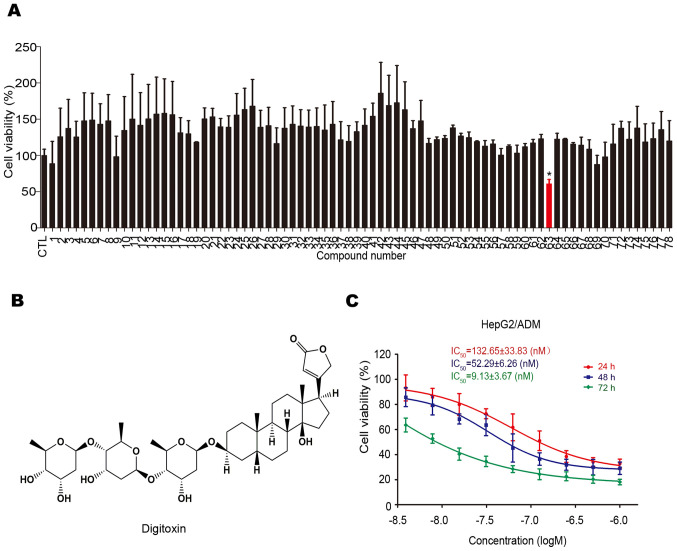
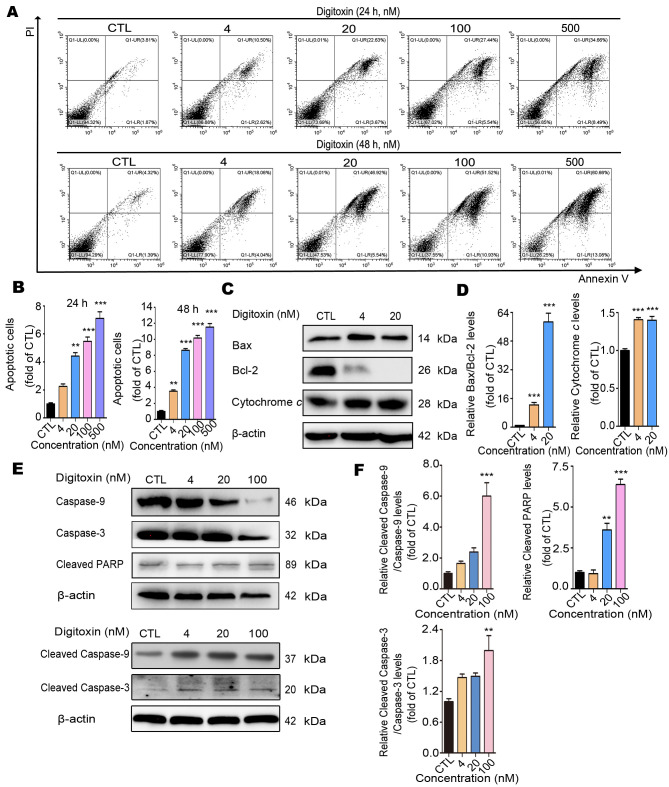
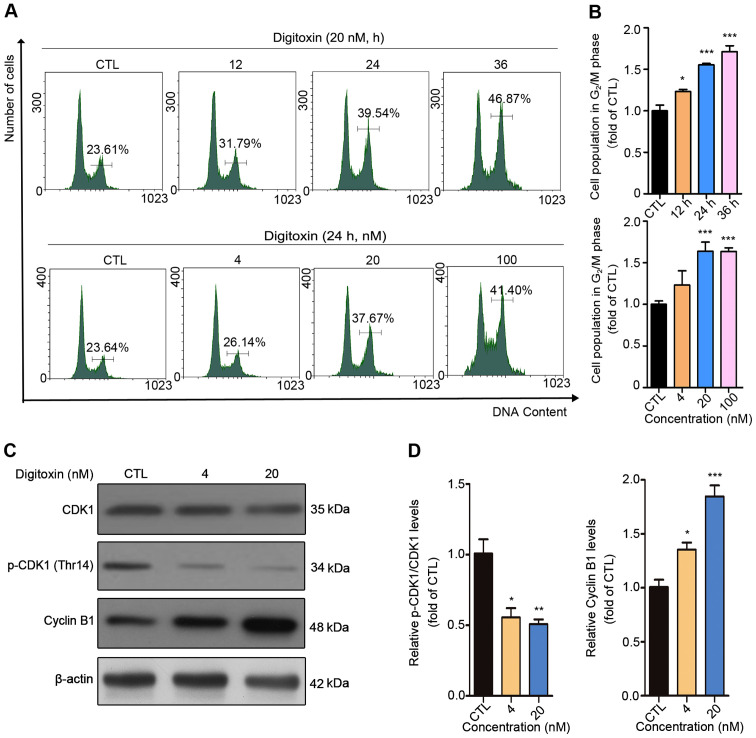
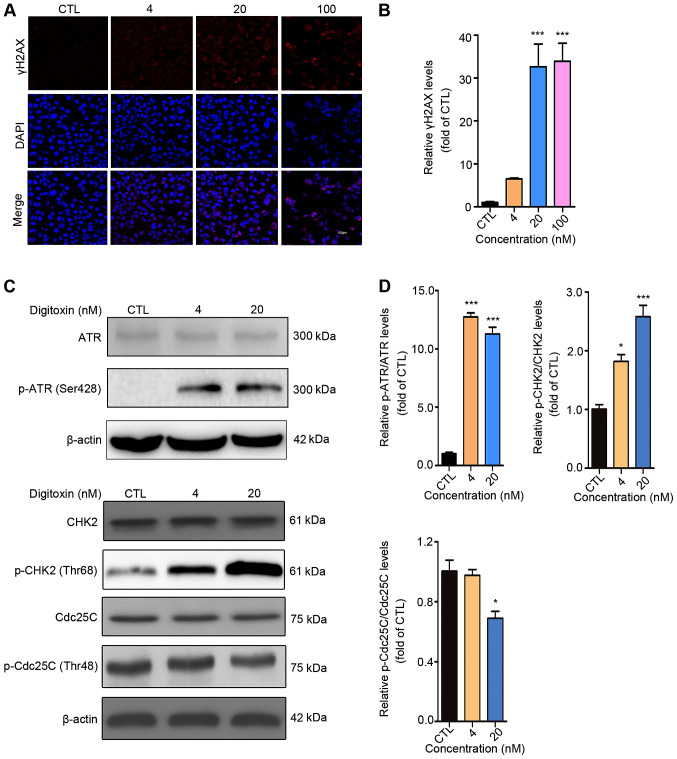
Hepatocellular carcinoma (HCC) remains a challenge in the medical field due to its high malignancy and mortality rates particularly for HCC, which has developed multidrug resistance. Therefore, the identification of efficient chemotherapeutic drugs for multidrug resistant HCC has become an urgent issue. Natural products have always been of significance in drug discovery. In the present study, a cell-based method was used to screen a natural compound library, which consisted of 78 compounds, and the doxorubicin-resistant cancer cell line, HepG2/ADM, as screening tools. The findings of the present study led to the shortlisting of one of the compounds, digitoxin, which displayed an inhibitory effect on HepG2/ADM cells, with 50% inhibitory concentration values of 132.65±3.83, 52.29±6.26, and 9.13±3.67 nM for 24, 48, and 72 h, respectively. Immunofluorescence, western blotting and cell cycle analyses revealed that digitoxin induced G/M cell cycle arrest via the serine/threonine-protein kinase ATR (ATR)-serine/threonine-protein kinase Chk2 (CHK2)-M-phase inducer phosphatase 3 (CDC25C) signaling pathway in HepG2/ADM cells, which may have resulted from a DNA double-stranded break. Digitoxin also induced mitochondrial apoptosis, which was characterized by changes in the interaction between Bcl-2 and Bax, the release of cytochrome , as well as the activation of the caspase-3 and -9. To the best of our knowledge, the present study is the first report that digitoxin displays an anti-HCC effect on HepG2/ADM cells through G/M cell cycle arrest, which was mediated by the ATR-CHK2-CDC25C signaling pathway and mitochondrial apoptosis. Therefore, digitoxin could be a promising chemotherapeutic agent for the treatment of patients with HCC.
肝细胞癌(HCC)因其高恶性和死亡率,尤其是已产生多药耐药性的HCC,仍然是医学领域的一项挑战。因此,确定针对多药耐药性HCC的有效化疗药物已成为一个紧迫问题。天然产物在药物发现中一直具有重要意义。在本研究中,采用基于细胞的方法筛选了一个由78种化合物组成的天然化合物库,并使用多柔比星耐药癌细胞系HepG2/ADM作为筛选工具。本研究结果导致其中一种化合物洋地黄毒苷入围,该化合物对HepG2/ADM细胞显示出抑制作用,在24、48和72小时时的半数抑制浓度值分别为132.65±3.83、52.29±6.26和9.13±3.67 nM。免疫荧光、蛋白质印迹和细胞周期分析表明,洋地黄毒苷通过丝氨酸/苏氨酸蛋白激酶ATR(ATR)-丝氨酸/苏氨酸蛋白激酶Chk2(CHK2)-M期诱导磷酸酶3(CDC25C)信号通路在HepG2/ADM细胞中诱导G/M期细胞周期阻滞,这可能是由DNA双链断裂引起的。洋地黄毒苷还诱导线粒体凋亡,其特征是Bcl-2和Bax之间相互作用的变化、细胞色素c的释放以及caspase-3和-9的激活。据我们所知,本研究是第一份报道洋地黄毒苷通过由ATR-CHK2-CDC25C信号通路介导的G/M期细胞周期阻滞和线粒体凋亡对HepG2/ADM细胞显示抗HCC作用的报告。因此,洋地黄毒苷可能是治疗HCC患者的一种有前景的化疗药物。