De Nardi Paola, Arru Giaime G, Guarneri Giovanni, Vlasakov Iliyan, Massimino Luca
Gastrointestinal Surgery, IRCCS San Raffaele Scientific Institute, Milan 20132, Italy.
Vita-Salute University San Raffaele, Milan 20132, Italy.
World J Gastrointest Oncol. 2020 Jul 15;12(7):732-740. doi: 10.4251/wjgo.v12.i7.732.
Carcinomas of the anal canal are staged according to the size and extent of the disease; however, we propose including a novel ultrasound (US) staging system, based on depth of tumor invasion. In this study the clinical American Joint Committee on Cancer (AJCC) staging guidelines and the US classificationss in patients with anal cancer were compared.
To evaluate the prognostic role of the US staging system in patients with anal cancer.
The data of 48 patients with anal canal squamous cells carcinoma, observed at our University Hospital between 2007 and 2017, who underwent pre-treatment assessment with pelvic magnetic resonance imaging (MRI), total body computed tomography (CT) scan and endoanal US were retrospectively reviewed. Anal canal tumors were clinically staged according to AJCC, determined by MRI by measurement of the longest tumor diameter, and CT scan. Endoanal US was performed with a high multi-frequency (9-16 MHz), 360° rotational mechanical probe; US classification was based on depth of tumor penetration through the anal wall, according to Giovannini's study. All patients were treated with definitive radiation combined with 5-fluorouracile and Mitomycin-C. After treatment patients were followed-up regularly.
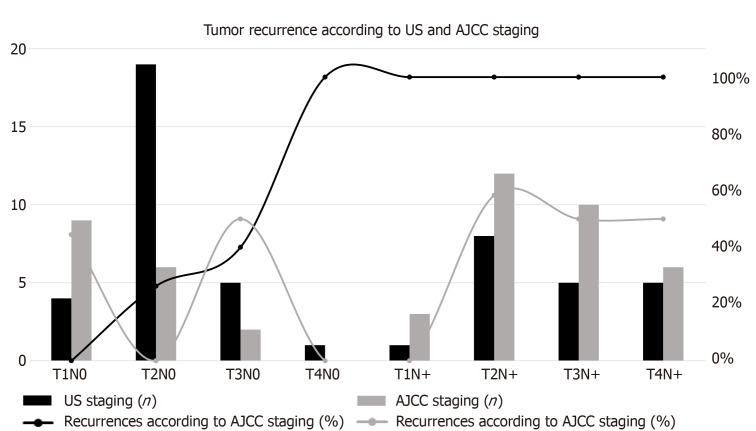
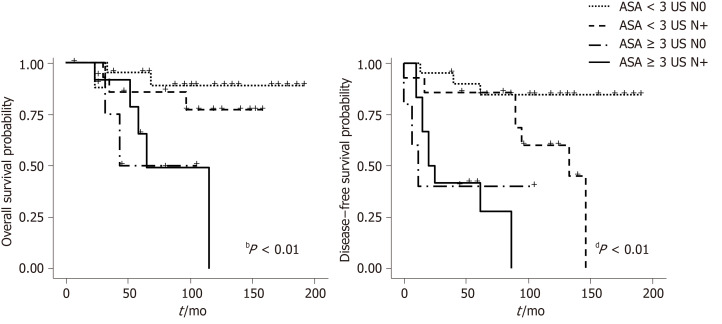
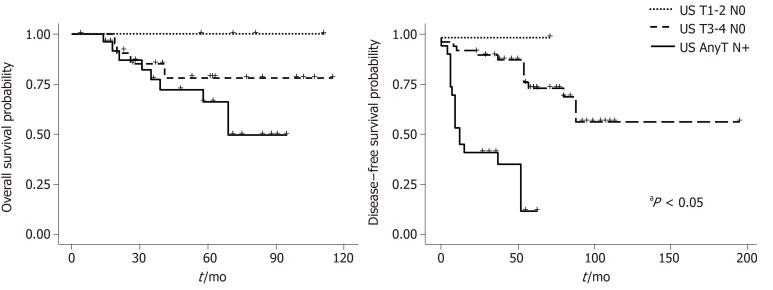
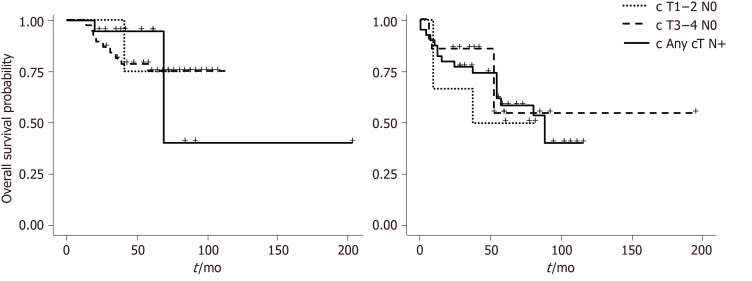
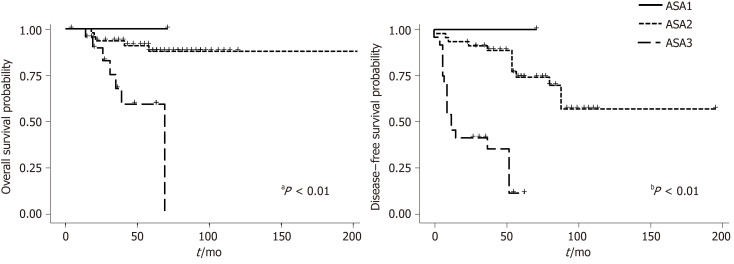
At baseline there were 30 and 32 T1-2, 18 and 16 T3-4, 31 and 19 N+ patients classified according to the clinical AJCC and US staging system respectively. After a mean follow-up of 98 months, 38 patients (79.1%) are alive and 28 (58.3%) are disease free. During follow up 20 patients (41.6%) experienced recurrences. After univariate analysis, American Society of Anesthesiologists (ASA) score ( = 0.00000001) and US staging ( = 0.009) were significantly related to disease-free survival (DFS). When overall survival and DFS functions were compared, a statistically significant difference was observed for DFS survival when the US staging was applied with respect to the clinical AJCC staging. By combining the 2 significant prognostic variables, namely the US staging with the ASA score, four risks groups with different prognoses were identified.
Our findings suggest that US staging may be superior to traditional clinical staging, since it is significantly associated with DFS in anal cancer patients.
肛管癌根据疾病的大小和范围进行分期;然而,我们建议纳入一种基于肿瘤浸润深度的新型超声(US)分期系统。在本研究中,对肛管癌患者的美国癌症联合委员会(AJCC)临床分期指南和超声分类进行了比较。
评估超声分期系统在肛管癌患者中的预后作用。
回顾性分析了2007年至2017年在我们大学医院观察到的48例肛管鳞状细胞癌患者的数据,这些患者接受了盆腔磁共振成像(MRI)、全身计算机断层扫描(CT)和经肛门超声的预处理评估。肛管肿瘤根据AJCC进行临床分期,通过MRI测量肿瘤最长直径并结合CT扫描来确定。经肛门超声采用高多频(9 - 16 MHz)、360°旋转机械探头进行;根据乔瓦尼尼的研究,超声分类基于肿瘤穿透肛管壁的深度。所有患者均接受了确定性放疗联合5 - 氟尿嘧啶和丝裂霉素 - C治疗。治疗后对患者进行定期随访。
基线时,根据临床AJCC和超声分期系统分别分类的T1 - 2期患者有30例和32例,T3 - 4期患者有18例和16例,N + 患者有31例和19例。平均随访98个月后,38例患者(79.1%)存活,28例患者(58.3%)无疾病。随访期间,20例患者(41.6%)出现复发。单因素分析后,美国麻醉医师协会(ASA)评分(= 0.00000001)和超声分期(= 0.009)与无病生存期(DFS)显著相关。当比较总生存期和DFS函数时,应用超声分期相对于临床AJCC分期在DFS生存期方面观察到统计学显著差异。通过结合两个显著的预后变量,即超声分期和ASA评分,确定了四个预后不同的风险组。
我们的研究结果表明,超声分期可能优于传统临床分期,因为它与肛管癌患者的DFS显著相关。