Massad Salwa, Gebre-Medhin Mehari, Dary Omar, Abdalla Marwah, Holleran Steve, Karmally Wahida, Bordelois Paula, Khammash Umaiyeh, Deckelbaum Richard J
Juzoor for Health and Social Development, Ramallah, 970 Palestine.
Department of Women's and Children's Health, Pediatrics, University Hospital, SE-751 85 Uppsala, Sweden.
BMC Nutr. 2020 Aug 26;6:38. doi: 10.1186/s40795-020-00367-2. eCollection 2020.
In 1996 and in 2006, Palestine initiated salt iodization and multiple micronutrient fortification of wheat flour, respectively as a strategy to prevent deficiencies of these nutrients. In 2009, we assessed the impact of these interventions on the health and nutritional status of schoolchildren residing in the West Bank.
We surveyed a sample of 22 schools run by the UN Relief and Works Agency for Palestine Refugees in the Near East (UNRWA) and the Palestinian Government. We randomly selected students from the first (mean age 6.7 years [SD 0.5]), sixth (11.8 years [0.6]), and ninth grades (14.8 years [0.6]). Data were obtained from 1484 (99%) of 1500 students planned for enrollment.
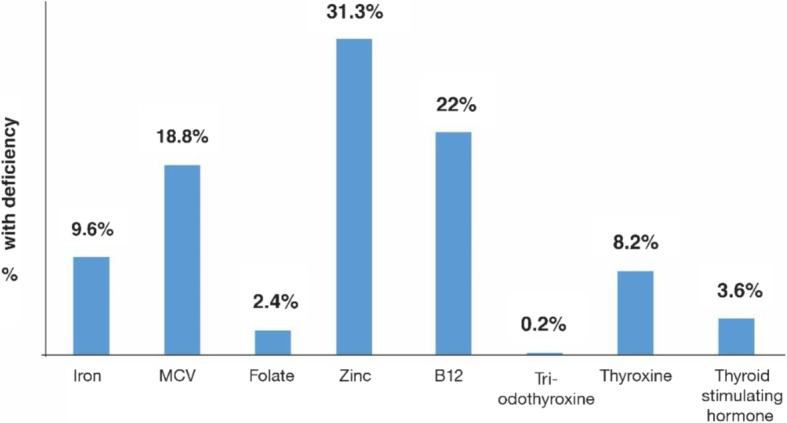
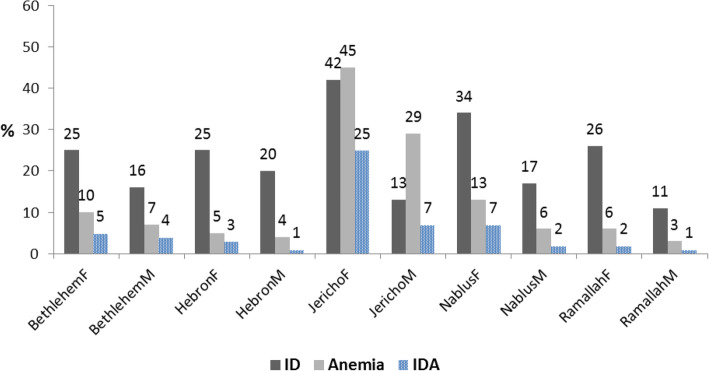
Our results suggest that iodine intake appears adequate and there was essentially no iodine deficiency. As to the status of other micronutrients, the main nutritional micronutrient risks for schoolchildren in the West Bank continue to be low serum levels of iron, zinc, and vitamin B-12; folate levels were seemingly high. The overall prevalence of anemia was 9.6%, but there were pockets of anemia in certain districts. Almost 42% of the anemia in our sample was explained by iron deficiency. There were significant differences in iron deficiency between girls and boys, 29.5% vs. 15.7%, respectively ( = 0.0001). There were no cases of lead toxicity in the studied sample.
Wheat flour and salt fortification has had a major influence on improving the micronutrient status of Palestinian children, for some but not all micronutrients. The recommended key blood and biochemical parameters to be incorporated in the surveillance system are iron, zinc, and vitamin B12.
1996年和2006年,巴勒斯坦分别启动了食盐碘化和小麦粉多种微量营养素强化项目,作为预防这些营养素缺乏的一项战略。2009年,我们评估了这些干预措施对约旦河西岸学童健康和营养状况的影响。
我们对由联合国近东巴勒斯坦难民救济和工程处(近东救济工程处)和巴勒斯坦政府管理的22所学校的样本进行了调查。我们从一年级(平均年龄6.7岁[标准差0.5])、六年级(11.8岁[0.6])和九年级(14.8岁[0.6])中随机挑选学生。数据来自计划入学的1500名学生中的1484名(99%)。
我们的结果表明,碘摄入量似乎充足,基本上不存在碘缺乏。至于其他微量营养素的状况,约旦河西岸学童主要的营养微量营养素风险仍然是血清铁、锌和维生素B-12水平较低;叶酸水平似乎较高。贫血的总体患病率为9.6%,但某些地区存在贫血聚集现象。在我们的样本中,近42%的贫血可归因于缺铁。女孩和男孩之间的缺铁情况存在显著差异,分别为29.5%和15.7%(P = 0.0001)。在研究样本中没有铅中毒病例。
小麦粉和食盐强化对改善巴勒斯坦儿童的微量营养素状况产生了重大影响,对一些但并非所有微量营养素而言。建议纳入监测系统的关键血液和生化参数是铁、锌和维生素B12。