Romero-Morales Alejandra I, O'Grady Brian J, Balotin Kylie M, Bellan Leon M, Lippmann Ethan S, Gama Vivian
Department of Cell & Developmental Biology, Vanderbilt University, Nashville, TN, USA.
Department of Mechanical Engineering, Vanderbilt University, Nashville, TN, USA.
HardwareX. 2019 Oct;6. doi: 10.1016/j.ohx.2019.e00084. Epub 2019 Oct 11.
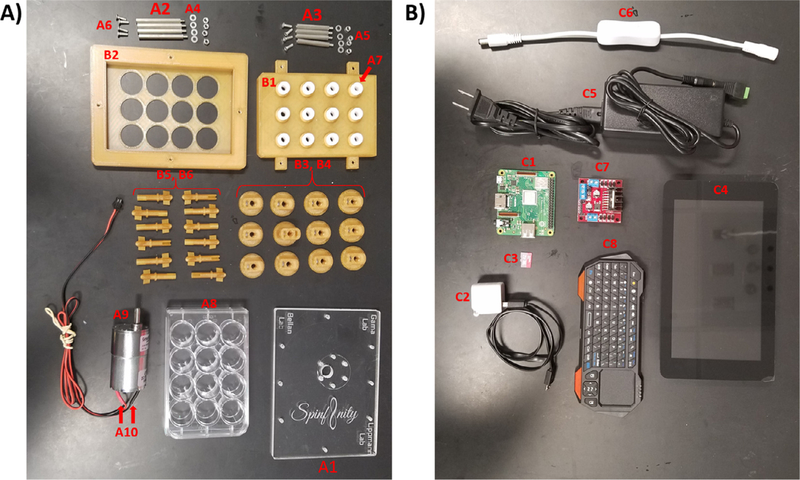
Three-dimensional (3D) brain organoids derived from human pluripotent stem cells (hPSCs), including human embryonic stem cells (hESCs) and induced pluripotent stem cells (iPSCs), have become a powerful system to study early development events and to model human disease. Cerebral organoids are generally produced in static culture or in a culture vessel with active mixing, and the two most widely used systems for mixing are a large spinning flask and a miniaturized multi-well spinning bioreactor (also known as Spin Omega (SpinΩ)). The SpinΩ provides a system that is amenable to drug testing, has increased throughput and reproducibility, and utilizes less culture media. However, technical limitations of this system include poor stability of select components and an elevated risk of contamination due to the inability to sterilize the device preassembled. Here, we report a new design of the miniaturized bioreactor system, which we term Spinfinity (Spin∞) that overcomes these concerns to permit long-term experiments. This updated device is amenable to months-long (over 200 days) experiments without concern of unexpected malfunctions.
源自人类多能干细胞(hPSC),包括人类胚胎干细胞(hESC)和诱导多能干细胞(iPSC)的三维(3D)脑类器官,已成为研究早期发育事件和模拟人类疾病的强大系统。脑类器官通常在静态培养或在具有主动混合功能的培养容器中产生,两种最广泛使用的混合系统是大型旋转烧瓶和小型化多孔旋转生物反应器(也称为Spin Omega(SpinΩ))。SpinΩ提供了一个适合药物测试的系统,具有更高的通量和可重复性,并且使用的培养基更少。然而,该系统的技术局限性包括某些组件稳定性差,以及由于无法对预组装的设备进行消毒而导致污染风险增加。在此,我们报告了一种小型化生物反应器系统的新设计,我们将其称为Spinfinity(Spin∞),它克服了这些问题,从而能够进行长期实验。这种更新后的设备适合进行长达数月(超过200天)的实验,而无需担心意外故障。