Department of Neuroscience and Mahoney Institute for Neurosciences, Perelman School of Medicine, University of Pennsylvania, Philadelphia, Pennsylvania, USA.
Biomedical Engineering Graduate Program, Johns Hopkins University School of Medicine, Baltimore, Maryland, USA.
Nat Protoc. 2018 Mar;13(3):565-580. doi: 10.1038/nprot.2017.152. Epub 2018 Feb 22.
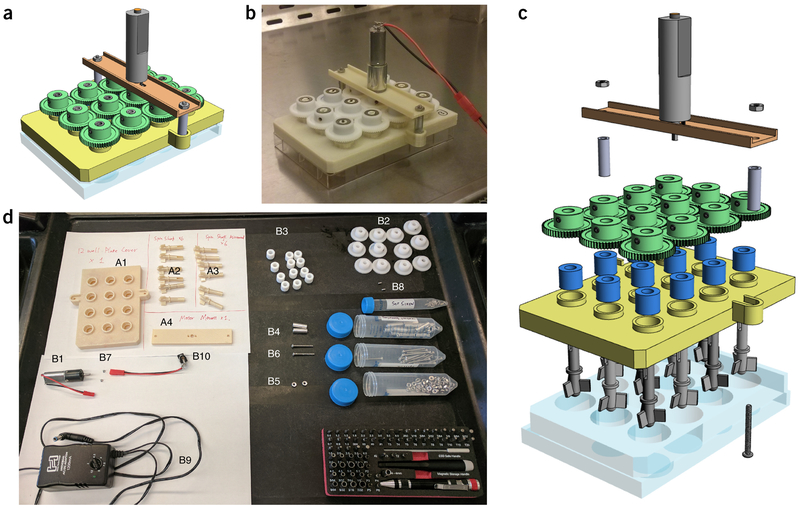
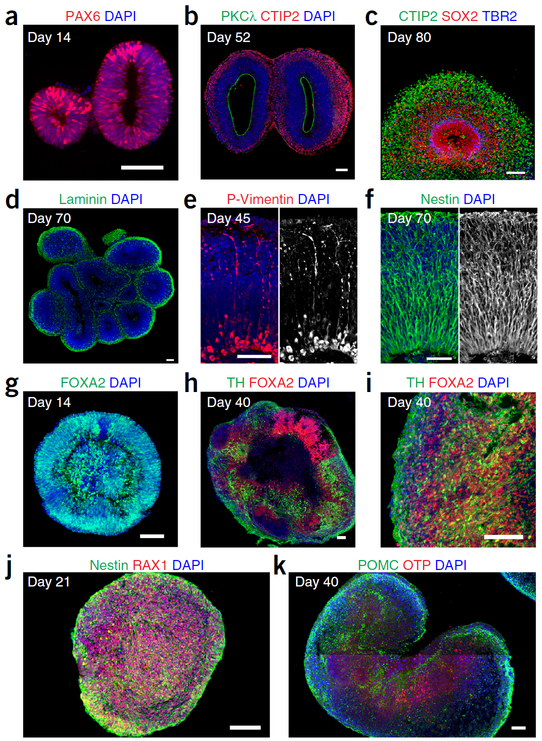
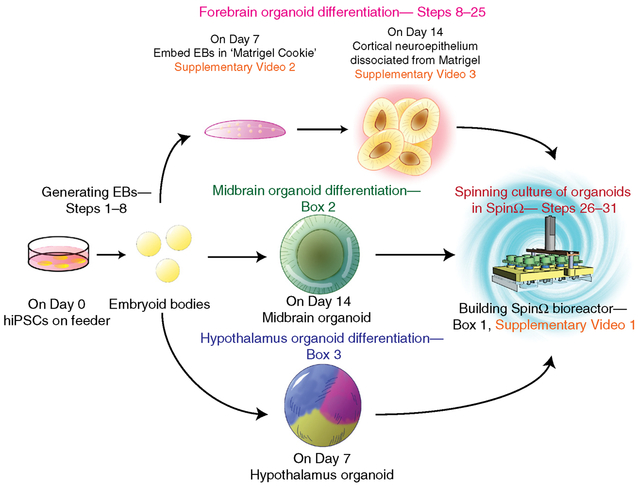
Human brain organoids, 3D self-assembled neural tissues derived from pluripotent stem cells, are important tools for studying human brain development and related disorders. Suspension cultures maintained by spinning bioreactors allow for the growth of large organoids despite the lack of vasculature, but commercially available spinning bioreactors are bulky in size and have low throughput. Here, we describe the procedures for building the miniaturized multiwell spinning bioreactor SpinΩ from 3D-printed parts and commercially available hardware. We also describe how to use SpinΩ to generate forebrain, midbrain and hypothalamus organoids from human induced pluripotent stem cells (hiPSCs). These organoids recapitulate key dynamic features of the developing human brain at the molecular, cellular and structural levels. The reduction in culture volume, increase in throughput and reproducibility achieved using our bioreactor and region-specific differentiation protocols enable quantitative modeling of brain disorders and compound testing. This protocol takes 14-84 d to complete (depending on the type of brain region-specific organoids and desired developmental stages), and organoids can be further maintained over 200 d. Competence with hiPSC culture is required for optimal results.
人脑类器官是由多能干细胞自组装形成的 3D 神经组织,是研究人类大脑发育和相关疾病的重要工具。旋转生物反应器维持的悬浮培养尽管缺乏血管系统,但允许大规模类器官的生长,但商业上可用的旋转生物反应器体积庞大,通量低。在这里,我们描述了从小型化多孔旋转生物反应器 SpinΩ 的 3D 打印部件和市售硬件构建的过程。我们还描述了如何使用 SpinΩ 从人诱导多能干细胞(hiPSC)生成前脑、中脑和下丘脑类器官。这些类器官在分子、细胞和结构水平上再现了人类大脑发育的关键动态特征。我们的生物反应器和区域特异性分化方案减少了培养体积,增加了通量和重现性,从而能够对大脑疾病进行定量建模和化合物测试。该方案需要 14-84 天(具体取决于所需的脑区特异性类器官类型和发育阶段),并且可以进一步维持 200 天以上。获得最佳结果需要具备 hiPSC 培养的能力。