Rosell Axel, Moser Bernhard, Hisada Yohei, Chinthapatla Rukesh, Lian Grace, Yang Yi, Flick Matthew J, Mackman Nigel
Division of Internal Medicine Department of Clinical Sciences Danderyd Hospital Karolinska Institutet Stockholm Sweden.
Institute of Vascular Biology and Thrombosis Research Center for Physiology and Pharmacology Medical University of Vienna Vienna Austria.
Res Pract Thromb Haemost. 2020 Jul 6;4(6):1013-1023. doi: 10.1002/rth2.12363. eCollection 2020 Aug.
Western blotting is used to measure protein expression in cells and tissues. Appropriate interpretation of resulting data is contingent upon antibody validation.
We assessed several commercial anti-human and anti-mouse tissue factor (TF) antibodies for their ability to detect TF by western blotting.
We used human pancreatic cancer cell lines expressing different levels of TF and a mouse pancreatic cancer cell line expressing TF with a matched knockout derivative.
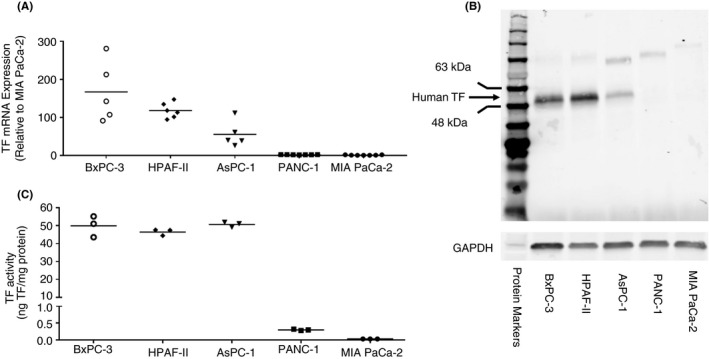
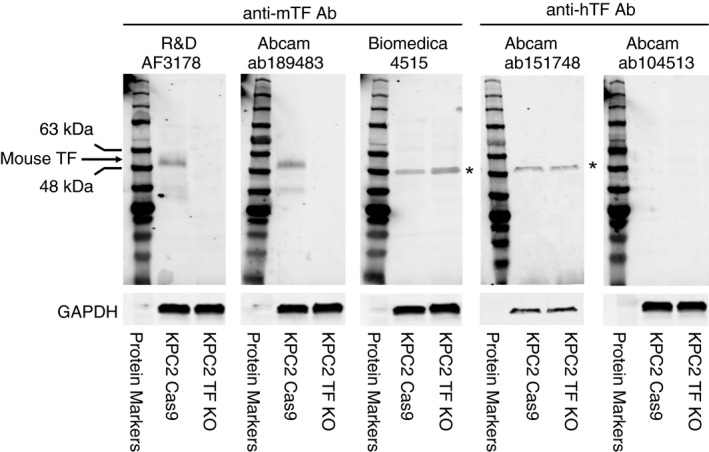
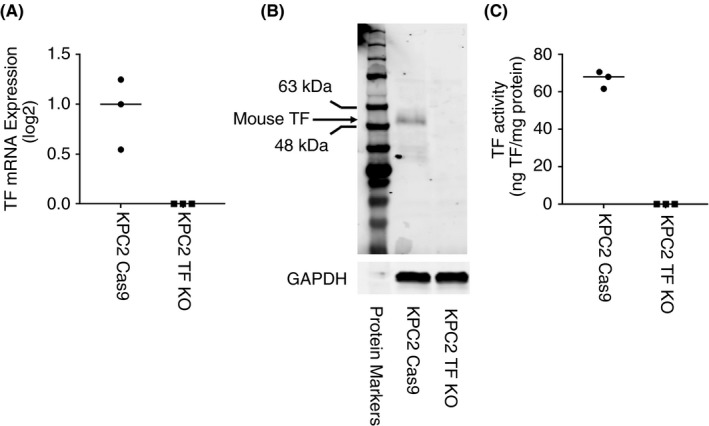
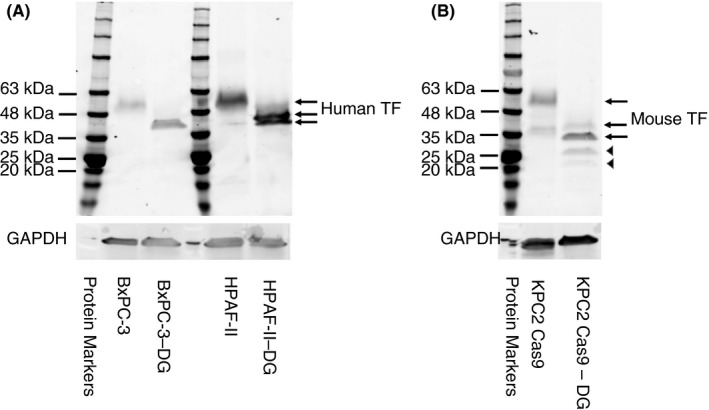
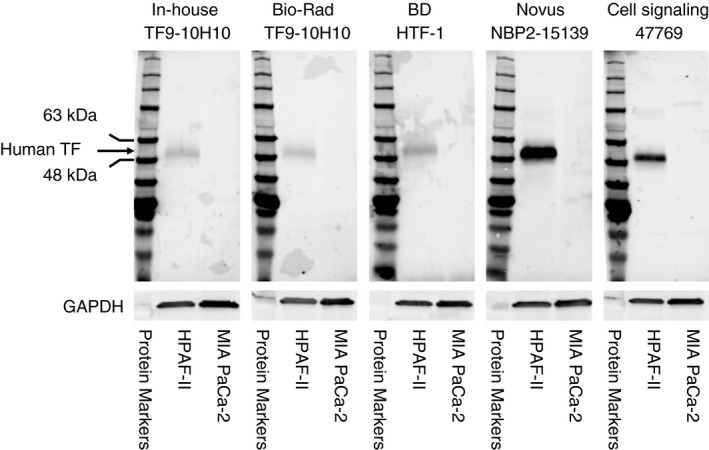
Human and mouse TF protein detected by western blotting correlated with levels of TF mRNA in these cell lines. The apparent molecular weight of TF is increased by N-linked glycosylation and, as expected, deglycosylation decreased the size of TF based on western blotting. We found that four commercial anti-human TF antibodies detected TF in a TF-positive cell line HPAF-II whereas no signal was observed in a TF-negative cell line MIA PaCa-2. More variability was observed in detecting mouse TF. Two anti-mouse TF antibodies detected mouse TF in a TF-positive cell line and no signal was observed in a TF knockout cell line. However, a third anti-mouse TF antibody detected a nonspecific protein in both the mouse TF-positive and TF-negative cell lines. Two anti-human TF antibodies that are claimed to cross react with mouse TF either recognized a nonspecific band or did not detect mouse TF.
Our results indicate that there is a range in quality of commercial anti-TF antibodies.
We recommend that all commercial antibodies should be validated to ensure that they detect TF.
蛋白质印迹法用于测量细胞和组织中的蛋白质表达。对所得数据的正确解读取决于抗体验证。
我们评估了几种市售的抗人及抗小鼠组织因子(TF)抗体通过蛋白质印迹法检测TF的能力。
我们使用了表达不同水平TF的人胰腺癌细胞系以及表达TF的小鼠胰腺癌细胞系及其匹配的基因敲除衍生物。
通过蛋白质印迹法检测到的人和小鼠TF蛋白与这些细胞系中TF mRNA的水平相关。TF的表观分子量因N-糖基化而增加,正如预期的那样,去糖基化基于蛋白质印迹法降低了TF的大小。我们发现四种市售的抗人TF抗体在TF阳性细胞系HPAF-II中检测到TF,而在TF阴性细胞系MIA PaCa-2中未观察到信号。在检测小鼠TF时观察到更多变异性。两种抗小鼠TF抗体在TF阳性细胞系中检测到小鼠TF,而在TF基因敲除细胞系中未观察到信号。然而,第三种抗小鼠TF抗体在小鼠TF阳性和TF阴性细胞系中均检测到一种非特异性蛋白。两种声称可与小鼠TF交叉反应的抗人TF抗体要么识别出非特异性条带,要么未检测到小鼠TF。
我们的结果表明市售抗TF抗体的质量存在差异。
我们建议对所有市售抗体进行验证,以确保它们能检测到TF。