Division of Urology, Department of Surgery, Chi Mei Medical Center, Tainan, Taiwan.
Management Office for Health Data, China Medical University Hospital, Taichung, Taiwan.
BMC Urol. 2020 Aug 31;20(1):135. doi: 10.1186/s12894-020-00706-2.
Studies have shown diverse results regarding the association between H. pylori (HP) infection and the risk of malignancy. There is accumulating evidence relating HP infection to urological diseases. We investigated whether there was an association between HP-infected peptic ulcers and the subsequent risk of prostate cancer.
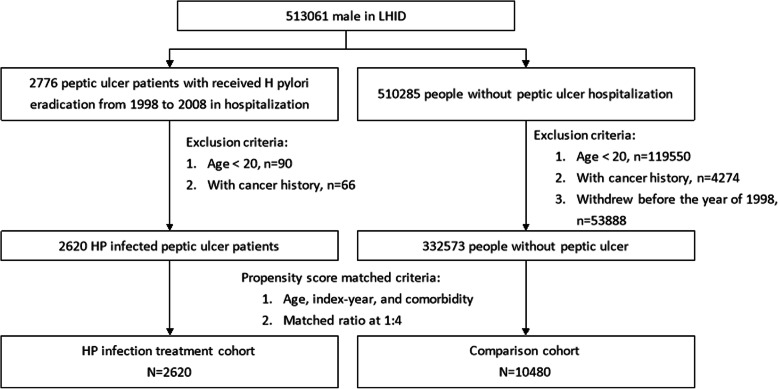
We collected HP-infected male patients from 1998 to 2008 from the Longitudinal Health Insurance Database (LHID). HP-infected patients were identified as those who had a diagnosis of peptic ulcers upon admission and received HP eradication therapy within 1 year after diagnosis. The date of HP infection diagnosis upon admission was defined as the index date. Patients aged < 20 years or with a cancer history were excluded. For each HP-infected patient, we selected four males without peptic ulcers or a history of HP eradication in the LHID for the comparison cohort according to propensity score matching by age, index year, and comorbidity. The risk of prostate cancer and associated risk factors was assessed by Cox proportional hazard regression.
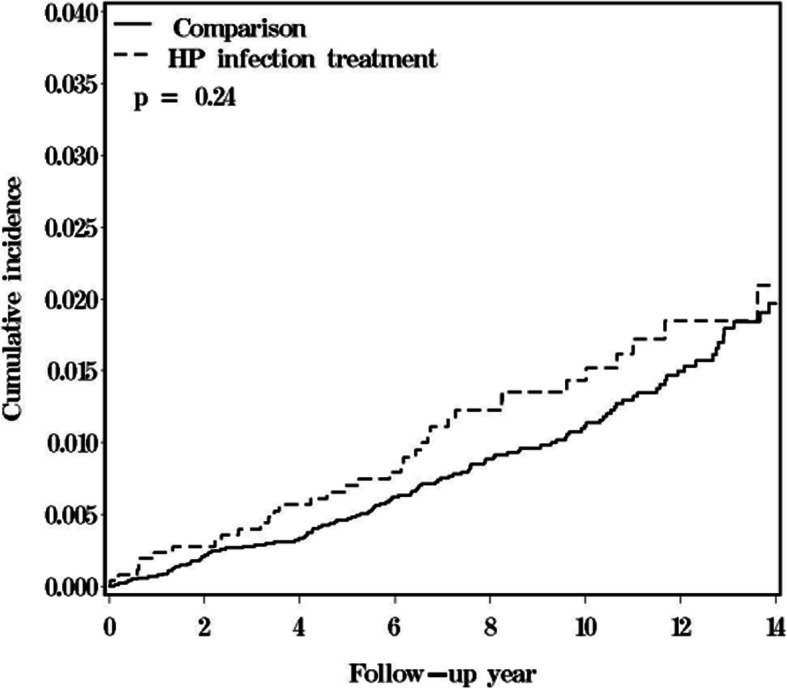
A total of 2620 HP infection treatment patients and 10,480 matched comparisons were selected. There were 36 patients in the HP-infected treatment cohort and 117 patients in the comparison cohort with documented prostate cancer development (1.52 and 1.21 per 1000 person-years, respectively). Compared to the comparison cohort, the HP infection cohort had a 1.26-fold increased prostate cancer risk in the Cox models after adjusting for matched-pairs (95% CI = 0.87-1.34). There were no significant differences in subsequent prostate cancer development between HP-infected treatment patients and the comparison cohort.
Our findings showed no significant association between HP-infected peptic ulcers and the subsequent risk of prostate cancer. Further studies are warranted to investigate whether this observation is attributable to an HP eradication policy.
研究表明,幽门螺杆菌(HP)感染与恶性肿瘤风险之间的关联存在差异。越来越多的证据表明 HP 感染与泌尿系统疾病有关。我们调查了 HP 感染性消化性溃疡与随后前列腺癌风险之间是否存在关联。
我们从纵向健康保险数据库(LHID)中收集了 1998 年至 2008 年间的男性 HP 感染患者。HP 感染患者被定义为入院时诊断为消化性溃疡并在诊断后 1 年内接受 HP 根除治疗的患者。入院时 HP 感染的诊断日期定义为索引日期。排除年龄<20 岁或有癌症病史的患者。对于每例 HP 感染患者,我们根据倾向评分匹配(按年龄、索引年份和合并症)在 LHID 中选择 4 名没有消化性溃疡或 HP 根除史的男性作为对照组。使用 Cox 比例风险回归评估前列腺癌的风险和相关风险因素。
共选择了 2620 例 HP 感染治疗患者和 10480 例匹配对照。在 HP 感染治疗组中有 36 例和对照组中有 117 例患者确诊为前列腺癌(分别为 1.52 和 1.21 例/1000 人年)。在调整了匹配对后,与对照组相比,HP 感染组在 Cox 模型中前列腺癌的风险增加了 1.26 倍(95%CI=0.87-1.34)。HP 感染治疗患者和对照组之间在随后的前列腺癌发展方面没有显著差异。
我们的研究结果表明,HP 感染性消化性溃疡与随后的前列腺癌风险之间没有显著关联。需要进一步的研究来调查这种观察结果是否归因于 HP 根除政策。