Alsuraim Bakr Salem, Han Dong-Hun
Department of Preventive and Social Dentistry, School of Dentistry & Dental Research Institute, Seoul National University, South Korea.
Medicine (Baltimore). 2020 Aug 28;99(35):e21767. doi: 10.1097/MD.0000000000021767.
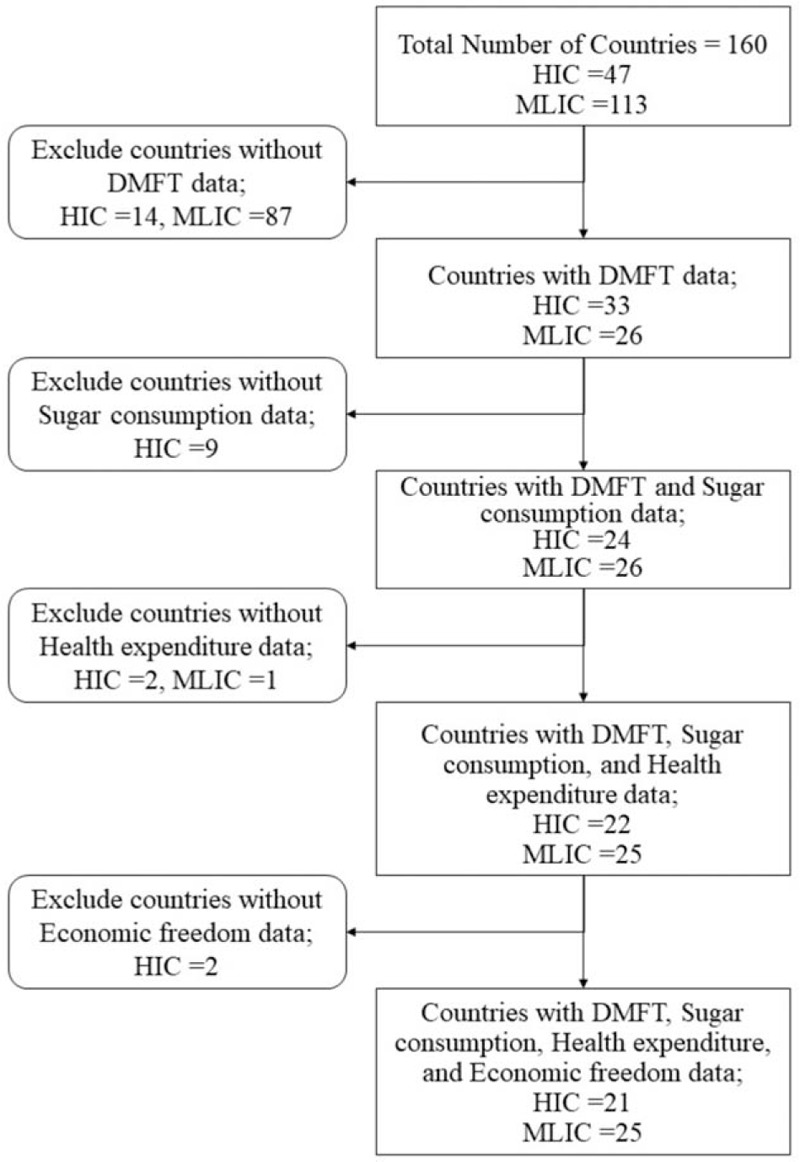
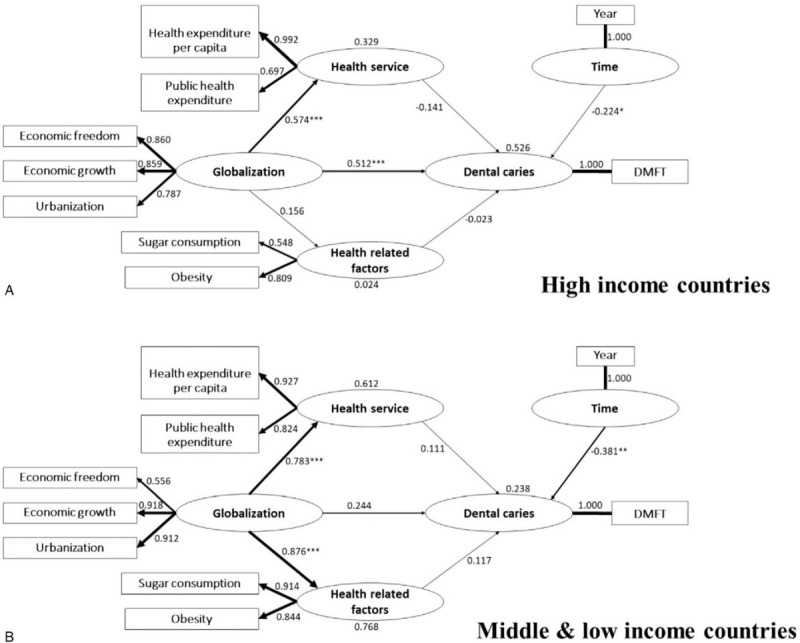
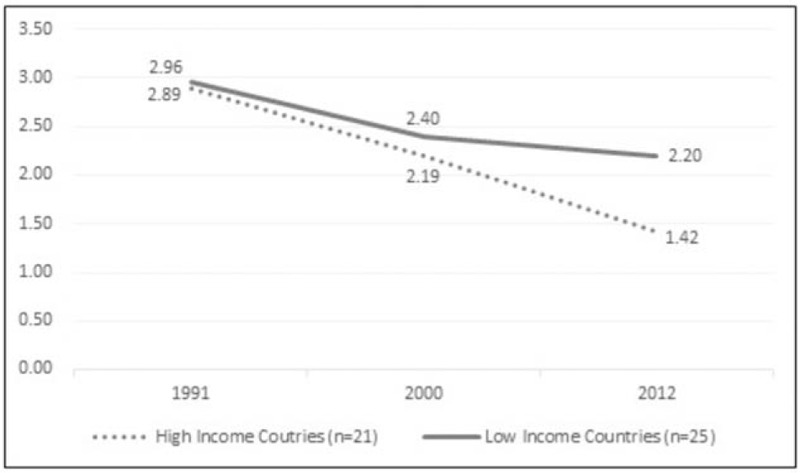
Risk factors such as smoking and sugar intake threaten the health of human being at an individual national level as well as at a global level. The globalization affect health indirectly through macro and micro-level factors. This study aimed to identify the global trend of dental caries according to countries national income level, and to examine the role of globalization, health services, obesity, and sugar consumption on dental caries. Data for 160 countries were collected for the time period of the 1990s to 2010s. The final sample included 46 countries with complete data (21 high income countries (HIC) and 25 middle and low income countries (MLIC)). The main dependent variable was the mean decayed, missing, and filled teeth (DMFT) index of 12-year-olds as an indicator of dental caries. Globalization was a main independent variable which was measured by economic growth, urbanization and economic freedom. Other independent variables were health services, obesity and sugar consumption. The data were analyzed first using repeated measures analysis of variance to compare dental caries trends in HIC and MLIC. Then, using multiple linear regression and partial least squares structural equation modeling (PLS-SEM), the relationships between globalization, health services, obesity, sugar consumption, and dental caries were examined. The results of PLS-SEM revealed that globalization was associated with lower DMFT in HIC. The global dental caries trend had a declined pattern, but this pattern has been attenuated in MLIC after the new millennium. There is a need for policy change and regulations on sugar trade especially in MLIC to diminish the adverse consequences of globalization, and to improve population dental health.
吸烟和糖分摄入等风险因素在国家层面和全球层面都威胁着人类健康。全球化通过宏观和微观层面的因素间接影响健康。本研究旨在根据各国国民收入水平确定全球龋齿趋势,并考察全球化、卫生服务、肥胖和糖分消费对龋齿的作用。收集了1990年代至2010年代期间160个国家的数据。最终样本包括46个拥有完整数据的国家(21个高收入国家和25个中低收入国家)。主要因变量是12岁儿童的平均龋失补牙(DMFT)指数,作为龋齿的一个指标。全球化是主要自变量,通过经济增长、城市化和经济自由度来衡量。其他自变量是卫生服务、肥胖和糖分消费。首先使用重复测量方差分析来比较高收入国家和中低收入国家的龋齿趋势。然后,使用多元线性回归和偏最小二乘结构方程模型(PLS-SEM)来考察全球化、卫生服务、肥胖、糖分消费与龋齿之间的关系。PLS-SEM的结果显示,全球化与高收入国家较低的DMFT相关。全球龋齿趋势呈下降模式,但在新千年之后,这种模式在中低收入国家有所减弱。有必要对糖分贸易进行政策变革和监管,尤其是在中低收入国家,以减少全球化的不利影响,并改善民众的口腔健康。