
肾透析对老年患者髋部骨折手术后死亡率和并发症的影响:一项基于人群的回顾性队列研究。
Effect of renal dialysis on mortality and complications following hip fracture surgery in elderly patients: A population based retrospective cohort study.
作者信息
Ahn Eun-Jin, Bang Si Ra
机构信息
Department of Anesthesiology and Pain Medicine, Chung-Ang University Medical Center, Chung-Ang University College of Medicine.
Department of Anesthesiology and Pain Medicine, Inje University Seoul Paik Hospital, Seoul, Korea.
出版信息
Medicine (Baltimore). 2020 Aug 14;99(33):e21676. doi: 10.1097/MD.0000000000021676.
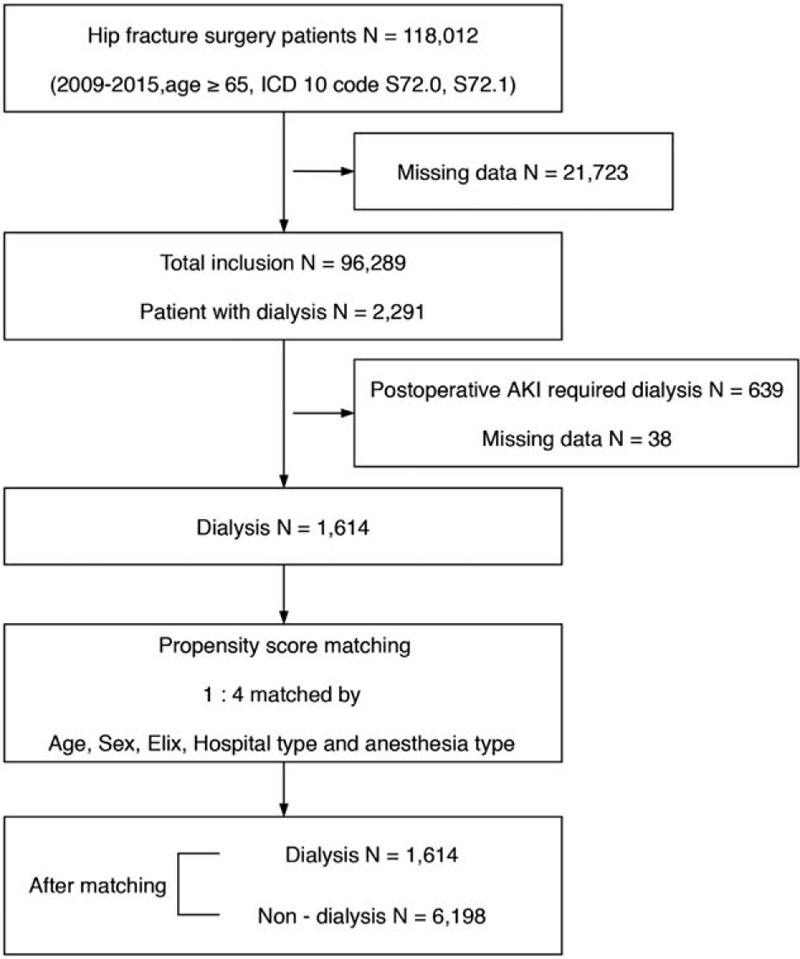
Hip fractures in older patients requiring dialysis are associated with high mortality. The primary aim of this study was to evaluate the specific burden of dialysis on 30-day mortality following hip fracture surgery. The secondary aim was to determine the burden of dialysis on overall survival as well as several postoperative complications.A retrospective cohort study was conducted using data from the Korean National Health Insurance Research Database. Patients were aged ≥65 years and underwent hip fracture surgery during the period from 2009 to 2015. To construct a matched cohort, each dialysis patient was matched to 4 non-dialysis patients based on age, sex, hospital type, anesthesia type, and comorbidities. Survival status was determined 30 days after surgery and at the end of the study period.In total, 96,289 patients were identified. Among them, 1614 dialysis patients were included and matched to 6198 non-dialysis patients. During the 30-day postoperative period, there were 102 mortality events in the dialysis group and 127 in the non-dialysis group, for an adjusted hazard ratio of 3.12 (95% confidence interval, 2.42-4.09). Overall, by the end of the study period, there were 1120 mortality events in the dialysis group and 2731 in the non-dialysis group, for an adjusted hazard ratio of 1.97 (95% confidence interval, 1.83-2.1). These findings may be limited by the characteristics of the administrative database.The 30-day mortality rate was 3-fold higher in the dialysis group than in the non-dialysis group, while the overall mortality rate was approximately 2-fold higher in the dialysis group than in the non-dialysis group. These findings suggest that caution in the perioperative period is required in dialysis patients undergoing hip fracture surgery. The results of our study represent only an association between dialysis and mortality. Further studies are necessary to investigate the possible causal effect of dialysis on mortality and complications after hip fracture surgery.
需要透析的老年患者髋部骨折与高死亡率相关。本研究的主要目的是评估透析对髋部骨折手术后30天死亡率的具体影响。次要目的是确定透析对总体生存率以及几种术后并发症的影响。利用韩国国民健康保险研究数据库的数据进行了一项回顾性队列研究。患者年龄≥65岁,在2009年至2015年期间接受了髋部骨折手术。为构建匹配队列,根据年龄、性别、医院类型、麻醉类型和合并症,将每名透析患者与4名非透析患者进行匹配。在手术后30天及研究期末确定生存状态。
总共识别出96289名患者。其中,纳入了1614名透析患者,并与6198名非透析患者进行匹配。在术后30天内,透析组有102例死亡事件,非透析组有127例,调整后的风险比为3.12(95%置信区间,2.42 - 4.09)。总体而言,到研究期末,透析组有1120例死亡事件,非透析组有2731例,调整后的风险比为1.97(95%置信区间,1.83 - 2.1)。这些发现可能受行政数据库特征的限制。
透析组的30天死亡率比非透析组高3倍,而透析组总的死亡率比非透析组高约2倍。这些发现表明,接受髋部骨折手术的透析患者在围手术期需要谨慎。我们研究的结果仅代表透析与死亡率之间的关联。有必要进一步研究以调查透析对髋部骨折手术后死亡率和并发症可能的因果效应。


 Zotero 插件