
髋部骨折修复术后的死亡及术后并发症:透析的影响
Death and Postoperative Complications After Hip Fracture Repair: Dialysis Effect.
作者信息
Hickson LaTonya J, Farah Wigdan H, Johnson Rebecca L, Thorsteinsdottir Bjorg, Ubl Daniel S, Yuan Brandon J, Albright Robert, Rule Andrew D, Habermann Elizabeth B
机构信息
Division of Nephrology and Hypertension, Department of Medicine, Mayo Clinic, Rochester, Minnesota, USA.
Robert D. and Patricia E. Kern Center for the Science of Health Care Delivery, Mayo Clinic, Rochester, Minnesota, USA.
出版信息
Kidney Int Rep. 2018 Jul 7;3(6):1294-1303. doi: 10.1016/j.ekir.2018.07.001. eCollection 2018 Nov.
INTRODUCTION
It is unknown whether patients receiving dialysis have a higher morbidity and mortality risk after hip fracture repair conferred by their kidney failure or by the high comorbidity burden often present.
METHODS
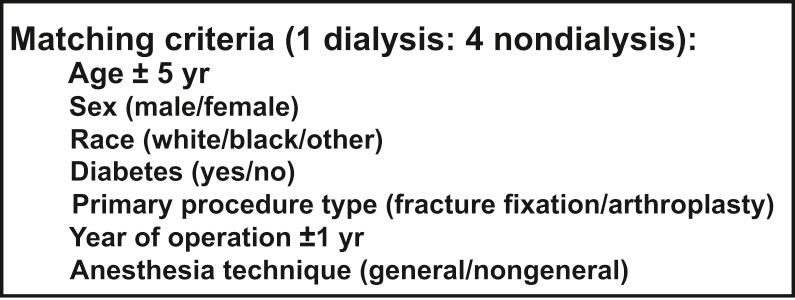
We examined associations of dialysis dependency with postoperative complications, death, and readmission in a matched cohort study of U.S. patients undergoing hip fracture repair, from January 2010 to December 2013, in the American College of Surgeons National Surgical Quality Improvement Program. Matching included sex, age, race, diabetes mellitus, operation year, primary surgery type, and anesthesia technique.
RESULTS
Among 22,621 patients, 377 dialysis-dependent patients were matched to 1508 nondialysis patients. Median age was 78 years (interquartile range = 68-85) years, 56% were men, 70% were white, 43% had diabetes, and 47% underwent fracture fixation under mostly (80%) general anesthesia. Dialysis-dependent patients had higher physical status classification, had more heart failure and hypoalbuminemia, and were less often smokers. After adjustment, a greater risk of prolonged postoperative stays beyond 7 days (odds ratio [OR] = 1.43, 95% confidence interval [CI] = 1.09-1.89), higher in-hospital mortality (OR = 3.13, CI = 1.72-5.7), and 30-day death (OR = 2.29, CI = 1.51-3.48) but not 30-day readmission ( = 0.09) was observed with dialysis dependency. Adjusted analyses in the original cohort (n = 22,621) were similar: the dialysis group had greater risk of prolonged postoperative stay (OR = 1.77, CI = 1.42-2.21), in-hospital mortality (OR = 2.65, CI = 1.74-4.05), and 30-day death (OR = 2.03, CI = 1.48-2.80) and 30-day readmission (OR = 1.62, CI = 1.66-2.26).
CONCLUSION
Dialysis dependency is associated with an increased risk of death and postoperative complications after hip fracture repair. These findings have implications for case-mix adjustment and quality metrics.
引言
接受透析治疗的患者在髋部骨折修复术后是否因肾衰竭或通常存在的高合并症负担而具有更高的发病和死亡风险尚不清楚。
方法
在美国外科医师学会国家外科质量改进计划中,我们对2010年1月至2013年12月期间接受髋部骨折修复术的美国患者进行了一项匹配队列研究,以检查透析依赖与术后并发症、死亡和再入院之间的关联。匹配因素包括性别、年龄、种族、糖尿病、手术年份、主要手术类型和麻醉技术。
结果
在22621名患者中,377名依赖透析的患者与1508名非透析患者进行了匹配。中位年龄为78岁(四分位间距=68-85岁),56%为男性,70%为白人,43%患有糖尿病,47%在大部分(80%)全身麻醉下接受骨折固定。依赖透析的患者身体状况分类较高,心力衰竭和低白蛋白血症较多,吸烟的情况较少。调整后,观察到依赖透析的患者术后住院时间延长超过7天的风险更高(比值比[OR]=1.43,95%置信区间[CI]=1.09-1.89)、住院死亡率更高(OR=3.13,CI=1.72-5.7)以及30天死亡率更高(OR=2.29,CI=1.51-3.48),但30天再入院率无差异(OR=0.09)。在原始队列(n=22621)中的调整分析结果相似:透析组术后住院时间延长的风险更高(OR=1.77,CI=1.42-2.21)、住院死亡率更高(OR=2.65,CI=1.74-4.05)、30天死亡率更高(OR=2.03,CI=1.48-2.80)以及30天再入院率更高(OR=1.62,CI=1.66-2.26)。
结论
透析依赖与髋部骨折修复术后死亡风险和术后并发症增加相关。这些发现对病例组合调整和质量指标具有启示意义。


 Zotero 插件