Torres-Do Rego Ana, Barrientos María, Ortega-Hernández Adriana, Modrego Javier, Gómez-Gordo Rubén, Álvarez-Sala Luis A, Cachofeiro Victoria, Gómez-Garre Dulcenombre
Internal Medicine Service, HGU Gregorio Marañón, Instituto Investigación Sanitaria Gregorio Marañón (IiSGM), 28007 Madrid, Spain.
Vascular Biology Research Laboratory, Hospital Clínico San Carlos-Instituto de Investigación Sanitaria del Hospital Clínico San Carlos (IdISSC), 28040 Madrid, Spain.
J Clin Med. 2020 Aug 28;9(9):2783. doi: 10.3390/jcm9092783.
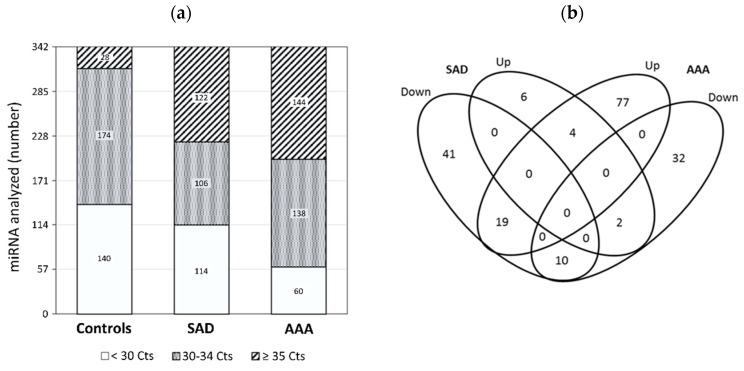
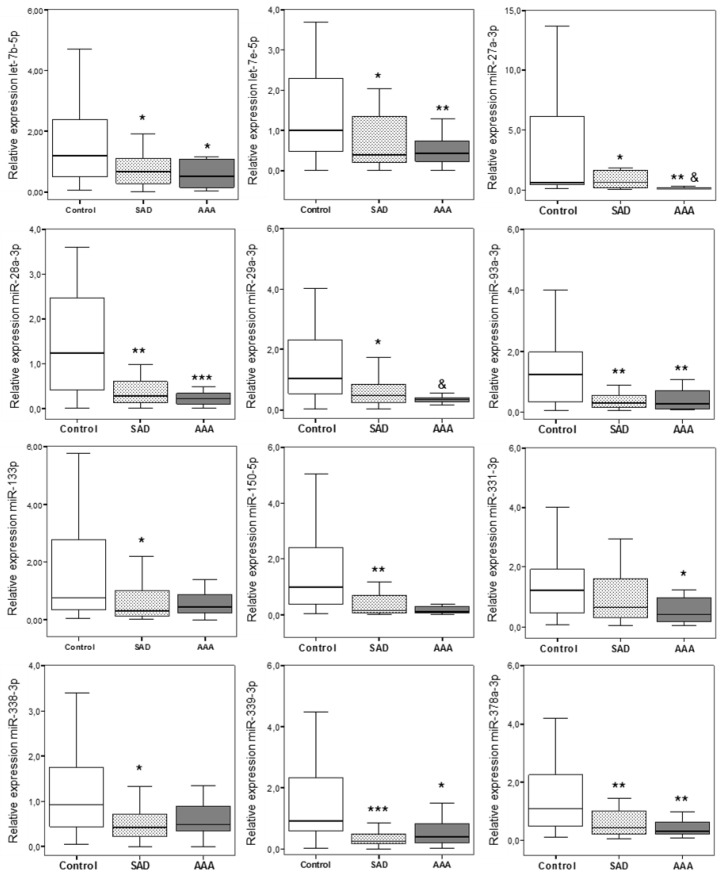
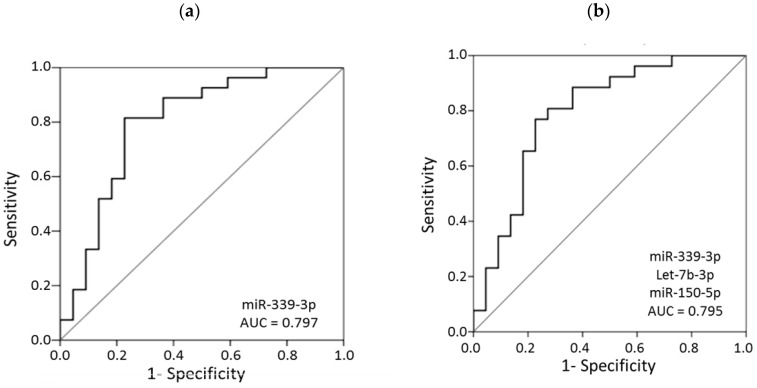
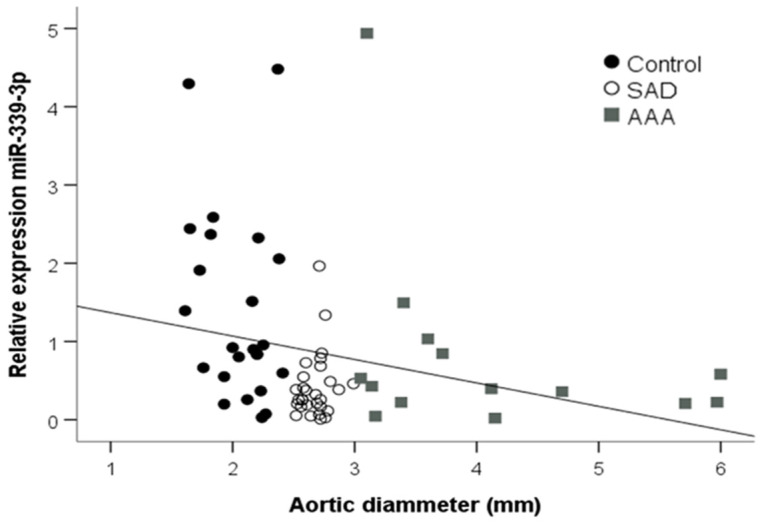
Patients with subaneurysmal aortic dilation (SAD; 25-29 mm diameter) are likely to progress to true abdominal aortic aneurysm (AAA). Despite these patients having a higher risk of all-cause mortality than subjects with aortic size <24 mm, early diagnostic biomarkers are lacking. MicroRNAs (miRs) are well-recognized potential biomarkers due to their differential expression in different tissues and their stability in blood. We have investigated whether a plasma miRs profile could identify the presence of SAD in high cardiovascular risk patients. Using qRT-PCR arrays in plasma samples, we determined miRs differentially expressed between SAD patients and patients with normal aortic diameter. We then selected 12 miRs to be investigated as biomarkers by construction of ROC curves. A total of 82 significantly differentially expressed miRs were found by qPCR array, and 12 were validated by qRT-PCR. ROC curve analyses showed that seven selected miRs (miR-28-3p, miR-29a-3p, miR-93-3p, miR-150-5p, miR-338-3p, miR-339-3p, and miR-378a-3p) could be valuable biomarkers for distinguishing SAD patients. MiR-339-3p showed the best sensitivity and specificity, even after combination with other miRs. Decreased miR-339-3p expression was associated with increased aortic abdominal diameter. MiR-339-3p, alone or in combination with other miRs, could be used for SAD screening in high cardiovascular risk patients, helping to the early diagnosis of asymptomatic AAA.
患有亚动脉瘤性主动脉扩张(SAD;直径25 - 29毫米)的患者很可能进展为真性腹主动脉瘤(AAA)。尽管这些患者的全因死亡率高于主动脉直径<24毫米的受试者,但目前缺乏早期诊断生物标志物。微小RNA(miRs)因其在不同组织中的差异表达及其在血液中的稳定性而被公认为潜在的生物标志物。我们研究了血浆miRs谱是否能够识别心血管高危患者中SAD的存在。通过对血浆样本进行qRT-PCR阵列分析,我们确定了SAD患者与主动脉直径正常患者之间差异表达的miRs。然后通过构建ROC曲线选择了12种miRs作为生物标志物进行研究。通过qPCR阵列共发现82种显著差异表达的miRs,其中12种通过qRT-PCR得到验证。ROC曲线分析表明,七种选定的miRs(miR-28-3p、miR-29a-3p、miR-93-3p、miR-150-5p、miR-338-3p、miR-339-3p和miR-378a-3p)可能是区分SAD患者的有价值的生物标志物。即使与其他miRs联合使用,miR-339-3p也表现出最佳的敏感性和特异性。miR-339-3p表达降低与腹主动脉直径增加相关。miR-339-3p单独或与其他miRs联合使用,可用于心血管高危患者的SAD筛查,有助于无症状AAA的早期诊断。