Department of Health Promotion System Sciences, Division of Health Sciences, Graduate School of Medicine, Osaka University, Osaka, Japan.
Department of Geriatric and General Medicine, Graduate School of Medicine, Osaka University, Osaka, Japan.
Environ Health Prev Med. 2020 Sep 1;25(1):46. doi: 10.1186/s12199-020-00884-3.
Preventing the need for long-term care (LTC) by identifying physical function risk factors are important to decrease the LTC burden. The objective of this study was to investigate whether grip strength and/or walking speed, which are components of the frailty definition, are associated with LTC in community-dwelling older and oldest people.
The participants were 1098 community-dwelling older and oldest people who had not received LTC at the baseline. The endpoint was receiving LTC after the baseline survey. The independent variables were grip strength and walking speed, and participants were divided into two groups based on these variables. The confounding factors were age, sex, the Japanese version of the Montreal Cognitive Assessment (MoCA-J), hypertension, diabetes mellitus, stroke, joint diseases, living alone, body mass index, and serum albumin. We calculated the hazard ratio of receiving LTC using the Cox proportional hazard model.
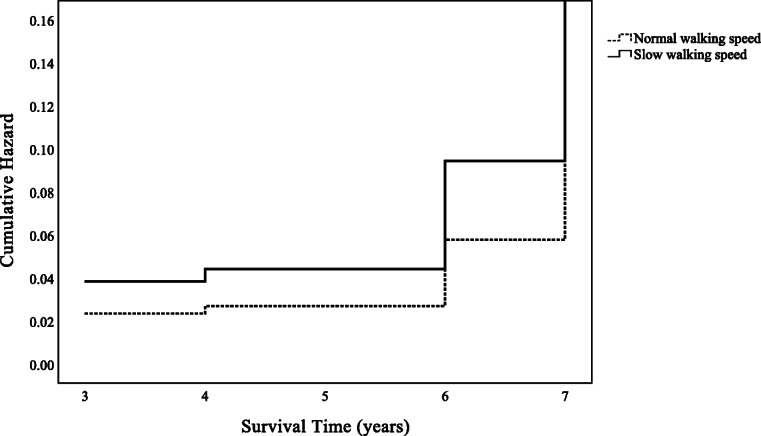
Among the 1098 participants, 107 (9.7%) newly received LTC during the follow-up. Regarding the physical function, only slow walking speed was significantly correlated with LTC after adjusting for all confounding factors except the MoCA-J score (HR = 1.74, 95% CI = 1.10-2.75, P = .018). However, slow walking speed was still a risk factor for LTC after adjusting for the MoCA-J score and other confounding factors (HR = 1.64, 95% CI = 1.03-2.60, P = .037).
The findings from this study may contribute to a better understanding of slow walking speed as a factor related to LTC, which might be a criterion for disability prevention and could serve as an outcome measure for physical function in older people.
通过识别身体功能风险因素来预防长期护理(LTC)的需求对于减轻 LTC 负担非常重要。本研究的目的是调查握力和/或步行速度(虚弱定义的组成部分)是否与社区居住的老年人和最老年人的 LTC 相关。
参与者为 1098 名在基线时未接受 LTC 的社区居住的老年人和最老年人。终点是在基线调查后接受 LTC。独立变量为握力和步行速度,根据这些变量将参与者分为两组。混杂因素为年龄、性别、日本蒙特利尔认知评估(MoCA-J)版本、高血压、糖尿病、中风、关节疾病、独居、体重指数和血清白蛋白。我们使用 Cox 比例风险模型计算接受 LTC 的风险比。
在 1098 名参与者中,有 107 名(9.7%)在随访期间新接受了 LTC。在身体功能方面,只有慢步行速度在调整除 MoCA-J 评分以外的所有混杂因素后与 LTC 显著相关(HR = 1.74,95%CI = 1.10-2.75,P =.018)。然而,在调整 MoCA-J 评分和其他混杂因素后,慢步行速度仍然是 LTC 的一个危险因素(HR = 1.64,95%CI = 1.03-2.60,P =.037)。
本研究的结果可能有助于更好地理解慢步行速度作为与 LTC 相关的因素,这可能是预防残疾的标准,并可作为老年人身体功能的结果衡量标准。