Lee Jia Jia, Nadkarni Nivedita Vikas, Teo Irene, Ozdemir Semra
Health Services and Systems Research, Duke-NUS Medical School, 8 College Road, Singapore, 169857 Singapore.
Centre for Quantitative Medicine, Duke-NUS Medical School, 8 College Road, Singapore, 169857 Singapore.
BMC Sports Sci Med Rehabil. 2020 Aug 31;12:52. doi: 10.1186/s13102-020-00202-y. eCollection 2020.
The rising prevalence of childhood obesity in developing and developed countries poses a major public health challenge to policy makers and an effective strategy to promote physical activity among adolescents is warranted. This study aimed to evaluate the effectiveness of providing descriptive norms messages with personal identification in promoting physical activity among adolescents by measuring step counts via a randomized controlled trial (NCT03081013).
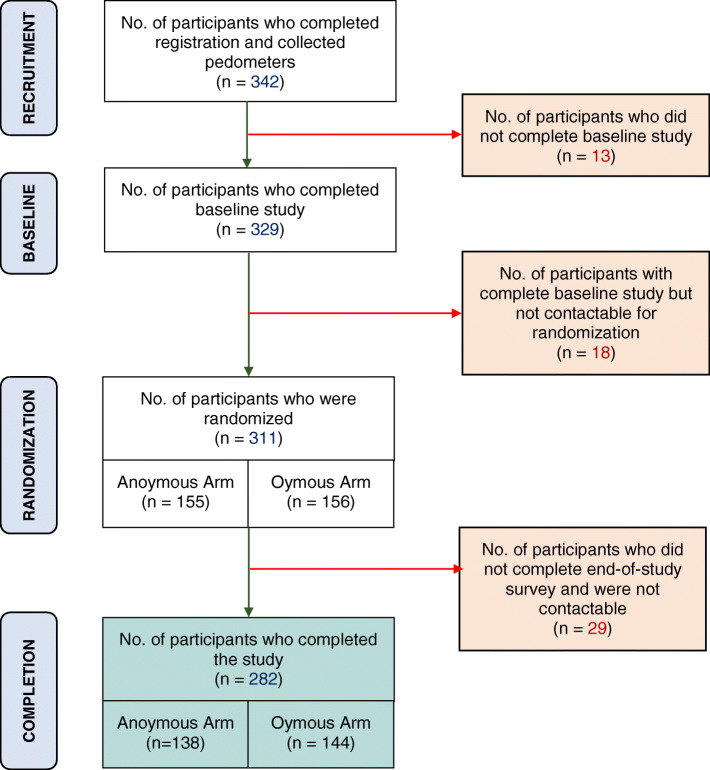
A total of 311 participants aged 13-16 were randomized into two study arms (Onymous and Anonymous Arms). Each arm consisted of 13 groups of 12 participants. During the trial, participants received weekly short message service (SMS) about their past week's physical activity performance. Participants in the Anonymous Arm received information about step counts of group members ranked from highest to lowest. Participants in the Onymous Arm received the same information with the group members' full names. Participants' quality of life, depression, physical activity social support, self-efficacy and enjoyment before and after the intervention were also evaluated. This study adheres to the CONSORT guidelines.
The number of steps was not higher when descriptive norm message was onymous compared to when it was anonymous. Scores in quality of life, depression, social support, self-efficacy, and enjoyment of physical activity were not significantly different between both arms ( > 0.05).
Our findings indicated that the effect of providing descriptive norms messages containing personal identification on physical activity promotion was not evident in the main analysis. Future studies may consider using a more relevant reference group to use social norms as a tool to increase physical activity among adolescents.
ClinicalTrials.gov - NCT03081013. Registered 15 Mar 2017-Retrospectively registered, https://clinicaltrials.gov/ct2/show/NCT03081013.
发展中国家和发达国家儿童肥胖率不断上升,给政策制定者带来了重大的公共卫生挑战,因此有必要采取有效策略促进青少年的体育活动。本研究旨在通过一项随机对照试验(NCT03081013)测量步数,评估提供带有个人身份识别的描述性规范信息对促进青少年体育活动的有效性。
共有311名年龄在13至16岁之间的参与者被随机分为两个研究组(实名组和匿名组)。每组由13个小组组成,每组12名参与者。在试验期间,参与者每周收到关于其过去一周体育活动表现的短信服务(SMS)。匿名组的参与者收到按步数从高到低排名的小组成员的步数信息。实名组的参与者收到相同的信息,但包含小组成员的全名。还评估了干预前后参与者的生活质量、抑郁程度、体育活动的社会支持、自我效能感和愉悦感。本研究遵循CONSORT指南。
与匿名时相比,实名的描述性规范信息并未使步数更高。两组在生活质量、抑郁程度、社会支持、自我效能感和体育活动愉悦感方面的得分无显著差异(P>0.05)。
我们的研究结果表明,在主要分析中,提供包含个人身份识别的描述性规范信息对促进体育活动的效果并不明显。未来的研究可以考虑使用更相关的参照组,将社会规范作为增加青少年体育活动的一种工具。
ClinicalTrials.gov - NCT03081013。于2017年3月15日注册——追溯注册,https://clinicaltrials.gov/ct2/show/NCT03081013 。