Rath Rama Shankar, Dixit Anand Mohan, Koparkar Anil Ramesh, Kharya Pradip, Joshi Hari Shanker
Assistant Professor, Department of Community Medicine & Family Medicine, All India Institute of Medical Sciences, Gorakhpur.
Department of Community Medicine & Family Medicine, All India Institute of Medical Sciences, Gorakhpur.
Nepal J Epidemiol. 2020 Jun 30;10(2):856-864. doi: 10.3126/nje.v10i2.28960. eCollection 2020 Jun.
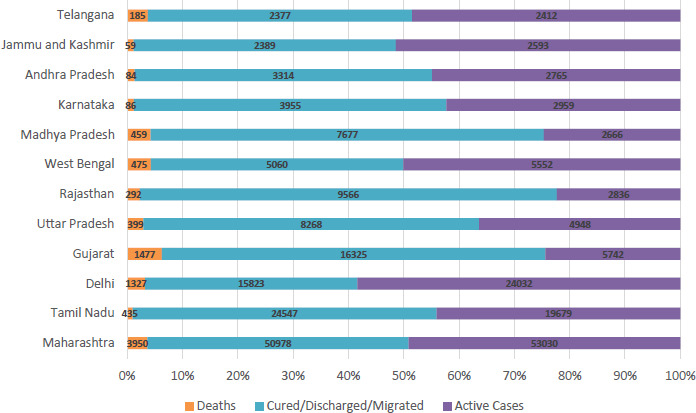
The COVID-19 pandemic currently expanded its roots to the 206 countries in the world. The morbidity and mortality are not only threat to humans but also its impact on economy is indirectly affecting us. The current review was done to find trend in various states of India. Data was collected from Ministry of Health and Family Welfare and descriptive analysis of the distribution of COVID-19 cases in different states of India. First case of COVID-19 was diagnosed in southernmost state Kerala and after that it has spread to all other states, but situations are more worsen in states with high international migration. Maharashtra is now the most affected state followed by Delhi. Among epidemic curve of all these states, Maharashtra has rapidly growing epidemic curve with highest slope, whereas Kerala has the lowest. When we compared the day wise cumulative case fatality rate, it was found that the case fatality rate of the states like Maharashtra, Madhya Pradesh & Rajasthan showed decrease in the case fatality rate over the period. Population density is also one of the key determinants of social interaction and thus the spread of disease specifically in communicable diseases. Government of India had taken many strong initiatives e.g. 40 days nation-wide lockdown, thermal screening at airport, announcement of relief packages for poor and quarantine of outsiders but still there are many missed opportunities like, early stoppage of international traffic, compulsory quarantine for all international travellers, better contact tracing, strong law and order and better preparedness plan.
新冠疫情目前已蔓延至全球206个国家。其发病率和死亡率不仅对人类构成威胁,而且对经济的影响也在间接影响着我们。本次综述旨在探究印度各邦的疫情趋势。数据收集自卫生和家庭福利部,并对印度不同邦新冠病例的分布进行了描述性分析。新冠首例病例在最南端的喀拉拉邦被确诊,此后疫情蔓延至所有其他邦,但在国际移民较多的邦情况更为严峻。马哈拉施特拉邦目前是受影响最严重的邦,其次是德里。在所有这些邦的疫情曲线中,马哈拉施特拉邦的疫情曲线增长迅速且斜率最高,而喀拉拉邦的斜率最低。当我们比较每日累计病死率时,发现马哈拉施特拉邦、中央邦和拉贾斯坦邦等邦的病死率在此期间有所下降。人口密度也是社会交往的关键决定因素之一,因此也是疾病传播尤其是传染病传播的关键因素之一。印度政府采取了许多有力举措,如全国范围内40天的封锁、机场体温筛查、宣布为贫困人口提供救济包以及对外来人员进行隔离,但仍存在许多错失的机会,如过早停止国际交通、对所有国际旅行者进行强制隔离、更好的接触者追踪、强有力的法律和秩序以及更好的准备计划。