• 文献检索
  • 文档翻译
  • 深度研究
  • 学术资讯
  • Suppr Zotero 插件Zotero 插件
  • 邀请有礼
  • 套餐&价格
  • 历史记录
应用&插件
Suppr Zotero 插件Zotero 插件浏览器插件Mac 客户端Windows 客户端微信小程序
定价
高级版会员购买积分包购买API积分包
服务
文献检索文档翻译深度研究API 文档MCP 服务
关于我们
关于 Suppr公司介绍联系我们用户协议隐私条款
关注我们

Suppr 超能文献

核心技术专利:CN118964589B侵权必究
粤ICP备2023148730 号-1Suppr @ 2026

文献检索

告别复杂PubMed语法,用中文像聊天一样搜索,搜遍4000万医学文献。AI智能推荐,让科研检索更轻松。

立即免费搜索

文件翻译

保留排版,准确专业,支持PDF/Word/PPT等文件格式,支持 12+语言互译。

免费翻译文档

深度研究

AI帮你快速写综述,25分钟生成高质量综述,智能提取关键信息,辅助科研写作。

立即免费体验

新冠疫情的潜在传播模式是什么?特定年龄的社会接触特征分析。

What are the underlying transmission patterns of COVID-19 outbreak? An age-specific social contact characterization.

作者信息

Liu Yang, Gu Zhonglei, Xia Shang, Shi Benyun, Zhou Xiao-Nong, Shi Yong, Liu Jiming

机构信息

Department of Computer Science, Hong Kong Baptist University, Hong Kong, China.

HKBU-CSD & NIPD Joint Research Laboratory for Intelligent Disease Surveillance and Control, Hong Kong, China.

出版信息

EClinicalMedicine. 2020 Apr 18;22:100354. doi: 10.1016/j.eclinm.2020.100354. eCollection 2020 May.

DOI:10.1016/j.eclinm.2020.100354
PMID:32313879
原文链接:https://pmc.ncbi.nlm.nih.gov/articles/PMC7165295/
Abstract

BACKGROUND

COVID-19 has spread to 6 continents. Now is opportune to gain a deeper understanding of what may have happened. The findings can help inform mitigation strategies in the disease-affected countries.

METHODS

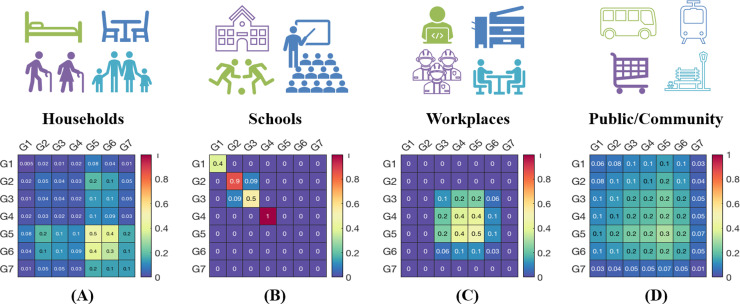
In this work, we examine an essential factor that characterizes the disease transmission patterns: the interactions among people. We develop a computational model to reveal the interactions in terms of the social contact patterns among the population of different age-groups. We divide a city's population into seven age-groups: 0-6 years old (children); 7-14 (primary and junior high school students); 15-17 (high school students); 18-22 (university students); 23-44 (young/middle-aged people); 45-64 years old (middle-aged/elderly people); and 65 or above (elderly people). We consider four representative settings of social contacts that may cause the disease spread: (1) individual households; (2) schools, including primary/high schools as well as colleges and universities; (3) various physical workplaces; and (4) public places and communities where people can gather, such as stadiums, markets, squares, and organized tours. A contact matrix is computed to describe the contact intensity between different age-groups in each of the four settings. By integrating the four contact matrices with the next-generation matrix, we quantitatively characterize the underlying transmission patterns of COVID-19 among different populations.

FINDINGS

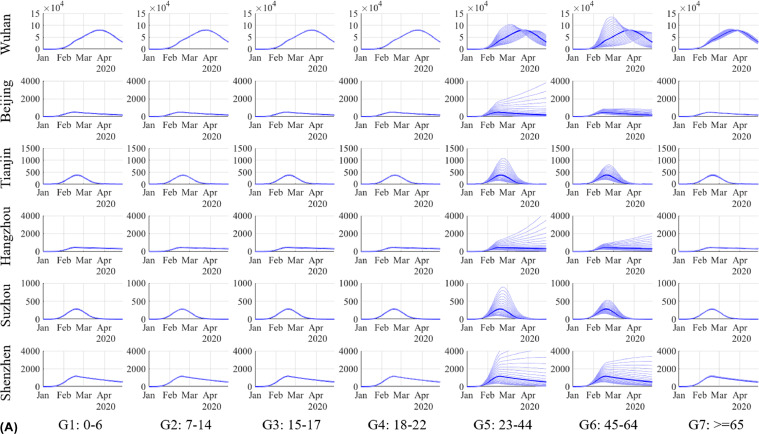
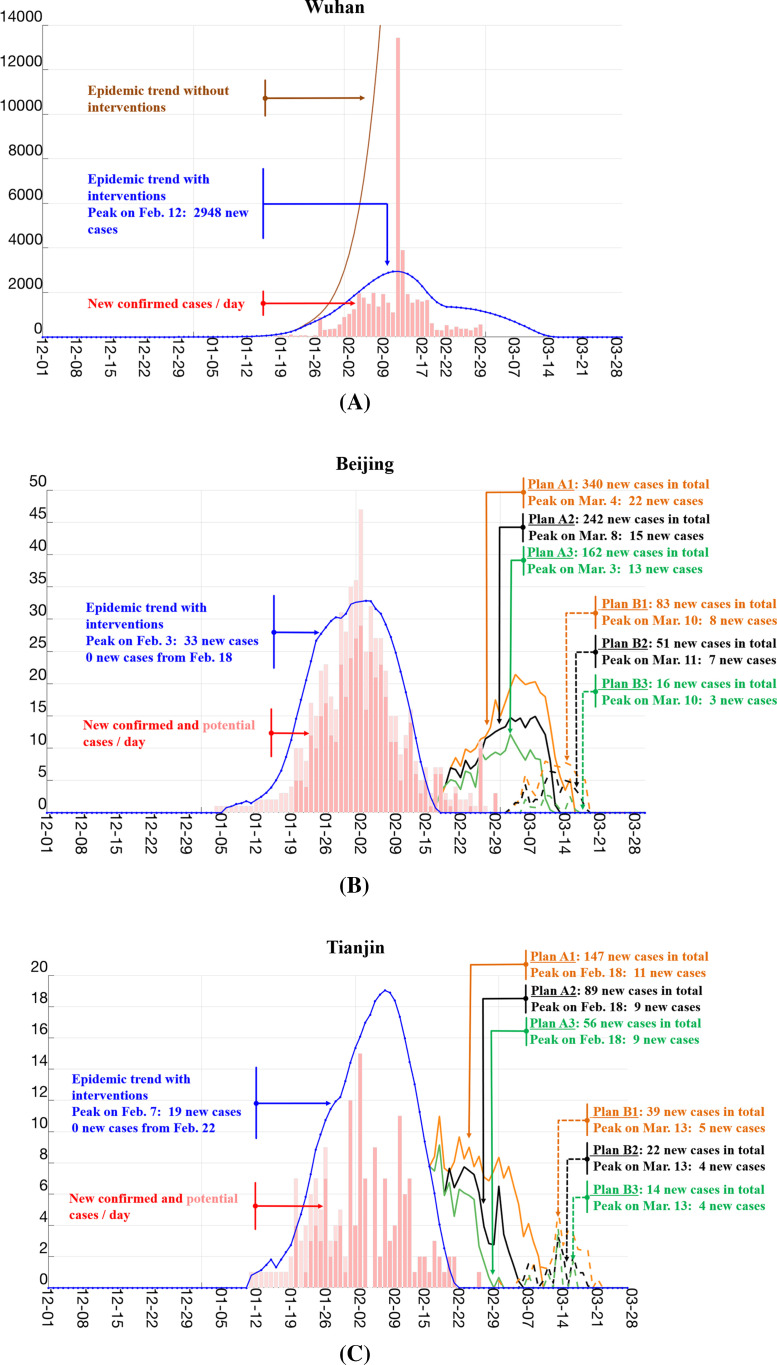
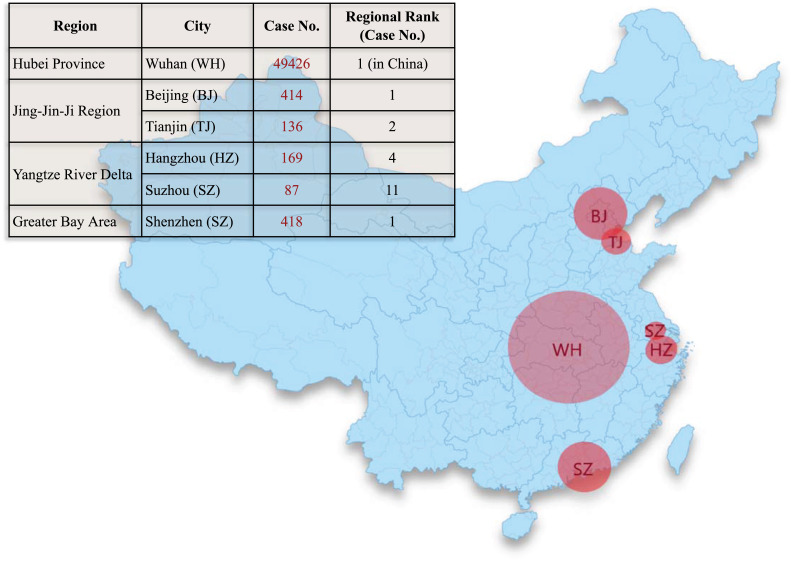
We focus our study on 6 representative cities in China: Wuhan, the epicenter of COVID-19 in China, together with Beijing, Tianjin, Hangzhou, Suzhou, and Shenzhen, which are five major cities from three key economic zones. The results show that the social contact-based analysis can readily explain the underlying disease transmission patterns as well as the associated risks (including both confirmed and unconfirmed cases). In Wuhan, the age-groups involving relatively intensive contacts in households and public/communities are dispersedly distributed. This can explain why the transmission of COVID-19 in the early stage mainly took place in public places and families in Wuhan. We estimate that Feb. 11, 2020 was the date with the highest transmission risk in Wuhan, which is consistent with the actual peak period of the reported case number (Feb. 4-14). Moreover, the surge in the number of new cases reported on Feb. 12 and 13 in Wuhan can readily be captured using our model, showing its ability in forecasting the potential/unconfirmed cases. We further estimate the disease transmission risks associated with different work resumption plans in these cities after the outbreak. The estimation results are consistent with the actual situations in the cities with relatively lenient policies, such as Beijing, and those with strict policies, such as Shenzhen.

INTERPRETATION

With an in-depth characterization of age-specific social contact-based transmission, the retrospective and prospective situations of the disease outbreak, including the past and future transmission risks, the effectiveness of different interventions, and the disease transmission risks of restoring normal social activities, are computationally analyzed and reasonably explained. The conclusions drawn from the study not only provide a comprehensive explanation of the underlying COVID-19 transmission patterns in China, but more importantly, offer the social contact-based risk analysis methods that can readily be applied to guide intervention planning and operational responses in other countries, so that the impact of COVID-19 pandemic can be strategically mitigated.

FUNDING

General Research Fund of the Hong Kong Research Grants Council; Key Project Grants of the National Natural Science Foundation of China.
https://cdn.ncbi.nlm.nih.gov/pmc/blobs/a1e6/7264976/c44fa6a20f9c/gr4a.jpg
https://cdn.ncbi.nlm.nih.gov/pmc/blobs/a1e6/7264976/31986cca9680/gr1.jpg
https://cdn.ncbi.nlm.nih.gov/pmc/blobs/a1e6/7264976/1382735ed8d8/gr2.jpg
https://cdn.ncbi.nlm.nih.gov/pmc/blobs/a1e6/7264976/7965ab87830f/gr3a-c.jpg
https://cdn.ncbi.nlm.nih.gov/pmc/blobs/a1e6/7264976/c44fa6a20f9c/gr4a.jpg
https://cdn.ncbi.nlm.nih.gov/pmc/blobs/a1e6/7264976/31986cca9680/gr1.jpg
https://cdn.ncbi.nlm.nih.gov/pmc/blobs/a1e6/7264976/1382735ed8d8/gr2.jpg
https://cdn.ncbi.nlm.nih.gov/pmc/blobs/a1e6/7264976/7965ab87830f/gr3a-c.jpg
https://cdn.ncbi.nlm.nih.gov/pmc/blobs/a1e6/7264976/c44fa6a20f9c/gr4a.jpg
摘要

背景

新型冠状病毒肺炎(COVID-19)已蔓延至六大洲。当下是深入了解可能发生情况的契机。这些发现有助于为疫情受影响国家的缓解策略提供参考。

方法

在本研究中,我们考察了表征疾病传播模式的一个关键因素:人与人之间的相互作用。我们开发了一个计算模型,以不同年龄组人群的社会接触模式来揭示这种相互作用。我们将城市人口划分为七个年龄组:0 - 6岁(儿童);7 - 14岁(中小学生);15 - 17岁(高中生);18 - 22岁(大学生);23 - 44岁(青年/中年人);45 - 64岁(中年/老年人);65岁及以上(老年人)。我们考虑了可能导致疾病传播的四种具有代表性的社会接触场景:(1)个体家庭;(2)学校,包括中小学以及高校;(3)各类工作场所;(4)人们可以聚集的公共场所和社区,如体育场、市场、广场及有组织的旅游活动场所。计算得出一个接触矩阵,以描述这四种场景中不同年龄组之间的接触强度。通过将这四个接触矩阵与下一代矩阵相结合,我们定量地刻画了COVID-19在不同人群中的潜在传播模式。

研究结果

我们的研究聚焦于中国6个具有代表性的城市:COVID-19在中国的疫情中心武汉,以及来自三个关键经济区的五个主要城市北京、天津、杭州、苏州和深圳。结果表明,基于社会接触的分析能够很好地解释潜在的疾病传播模式以及相关风险(包括确诊和未确诊病例)。在武汉,家庭及公共/社区中接触相对密集的年龄组分布较为分散。这可以解释为什么COVID-19在武汉早期主要在公共场所和家庭中传播。我们估计2020年2月11日是武汉传播风险最高的日期,这与报告病例数的实际高峰期(2月4日至14日)相符。此外,我们的模型能够很好地捕捉到武汉2月12日和13日报告的新增病例激增情况,显示出其对潜在/未确诊病例的预测能力。我们进一步估计了疫情爆发后这些城市不同复工计划所带来的疾病传播风险。估计结果与政策相对宽松的城市(如北京)和政策严格的城市(如深圳)的实际情况相符。

解读

通过深入刻画基于特定年龄社会接触的传播情况,对疾病爆发的回顾性和前瞻性情况进行了计算分析和合理解释,包括过去和未来的传播风险、不同干预措施的效果以及恢复正常社会活动的疾病传播风险。该研究得出的结论不仅全面解释了中国COVID-19的潜在传播模式,更重要的是,提供了基于社会接触的风险分析方法,可直接应用于指导其他国家的干预规划和应对行动,从而从战略上减轻COVID-19大流行的影响。

资金来源

香港研究资助局一般研究基金;中国国家自然科学基金重点项目资助。

相似文献

1
What are the underlying transmission patterns of COVID-19 outbreak? An age-specific social contact characterization.新冠疫情的潜在传播模式是什么?特定年龄的社会接触特征分析。
EClinicalMedicine. 2020 Apr 18;22:100354. doi: 10.1016/j.eclinm.2020.100354. eCollection 2020 May.
2
Folic acid supplementation and malaria susceptibility and severity among people taking antifolate antimalarial drugs in endemic areas.在流行地区,服用抗叶酸抗疟药物的人群中,叶酸补充剂与疟疾易感性和严重程度的关系。
Cochrane Database Syst Rev. 2022 Feb 1;2(2022):CD014217. doi: 10.1002/14651858.CD014217.
3
Social contact patterns and implications for infectious disease transmission - a systematic review and meta-analysis of contact surveys.社交接触模式及其对传染病传播的影响——基于接触调查的系统评价和荟萃分析。
Elife. 2021 Nov 25;10:e70294. doi: 10.7554/eLife.70294.
4
Nowcasting and forecasting the potential domestic and international spread of the 2019-nCoV outbreak originating in Wuhan, China: a modelling study.实时预测和预报源自中国武汉的 2019-nCoV 疫情在国内和国际的潜在传播:一项建模研究。
Lancet. 2020 Feb 29;395(10225):689-697. doi: 10.1016/S0140-6736(20)30260-9. Epub 2020 Jan 31.
5
Uncovering transmission patterns of COVID-19 outbreaks: A region-wide comprehensive retrospective study in Hong Kong.揭示新冠疫情的传播模式:香港地区范围的全面回顾性研究
EClinicalMedicine. 2021 Jun;36:100929. doi: 10.1016/j.eclinm.2021.100929. Epub 2021 Jun 6.
6
Patterns of human social contact and mask wearing in high-risk groups in China.中国人的社会接触模式和高风险人群的口罩佩戴情况。
Infect Dis Poverty. 2022 Jun 18;11(1):69. doi: 10.1186/s40249-022-00988-8.
7
Measures implemented in the school setting to contain the COVID-19 pandemic.学校为控制 COVID-19 疫情而采取的措施。
Cochrane Database Syst Rev. 2022 Jan 17;1(1):CD015029. doi: 10.1002/14651858.CD015029.
8
A familial cluster of pneumonia associated with the 2019 novel coronavirus indicating person-to-person transmission: a study of a family cluster.一个涉及 2019 年新型冠状病毒的家庭聚集性肺炎病例,提示存在人际传播:一项家庭聚集性研究。
Lancet. 2020 Feb 15;395(10223):514-523. doi: 10.1016/S0140-6736(20)30154-9. Epub 2020 Jan 24.
9
Associations between changes in population mobility in response to the COVID-19 pandemic and socioeconomic factors at the city level in China and country level worldwide: a retrospective, observational study.应对 COVID-19 大流行期间人口流动变化与中国城市层面和全球国家层面社会经济因素的关联:一项回顾性观察研究。
Lancet Digit Health. 2021 Jun;3(6):e349-e359. doi: 10.1016/S2589-7500(21)00059-5.
10
Estimating Changes in Contact Patterns in China Over the First Year of the COVID-19 Pandemic: Implications for SARS-CoV-2 Spread - Four Cities, China, 2020.评估新冠疫情大流行第一年中国接触模式的变化:对严重急性呼吸综合征冠状病毒2传播的影响——中国四个城市,2020年
China CDC Wkly. 2023 Feb 3;5(5):113-119. doi: 10.46234/ccdcw2023.021.

引用本文的文献

1
Impact of COVID-19 on Stock Indices Volatility: Long-Memory Persistence, Structural Breaks, or Both?新冠疫情对股票指数波动率的影响:长期记忆持续性、结构突变,还是两者皆有?
Ann Data Sci. 2022 Sep 12:1-28. doi: 10.1007/s40745-022-00446-0.
2
Assessing the role of children in the COVID-19 pandemic in Belgium using perturbation analysis.运用扰动分析评估比利时儿童在新冠疫情中的作用。
Nat Commun. 2025 Mar 5;16(1):2230. doi: 10.1038/s41467-025-57087-z.
3
Bayesian inference for the onset time and epidemiological characteristics of emerging infectious diseases.

本文引用的文献

1
Feasibility of controlling COVID-19 outbreaks by isolation of cases and contacts.通过隔离病例和接触者控制 COVID-19 疫情爆发的可行性。
Lancet Glob Health. 2020 Apr;8(4):e488-e496. doi: 10.1016/S2214-109X(20)30074-7. Epub 2020 Feb 28.
2
[Urgent research agenda for the novel coronavirus epidemic: transmission and non-pharmaceutical mitigation strategies].[新型冠状病毒疫情的紧急研究议程:传播与非药物缓解策略]
Zhonghua Liu Xing Bing Xue Za Zhi. 2020 Feb 10;41(2):135-138. doi: 10.3760/cma.j.issn.0254-6450.2020.02.001.
3
Nowcasting and forecasting the potential domestic and international spread of the 2019-nCoV outbreak originating in Wuhan, China: a modelling study.
贝叶斯推断在新发传染病发病时间和流行病学特征中的应用。
Front Public Health. 2024 May 17;12:1406566. doi: 10.3389/fpubh.2024.1406566. eCollection 2024.
4
Intervention Analysis of COVID-19 Vaccination in Nigeria: The Naive Solution Versus Interrupted Time Series.尼日利亚新冠疫苗接种的干预分析:朴素解法与中断时间序列法
Ann Data Sci. 2023 Jan 19:1-26. doi: 10.1007/s40745-023-00462-8.
5
Monitoring COVID-19 Cases and Vaccination in Indian States and Union Territories Using Unsupervised Machine Learning Algorithm.使用无监督机器学习算法监测印度各邦和中央直辖区的新冠肺炎病例及疫苗接种情况。
Ann Data Sci. 2023;10(4):967-989. doi: 10.1007/s40745-022-00404-w. Epub 2022 May 4.
6
What Country, University, or Research Institute, Performed the Best on Covid-19 During the First Wave of the Pandemic?: Bibliometric analysis of scientific literature - analysing a 'snapshot in time' of the first wave of COVID-19.在疫情第一波期间,哪个国家、大学或研究机构在新冠疫情方面表现最佳?:科学文献的文献计量分析——分析新冠疫情第一波的“时间快照”
Ann Data Sci. 2022;9(5):1049-1067. doi: 10.1007/s40745-022-00406-8. Epub 2022 Jun 28.
7
Forecasting the Trends of Covid-19 and Causal Impact of Vaccines Using Bayesian Structural time Series and ARIMA.使用贝叶斯结构时间序列和自回归积分移动平均模型预测新冠疫情趋势及疫苗的因果影响。
Ann Data Sci. 2022;9(5):1025-1047. doi: 10.1007/s40745-022-00418-4. Epub 2022 Jun 13.
8
Bayesian Hierarchical Spatial Modeling of COVID-19 Cases in Bangladesh.孟加拉国新冠肺炎病例的贝叶斯分层空间建模
Ann Data Sci. 2023 Jan 22:1-27. doi: 10.1007/s40745-022-00461-1.
9
A Survey on Differential Privacy for Medical Data Analysis.医学数据分析中的差分隐私研究
Ann Data Sci. 2023 Jun 10:1-15. doi: 10.1007/s40745-023-00475-3.
10
Global Economic Impact in Stock and Commodity Markets during Covid-19 pandemic.新冠疫情期间股票和商品市场的全球经济影响。
Ann Data Sci. 2022;9(5):889-907. doi: 10.1007/s40745-022-00403-x. Epub 2022 Apr 19.
实时预测和预报源自中国武汉的 2019-nCoV 疫情在国内和国际的潜在传播:一项建模研究。
Lancet. 2020 Feb 29;395(10225):689-697. doi: 10.1016/S0140-6736(20)30260-9. Epub 2020 Jan 31.
4
Early Transmission Dynamics in Wuhan, China, of Novel Coronavirus-Infected Pneumonia.新型冠状病毒感染肺炎在中国武汉的早期传播动力学。
N Engl J Med. 2020 Mar 26;382(13):1199-1207. doi: 10.1056/NEJMoa2001316. Epub 2020 Jan 29.
5
The continuing 2019-nCoV epidemic threat of novel coronaviruses to global health - The latest 2019 novel coronavirus outbreak in Wuhan, China.新型冠状病毒持续的2019 - nCoV疫情对全球健康构成威胁——中国武汉最新的2019新型冠状病毒爆发。
Int J Infect Dis. 2020 Feb;91:264-266. doi: 10.1016/j.ijid.2020.01.009. Epub 2020 Jan 14.
6
A Systematic Review of Social Contact Surveys to Inform Transmission Models of Close-contact Infections.系统评价社会接触调查以了解密切接触感染的传播模型。
Epidemiology. 2019 Sep;30(5):723-736. doi: 10.1097/EDE.0000000000001047.
7
Identifying the relative priorities of subpopulations for containing infectious disease spread.确定亚人群在控制传染病传播方面的相对优先级。
PLoS One. 2013 Jun 12;8(6):e65271. doi: 10.1371/journal.pone.0065271. Print 2013.
8
Inferring the structure of social contacts from demographic data in the analysis of infectious diseases spread.从传染病传播分析中的人口数据推断社会接触结构。
PLoS Comput Biol. 2012;8(9):e1002673. doi: 10.1371/journal.pcbi.1002673. Epub 2012 Sep 13.
9
Little Italy: an agent-based approach to the estimation of contact patterns- fitting predicted matrices to serological data.小意大利:基于主体的方法估计接触模式——将预测矩阵拟合血清学数据。
PLoS Comput Biol. 2010 Dec 2;6(12):e1001021. doi: 10.1371/journal.pcbi.1001021.
10
The construction of next-generation matrices for compartmental epidemic models.构建用于隔室流行病模型的下一代矩阵。
J R Soc Interface. 2010 Jun 6;7(47):873-85. doi: 10.1098/rsif.2009.0386. Epub 2009 Nov 5.