Yanase Sumino, Yasuda Kayo, Ishii Naoaki
Department of Health Science, Daito Bunka University School of Sports & Health Science, 560 Iwadono, Higashi-matsuyama, Saitama, 355-8501, Japan.
Department of Health Management, Tokai University Undergraduate School of Health Studies, 4-1-1 Kitakaname, Hiratsuka, Kanagawa, 259-1292, Japan.
Biochem Biophys Rep. 2020 Aug 17;23:100796. doi: 10.1016/j.bbrep.2020.100796. eCollection 2020 Sep.
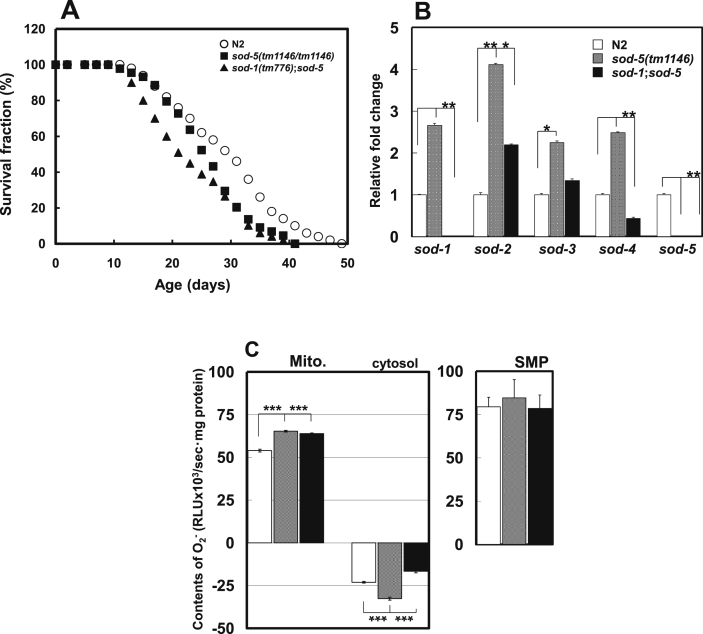
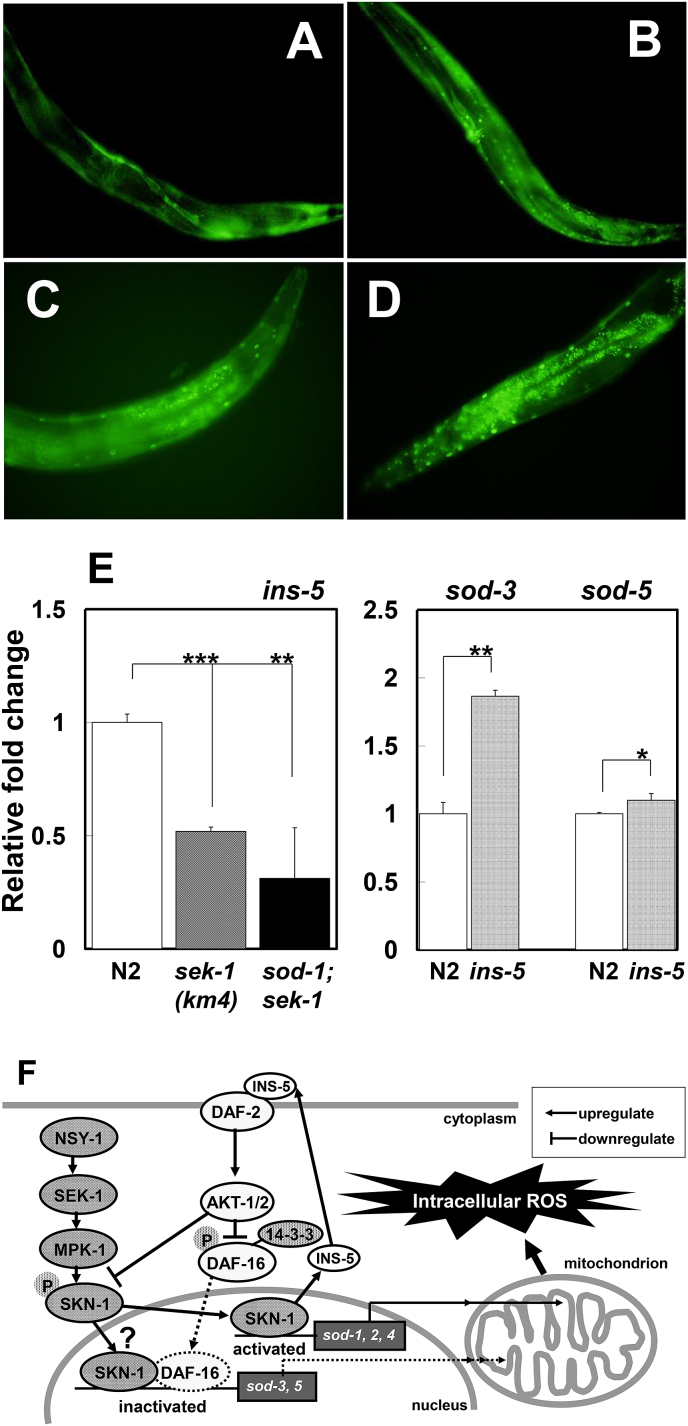
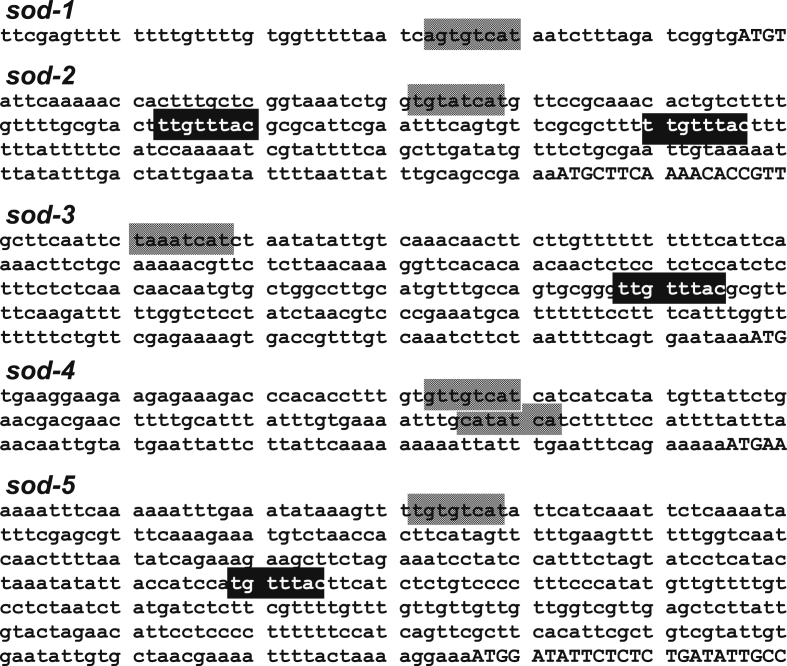
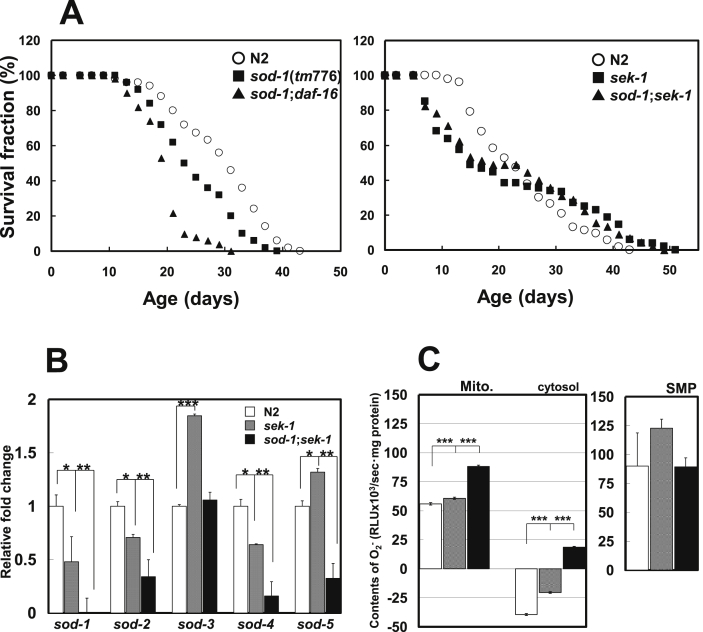
Superoxide dismutases, which catalytically remove intracellular superoxide radicals by the disproportionation of molecular oxygen and hydrogen peroxide, are encoded by the to genes in the nematode . Expression of the genes is mutually compensatory for the modulation of intracellular oxidative stress during aging. Interestingly, several-fold higher expression of the to was induced in a deletion mutant, despite the low expression levels of in wild-type animals. Consequently, this molecular compensation facilitated recovery of lifespan in the mutant. In previous reports, two transcription factors DAF-16 and SKN-1 are associated with the compensatory expression of genes, which are downstream targets of the ins/IGF-1 and p38 MAPK signaling pathways activated under oxidative and heavy metal stresses, respectively. Here, we show that p38 MAPK signaling regulates induction of not only the direct expression of , and but also the indirect modulation of DAF-16 targets, such as and genes. Moreover, a SKN-1 target, the insulin peptide gene , partially mediates the expression of DAF-16 targets via p38 MAPK signaling. These findings suggest that the interaction of ins/IGF-1 and p38 MAPK signaling pathways plays an important role in the fine-tuning of molecular compensation among genes to protect against mitochondrial oxidative damage during aging.
超氧化物歧化酶通过分子氧和过氧化氢的歧化反应催化去除细胞内的超氧自由基,由线虫中的 到 基因编码。这些基因的表达在衰老过程中对细胞内氧化应激的调节具有相互补偿作用。有趣的是,尽管野生型动物中 的表达水平较低,但在 缺失突变体中, 到 的表达却被诱导提高了几倍。因此,这种分子补偿促进了 突变体寿命的恢复。在之前的报道中,两个转录因子DAF-16和SKN-1与 基因的补偿性表达相关,它们分别是在氧化应激和重金属应激下激活的胰岛素/胰岛素样生长因子-1(ins/IGF-1)和p38丝裂原活化蛋白激酶(p38 MAPK)信号通路的下游靶点。在这里,我们表明p38 MAPK信号通路不仅调节 、 和 的直接表达诱导,还调节DAF-16靶点如 和 基因的间接调控。此外,一个SKN-1靶点,胰岛素肽基因 ,通过p38 MAPK信号通路部分介导DAF-16靶点的表达。这些发现表明,ins/IGF-1和p38 MAPK信号通路的相互作用在 基因之间分子补偿的微调中起重要作用,以保护细胞在衰老过程中免受线粒体氧化损伤。