Institute for Earth and Space Exploration, University of Western Ontario, London, Canada.
Department of Earth Sciences, University of Western Ontario, London, Canada.
Astrobiology. 2020 Sep;20(9):1121-1149. doi: 10.1089/ast.2019.2203. Epub 2020 Sep 1.
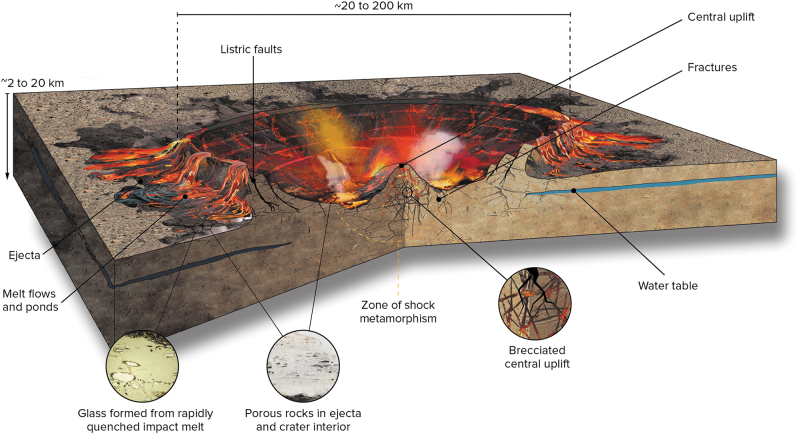
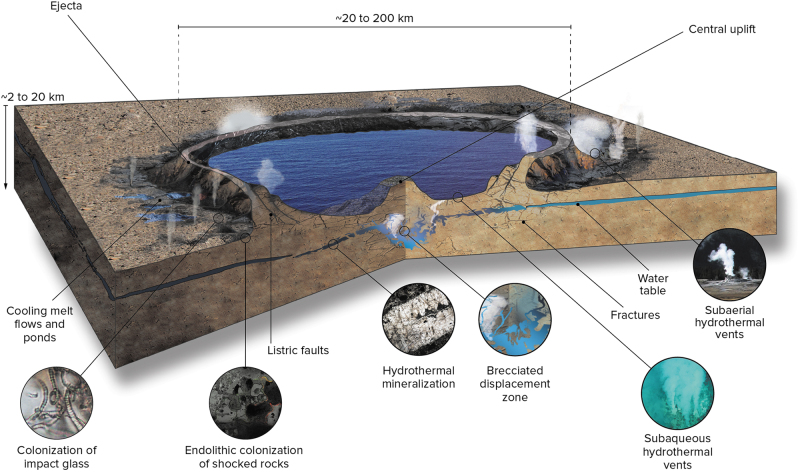
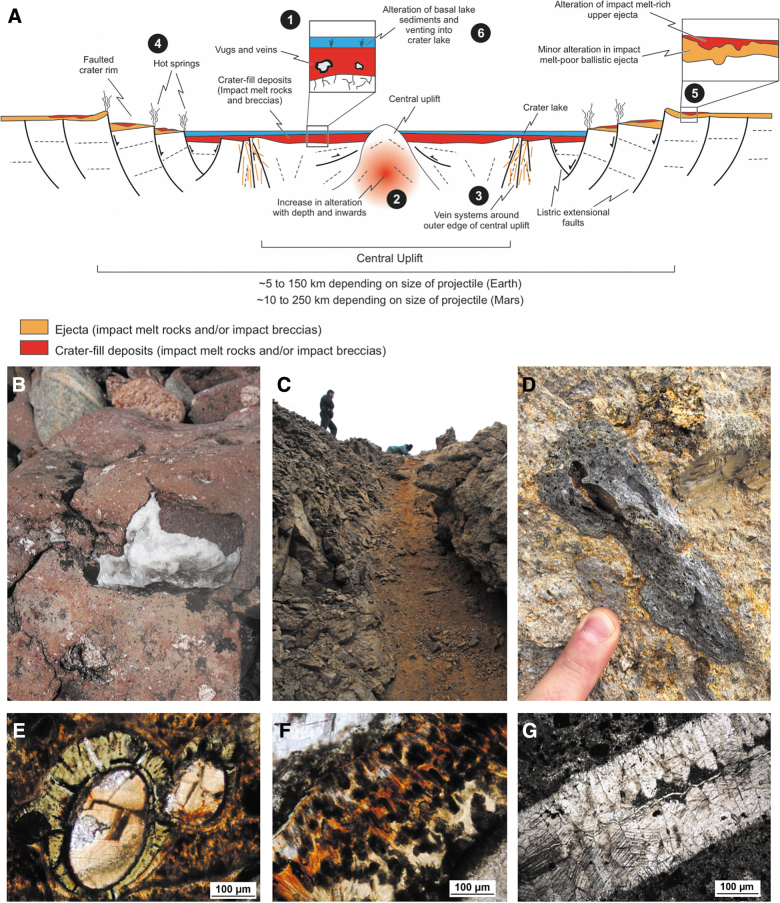
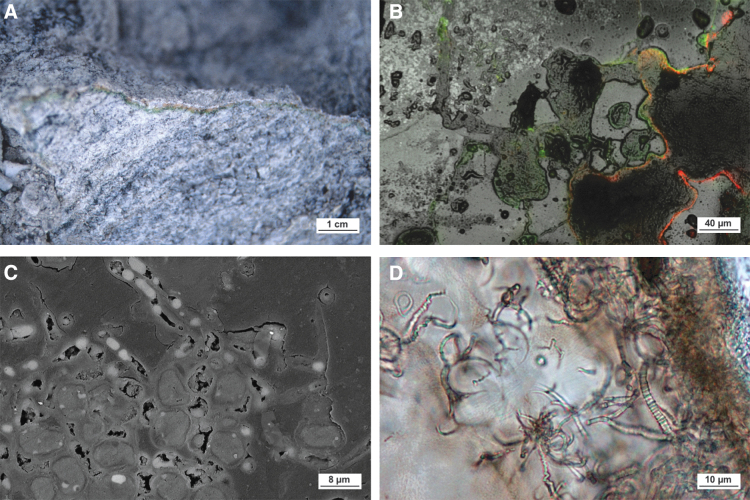
The conditions, timing, and setting for the origin of life on Earth and whether life exists elsewhere in our solar system and beyond represent some of the most fundamental scientific questions of our time. Although the bombardment of planets and satellites by asteroids and comets has long been viewed as a destructive process that would have presented a barrier to the emergence of life and frustrated or extinguished life, we provide a comprehensive synthesis of data and observations on the beneficial role of impacts in a wide range of prebiotic and biological processes. In the context of previously proposed environments for the origin of life on Earth, we discuss how meteorite impacts can generate both subaerial and submarine hydrothermal vents, abundant hydrothermal-sedimentary settings, and impact analogues for volcanic pumice rafts and splash pools. Impact events can also deliver and/or generate many of the necessary chemical ingredients for life and catalytic substrates such as clays as well. The role that impact cratering plays in fracturing planetary crusts and its effects on deep subsurface habitats for life are also discussed. In summary, we propose that meteorite impact events are a fundamental geobiological process in planetary evolution that played an important role in the origin of life on Earth. We conclude with the recommendation that impact craters should be considered prime sites in the search for evidence of past life on Mars. Furthermore, unlike other geological processes such as volcanism or plate tectonics, impact cratering is ubiquitous on planetary bodies throughout the Universe and is independent of size, composition, and distance from the host star. Impact events thus provide a mechanism with the potential to generate habitable planets, moons, and asteroids throughout the Solar System and beyond.
地球上生命起源的条件、时间和环境,以及太阳系内外是否存在生命,这些都是我们时代最基本的科学问题。尽管行星和卫星经常受到小行星和彗星的撞击,长期以来人们一直认为这是一个具有破坏性的过程,它会对生命的出现构成障碍,并且会挫败或消灭生命,但我们全面综合了关于撞击在广泛的前生物和生物过程中有益作用的数据和观察结果。在之前提出的地球生命起源环境的背景下,我们讨论了陨石撞击如何产生陆上和海底热液喷口、丰富的热液沉积环境,以及火山浮石筏和飞溅池的撞击模拟物。撞击事件还可以输送和/或产生生命所必需的许多化学物质成分以及催化底物,如粘土。撞击事件在断裂行星地壳方面的作用及其对生命深部地下栖息地的影响也在讨论之中。总之,我们提出陨石撞击事件是行星演化中的一个基本地球生物学过程,它在地球生命起源中发挥了重要作用。我们最后建议应将撞击坑视为在火星上寻找过去生命证据的主要地点。此外,与火山活动或板块构造等其他地质过程不同,撞击坑在整个宇宙中的行星体上普遍存在,并且与行星体的大小、组成和与宿主恒星的距离无关。因此,撞击事件提供了一种潜在的机制,可以在太阳系内外的行星、卫星和小行星上产生宜居环境。