Yang Yue, Li Xing-Fu, Zhang Xiao, Bao Chun-De, Hu Jian-Kang, Xu Jian-Hua, Li Xiang-Pei, Xu Jian, He Dong-Yi, Li Zhi-Jun, Wang Guo-Chun, Wu Han-Jun, Ji Fei, Zhan Lu-Jing, Zerbini Cristiano A F, Li Zhan-Guo
Peking University People's Hospital, Beijing, China.
Qilu Hospital of Shandong University, Jinan, China.
Rheumatol Ther. 2020 Dec;7(4):851-866. doi: 10.1007/s40744-020-00231-6. Epub 2020 Sep 2.
Baricitinib is an oral selective inhibitor of Janus kinase (JAK) 1 and JAK 2, which has demonstrated significant efficacy in patients with moderately to severely active rheumatoid arthritis (RA). This analysis aims to describe the efficacy and safety of baricitinib in Chinese RA patients with an inadequate response to methotrexate (MTX-IR), and to analyze the effects of baseline characteristics on the efficacy of baricitinib treatment.
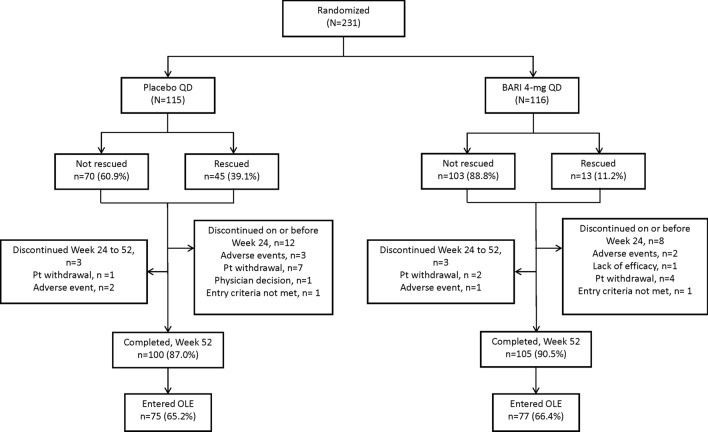
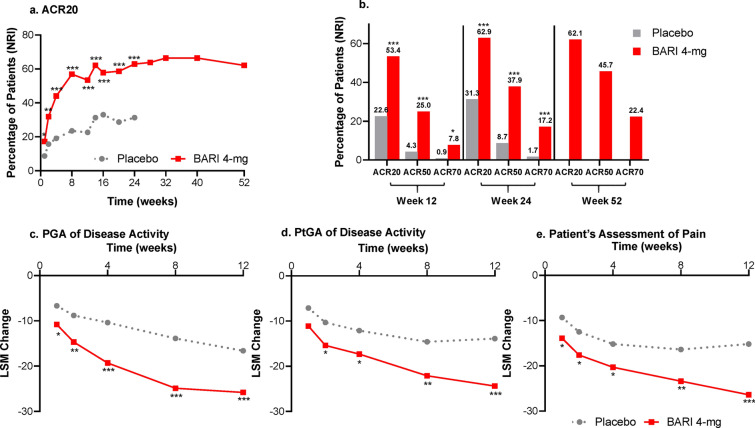
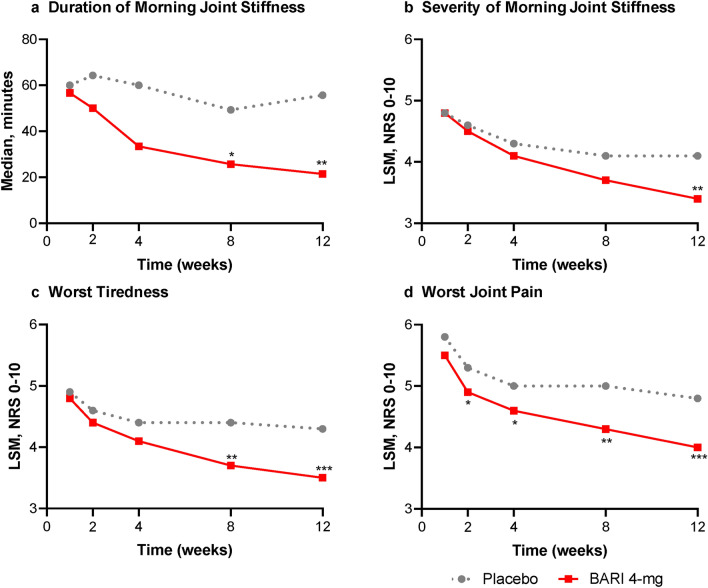
In this 52-week, randomized, double-blind, placebo-controlled study, 231 Chinese patients with moderately to severely active RA who had MTX-IR were randomly assigned to placebo (n = 115) or baricitinib 4 mg once daily (n = 116). The primary endpoint was American College of Rheumatology 20% (ACR20) response at week 12. Other efficacy measures included ACR50, ACR70, Physician's Global Assessment of Disease Activity, Patient's Global Assessment of Disease Activity, patient's assessment of pain, Disease Activity Score in 28 joints using high-sensitivity C-reactive protein, remission and low disease activity rates according to Simplified Disease Activity Index or Clinical Disease Activity Index, Health Assessment Questionnaire-Disability Index, and mean duration and severity of morning joint stiffness, worst tiredness and worst joint pain were analyzed. Additionally, subgroup analyses were performed across baseline characteristics.
Statistically significant improvement in ACR20 response was achieved with baricitinib at week 12 (53.4 vs. 22.6%, p = 0.001) in Chinese patients, compared to placebo. Most of the secondary objectives were met with statistically significant improvements. Efficacy of baricitinib was irrespective of patient demographics and baseline characteristics. Safety events were similar between the baricitinib and placebo groups.
The efficacy of baricitinib 4 mg in Chinese patients with moderately to severely active RA and prior MTX-IR was clinically significant compared to placebo regardless of baseline characteristics. Baricitinib was well tolerated with an acceptable safety profile during the full study period.
NCT02265705.
巴瑞替尼是一种口服的Janus激酶(JAK)1和JAK 2选择性抑制剂,已在中度至重度活动性类风湿关节炎(RA)患者中显示出显著疗效。本分析旨在描述巴瑞替尼在中国对甲氨蝶呤反应不足(MTX-IR)的RA患者中的疗效和安全性,并分析基线特征对巴瑞替尼治疗疗效的影响。
在这项为期52周的随机、双盲、安慰剂对照研究中,231例中度至重度活动性RA且有MTX-IR的中国患者被随机分配至安慰剂组(n = 115)或巴瑞替尼4 mg每日一次组(n = 116)。主要终点是第12周时美国风湿病学会20%(ACR20)反应。其他疗效指标包括ACR50、ACR70、医生对疾病活动的整体评估、患者对疾病活动的整体评估、患者的疼痛评估、使用高敏C反应蛋白的28个关节疾病活动评分、根据简化疾病活动指数或临床疾病活动指数的缓解率和低疾病活动率、健康评估问卷残疾指数,以及分析晨僵、最严重疲劳和最严重关节疼痛的平均持续时间和严重程度。此外,还根据基线特征进行了亚组分析。
与安慰剂相比,中国患者在第12周时使用巴瑞替尼实现了ACR20反应的统计学显著改善(53.4%对22.6%,p = 0.001)。大多数次要目标在统计学上有显著改善。巴瑞替尼的疗效与患者人口统计学和基线特征无关。巴瑞替尼组和安慰剂组的安全事件相似。
无论基线特征如何,与安慰剂相比,4 mg巴瑞替尼对中度至重度活动性RA且既往有MTX-IR的中国患者的疗效具有临床意义。在整个研究期间,巴瑞替尼耐受性良好,安全性可接受。
NCT02265705。