Research Department, New England Biolabs, Ipswich, Massachusetts, United States of America.
Applications and Product Development, New England Biolabs, Ipswich, Massachusetts, United States of America.
PLoS One. 2020 Sep 2;15(9):e0238592. doi: 10.1371/journal.pone.0238592. eCollection 2020.
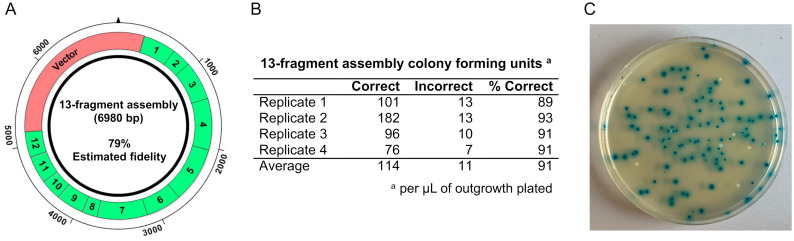
DNA assembly is an integral part of modern synthetic biology, as intricate genetic engineering projects require robust molecular cloning workflows. Golden Gate assembly is a frequently employed DNA assembly methodology that utilizes a Type IIS restriction enzyme and a DNA ligase to generate recombinant DNA constructs from smaller DNA fragments. However, the utility of this methodology has been limited by a lack of resources to guide experimental design. For example, selection of the DNA sequences at fusion sites between fragments is based on broad assembly guidelines or pre-vetted sets of junctions, rather than being customized for a particular application or cloning project. To facilitate the design of robust assembly reactions, we developed a high-throughput DNA sequencing assay to examine reaction outcomes of Golden Gate assembly with T4 DNA ligase and the most commonly used Type IIS restriction enzymes that generate three-base and four-base overhangs. Next, we incorporated these findings into a suite of webtools that design assembly reactions using the experimental data. These webtools can be used to create customized assemblies from a target DNA sequence or a desired number of fragments. Lastly, we demonstrate how using these tools expands the limits of current assembly systems by carrying out one-pot assemblies of up to 35 DNA fragments. Full implementation of the tools developed here enables direct expansion of existing assembly standards for modular cloning systems (e.g. MoClo) as well as the formation of robust new high-fidelity standards.
DNA 组装是现代合成生物学的一个组成部分,因为复杂的基因工程项目需要强大的分子克隆工作流程。Golden Gate 组装是一种常用的 DNA 组装方法,它利用 Type IIS 限制酶和 DNA 连接酶从较小的 DNA 片段生成重组 DNA 构建体。然而,由于缺乏指导实验设计的资源,这种方法的实用性受到了限制。例如,片段之间融合位点的 DNA 序列的选择是基于广泛的组装指南或经过预先审查的接头集,而不是针对特定的应用或克隆项目进行定制。为了促进稳健的组装反应设计,我们开发了一种高通量 DNA 测序测定法,以检查 Golden Gate 组装与 T4 DNA 连接酶以及最常用的产生三碱基和四碱基突出端的 Type IIS 限制酶的反应结果。接下来,我们将这些发现纳入一套使用实验数据设计组装反应的网络工具中。这些网络工具可用于从目标 DNA 序列或所需数量的片段创建定制组装。最后,我们展示了如何通过进行多达 35 个 DNA 片段的一锅组装来扩展当前组装系统的限制。这里开发的工具的全面实施可以直接扩展模块化克隆系统(例如 MoClo)的现有组装标准,以及形成稳健的新高精度标准。