Leimbach-Maus Hailee B, McCluskey Eric M, Locher Alexandra, Parks Syndell R, Partridge Charlyn G
Annis Water Resources Institute, Grand Valley State University (AWRI-GVSU), Muskegon, MI 49441, USA.
Department of Biology, Grand Valley State University, Allendale, MI 49401, USA.
Plants (Basel). 2020 Aug 31;9(9):1123. doi: 10.3390/plants9091123.
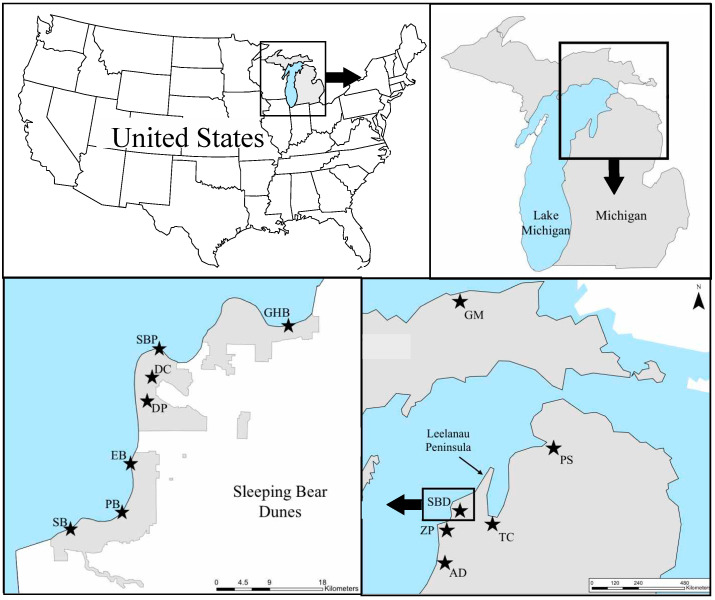
Coastal sand dunes are dynamic ecosystems with elevated levels of disturbance and are highly susceptible to plant invasions. One invasive plant that is of concern to the Great Lakes system is L. (perennial baby's breath). The presence of negatively impacts native species and has the potential to alter ecosystem dynamics. Our research goals were to (1) estimate the genetic structure of invasive along the Michigan dune system and (2) identify landscape features that influence gene flow in this area. We analyzed 12 populations at 14 nuclear and two chloroplast microsatellite loci. We found strong genetic structure among populations (global F = 0.228), and pairwise comparisons among all populations yielded significant F values. Results from clustering analysis via STRUCTURE and discriminant analysis of principal components (DAPC) suggest two main genetic clusters that are separated by the Leelanau Peninsula, and this is supported by the distribution of chloroplast haplotypes. Land cover and topography better explained pairwise genetic distances than geographic distance alone, suggesting that these factors influence the genetic distribution of populations within the dunes system. Together, these data aid in our understanding of how invasive populations move through the dune landscape, providing valuable information for managing the spread of this species.
沿海沙丘是动态生态系统,干扰程度较高,极易受到植物入侵。一种令五大湖系统担忧的入侵植物是多年生补血草(L. (perennial baby's breath))。多年生补血草的存在对本地物种产生负面影响,并有可能改变生态系统动态。我们的研究目标是:(1)估计密歇根沙丘系统沿线入侵的多年生补血草的遗传结构,以及(2)确定影响该地区基因流动的景观特征。我们分析了12个种群的14个核微卫星位点和2个叶绿体微卫星位点。我们发现种群间存在强烈的遗传结构(全局F = 0.228),所有种群的成对比较产生了显著的F值。通过STRUCTURE聚类分析和主成分判别分析(DAPC)的结果表明,有两个主要的遗传簇被利兰瑙半岛隔开,叶绿体单倍型的分布也支持了这一点。土地覆盖和地形比单独的地理距离能更好地解释成对遗传距离,这表明这些因素影响了沙丘系统内种群的遗传分布。总之,这些数据有助于我们了解入侵种群如何在沙丘景观中移动,为管理该物种的扩散提供了有价值的信息。